Updated: Sep 17
Build your website, your way with Wix Harmony →
The short answer is that an API is built for developers and MCP is built for AI agents, even though both let one system request data or trigger actions from another.
API stands for application programming interface, a long-established way for one program to talk to another. MCP stands for Model Context Protocol, an open standard that lets large language models like Claude or GPT connect to external tools and data in a structured way.
That shift is why MCP matters for anyone building online, from developers wiring up services to creators using an AI website builder. Wix's core commerce and website building capabilities are now accessible from the AI tools people use every day. It even changes what AI agents can do day to day. Here is how MCP and APIs compare and when each one is the right call.
TL;DR: MCP vs API
MCP and APIs both connect software to software, but an API is a general-purpose interface written for developers while MCP is a purpose-built protocol that lets AI agents discover and use tools on their own. One is not a replacement for the other. In most real setups MCP sits on top of your existing APIs so AI models can reach them without custom code for each one.
Aspect | Traditional API | MCP |
|---|---|---|
Built for | Human developers writing code | AI models and agents making decisions |
Discovery | Static docs you read in advance | Runtime discovery, the agent asks what tools exist |
State | Stateless, each request stands alone | Stateful, context carries across steps |
Security | Caller handles keys and tokens directly | The MCP server holds credentials, the model never sees them |
Best fit | Predictable app-to-app integrations | Letting AI agents use tools safely and flexibly |

Wix Harmony brings AI and manual creation together in a single, smart platform. You can generate full pages, layouts and content with natural language, then fine-tune every detail with precise drag-and-drop control. It's faster, more flexible website creation, without sacrificing quality or creative freedom.
What is an API?
An API, or application programming interface, is a set of rules that lets one software system request data or actions from another. Think of it like a waiter in a restaurant. You tell the waiter what you want, the kitchen prepares it and the order comes back to your table, all without you ever stepping into the kitchen. REST APIs, the most common style on the web, follow a simple request and response pattern over HTTP.
APIs have been the backbone of software integration for decades. They power everything from payment processing to social logins to the way a weather app pulls today's forecast. Each API exposes specific endpoints, like /users or /orders, and a developer reads the documentation to learn how to call them correctly.
Worth knowing: An API is only as useful as its documentation. A developer has to read the docs, learn each endpoint and write the code to call it, which is exactly the manual work that MCP was created to reduce for AI agents.
What is MCP (Model Context Protocol)?
MCP, or Model Context Protocol, is an open standard that defines how AI models connect to external tools, data sources and services in a structured way. Anthropic introduced it in late 2024, and it has quickly become a common way to give large language models real-world capabilities. A helpful analogy is USB-C. Just as USB-C gives you one universal port for many devices, MCP gives an AI model one universal way to plug into many tools.
Under the hood, MCP uses a client-server model. The MCP host is the AI application, MCP clients manage each connection and MCP servers expose the actual tools and data. Instead of calling a raw URL, the model asks an MCP server what it can do and then calls a named capability like get_weather with typed parameters.
Wix even runs its own Wix MCP, so you can connect an AI tool like Claude to your site and manage it through conversation.
MCP is also one building block of a bigger shift. It helps to see what an agentic AI platform is to understand where these protocols lead.
One thing worth knowing: MCP is a busy acronym. In the AI world it means Model Context Protocol, but you may also see it used for older unrelated ideas in computing, so it is worth confirming the context before assuming two sources mean the same thing.
MCP vs API: the key differences

At a glance MCP and APIs look similar because both pass structured data between systems. The differences show up in what each one assumes about the caller. Here are the five that matter most.
01. Who it is built for
APIs are built for developers. They assume the caller can read documentation, manage authentication and format requests correctly. MCP is built for AI agents, which are capable but untrusted callers that cannot be handed secrets or expected to memorize every endpoint. That single assumption shapes almost everything else about how the two behave.
02. How capabilities get found
With an API, discovery is static. A developer reads the docs, learns the endpoints and updates their code whenever the API changes. MCP flips this with runtime discovery. An agent connects to an MCP server and asks what tools are available, then uses them on the spot. New capabilities can appear without anyone rewriting the client.
03. State and context
Traditional REST APIs are stateless. Each request is independent and carries everything the server needs, because the server does not remember the last call. MCP is designed to hold context across a session. An agent can pull a record, check a related result and act on both without losing track of what it already learned, which matters for multi-step tasks.
04. Security and credentials
With a plain API, the caller usually handles keys and tokens directly. That works for a trusted app but it is risky for an AI model. With MCP, the MCP server handles authentication on behalf of the agent, so the model calls a tool without ever seeing the API key or the underlying URL. The sensitive parts stay on the server side.
05. Execution
When an LLM works directly against an API, it has to generate the HTTP request itself, which can be error prone. MCP separates the decision from the execution. The model picks which tool to run and passes typed parameters, then deterministic code on the server actually makes the call. You get the flexibility of AI with the reliability of tested code.
Worth knowing: None of these differences make APIs obsolete. MCP servers almost always call regular APIs behind the scenes, so strong API design still pays off. MCP changes how an AI agent reaches those APIs rather than removing the need for them.
When to use MCP and when to use an API
Reach for a plain API when you are building predictable software-to-software connections that developers control, like a mobile app talking to your backend or one service calling another. The caller knows the endpoints in advance and the flow rarely changes.
Reach for MCP when you want an AI agent to use your tools without custom wiring for each one. If you are letting a model read data, trigger actions or move through a multi-step task, MCP gives it a safe and standardized way in. Many teams end up using both, with APIs doing the real work and MCP acting as the layer that lets AI reach them, a pattern now common across AI tools for business.
One thing worth knowing: You rarely have to choose once and forever. A common path is to keep your existing APIs exactly as they are and add an MCP server on top when you are ready to let AI agents in, so the two coexist instead of competing.
Increasingly, the platform you build on absorbs that decision for you.
"Every site runs on Wix's proven infrastructure, with advanced commerce, payments, SEO and GEO, accessibility and scalability built in by default. As AI evolves and new standards emerge, Wix absorbs the underlying complexity so users can focus on creating and running their business, not managing the machinery behind it." - Nir Zohar, President of Wix
Do MCP and APIs work together?
Yes, and in practice they almost always do. MCP does not replace APIs. It builds a standardized layer on top of them so AI agents can discover and use tools without custom code for every single one. This solves what teams sometimes call the many-to-many problem, where every AI model used to need a custom connector for every data source.
Think of it as layers rather than a competition. APIs still provide the secure structured pathways between systems. MCP gives AI agents a consistent way to travel those pathways. As more software adds MCP support, the same agent can work across many tools with far less setup.
This is where Wix fits. Its commerce and site tools stay reachable from the AI tools people already use, and the platform keeps pace as new AI standards emerge.
That trend is bigger than any single tool, and it raises real questions like whether customers will stop visiting your website once agents browse for them.
Worth knowing: MCP support is still spreading across the software world, so not every tool exposes an MCP server yet. Where one does not exist, an agent can still reach the tool through its API, which is why keeping good APIs in place matters.
Learn more:
How Wix fits into the agentic web
If APIs and MCP are how software gets ready for AI, Wix is already living in that world. The Wix plugin for ChatGPT allows you to type "@Wix" in a conversation to invoke its Wix Harmony vibe code website builder and generate a full, live Wix website including booking systems and menus.
Wix in Copilot turns Microsoft's AI assistant into a full-time Web Operations Manager integrated directly into your Windows or 365 environment, allowing natural language commands to manage your Wix back-office. Wix's Claude integration allows a Claude user to create complex automated business logic, using Wix's infrastructure to do so.
For example, it can automatically generate and publish landing pages optimized for social trends. That means an AI assistant can spin up a real site for you without you touching a single endpoint.
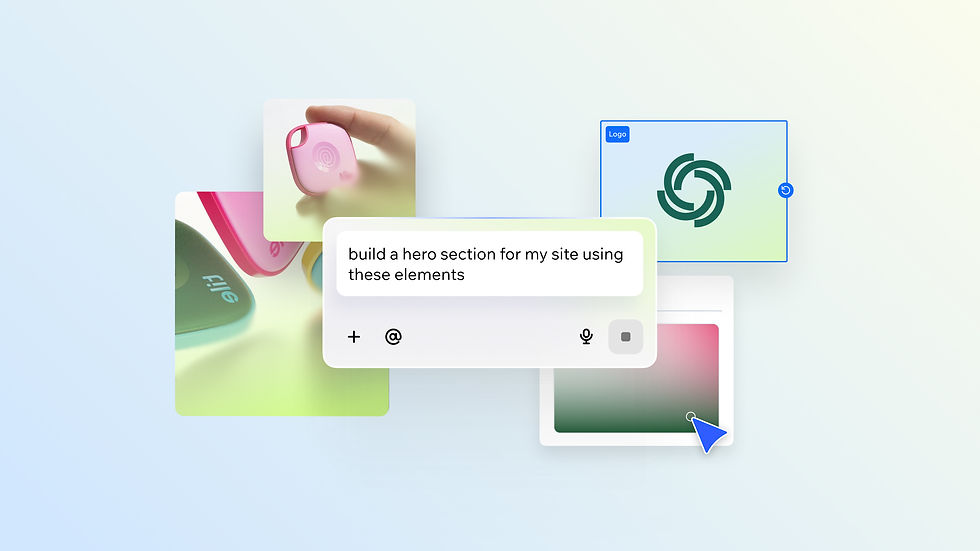
At the center of this is Wix Harmony. Wix Harmony takes you from a single prompt to a business-ready site for any industry or creative vision. Wix offers an AI website builder for on-brand, professional design. You can keep shaping the result by chatting with Aria, Wix Harmony's built-in AI agent, or by editing by hand with full drag and drop control. If you want the wider toolkit, guides on how to make a website and how to design a website with AI walk through the process step by step.
Along the way it helps to know the mistakes to avoid when using an AI website builder, and for stores, the AI eCommerce builder features that matter most.
Adoption is already real. Nearly 32,000 people used Wix MCP to connect external AI tools like Claude directly to their websites, managing content and updates through natural conversation, according to Wix State of Websites 2026.
For businesses that want AI to run more of the back office, Wix Symphony brings agents into everyday operations. If you are just making a website or wiring AI agents into your stack, the same infrastructure powers it.
Expert tip from Yarin Singolda, Product Marketing Manager at Wix:
"Aria isn't just an assistant, she's a collaborator who can handle complex tasks in one go. You can have her create a new section, add text, pull in best-selling items, insert images and even add linked buttons, all at once. She offers expert guidance and support while executing tasks for you, but the creative choices always stay in your hands."
Worth knowing: You do not need to understand MCP or APIs to build on Wix. The platform handles the technical layer so you can focus on your site, and the deeper integrations are there when you want them.
Learn more: Do I need MCP for my Wix site?
MCP vs API FAQ
Will MCP replace APIs?
No. MCP is built on top of APIs, not instead of them. An MCP server typically calls regular APIs to do its work, so APIs remain the foundation. What MCP changes is how easily an AI agent can find and use those APIs.
Is MCP just a wrapper around an API?
It is more than a wrapper. MCP is a standard protocol with a defined message structure, runtime discovery and built-in handling of context and credentials. A wrapper hides one API, while MCP gives an AI agent a consistent way to work across many tools at once.
Is an MCP server the same as an API?
Not quite. An MCP server often sits in front of one or more APIs and exposes them as tools an AI model can use. The API defines the underlying capability and the MCP server makes that capability safe and discoverable for an agent.
Do I still need MCP if I already have APIs?
Only if you want AI agents to use your tools. If your integrations are all developer-to-developer, APIs alone are fine. If you plan to let a model read data or trigger actions, adding MCP gives it a cleaner and safer way in.
What does MCP stand for?
MCP stands for Model Context Protocol. It is an open standard introduced by Anthropic in late 2024 that lets AI models connect to external tools and data through a shared interface.


