Updated: Sep 22
AI agents for every part of your business. Check out Symphony by Wix →
The best multi-agent AI platforms don't just answer questions, they coordinate teams of specialized agents that work in parallel, share context and execute across every layer of your business at the same time. Whether you're a small business owner who needs a full operations team without the headcount, a developer building custom agent pipelines or an enterprise deploying agents at scale, the right platform changes what's realistically possible for your team.
This guide covers the best multi-agent AI platforms available in 2026, with honest breakdowns of what each one does well, who it's built for and what it actually costs. We've put Symphony by Wix first because it's the most complete solution for business owners who want results without building anything from scratch, but every platform on this list has a genuine use case, and we'll tell you exactly what it is.
TL;DR: best multi-agent AI platforms
Multi-agent AI platforms coordinate multiple AI agents working in parallel, each specialized for a different task. The best one for you depends on how technical your team is, what you're trying to automate and how quickly you need to move. Here's what to expect from this list:
Symphony by Wix: the best option for small business owners who want a full AI team without setup.
LangGraph, CrewAI and n8n: best for developers and technical teams building custom pipelines.
Gumloop, Make and Stack AI: best for no-code or low-code automation.
Voiceflow: best for conversational and voice-powered agent workflows.
Postman and Replay.app: best for developer tooling, API workflows and QA automation.
Zep and Claude Code: best as infrastructure layers that power other agent systems.
Cofounder: best for startup founders and early-stage business builders.
New to this space? Read our guide to what an agentic AI platform actually is before diving in.

Growing a business shouldn't mean doing everything yourself. Symphony by Wix is an AI agent platform that builds a dedicated team of agents around your business, helping you win new clients, stay on top of operations and actually grow revenue. Symphony learns how your business works so you can spend less time on the day-to-day and more time on the work only you can do.
13 best multi-agent AI platforms in 2026
Not every multi-agent AI platform is built for the same person. Some are designed for business owners who want results without touching a line of code. Others are built for developers who want full control over how their agents think, branch and communicate. A few are infrastructure layers that make other systems smarter.
The 13 platforms below cover the full range, from the most beginner-friendly option on the market to the frameworks powering enterprise agent deployments at scale. Each one is reviewed on what it actually does well, who it's right for and what it costs to get started.
For a broader look, see our full roundup of the best AI agent platforms in 2026.
01. Symphony by Wix
Best for: small business owners who want a full AI operations team without setup, configuration or technical skills.
Pricing: free plan available; paid plans start at $16/month (billed annually). For a full breakdown of Symphony pricing, explore: how much does Symphony by Wix cost?
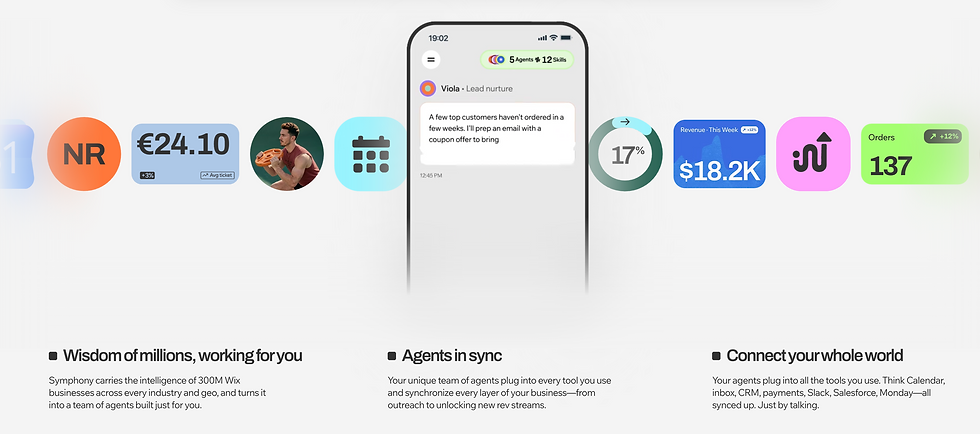
Symphony is an AI agent platform built for independent business owners and small teams. It's not a chatbot, a workflow tool or a prompt interface, it's a coordinated system of specialized agents that works across every function of your business at the same time. Symphony learns how your business operates and proactively surfaces what needs to happen next, without waiting to be asked.
Symphony is built by Wix, which has powered over 300 million businesses for more than 20 years. That history means Symphony comes pre-loaded with practical, real-world small business knowledge built into every agent. A dedicated coordinator learns your goals, your industry and how you work, then dispatches the right agents for each task: your marketing agent, scheduling agent, front desk agent and operations agent all working simultaneously and sharing context so their outputs build on each other.
Symphony is designed to be mobile-first. It's built for business owners who run their operations from their phone, not from a desk with three monitors. There's no setup flow, no integration wizard and no learning curve before you see value. You start a conversation, and the agents orient themselves around your business from there.
"What's different about Symphony is what happens between agents," says Ronny Elkayam, COO and Head of R&D at Wix. "They don't just execute in parallel, they actively share context with each other. So your marketing agent knows what your front desk agent learned last week about your best customers. That compounding effect is where the real value lives."
Something most people don't expect: Symphony doesn't just wait for instructions. It proactively flags what needs your attention, recommends next steps and proposes actions you can approve and execute in one tap. Most AI tools are reactive. Symphony isn't.
Find out more: What is Symphony by Wix? | Symphony agents explained | Best Symphony features | Business processes to automate | How to grow your business with Symphony
02. LangGraph
Best for: developers building stateful, graph-based agent workflows with complex branching and execution logic.
Pricing: Free plan available; LangSmith cloud starts at $39/month (billed annually).
LangGraph is a graph-based framework from LangChain for building stateful multi-agent workflows in Python. It models agent logic as a directed graph, where each node is an agent or function and each edge defines what happens next based on the output. That structure makes it the best option in the open-source space for workflows that need precise state management, conditional branching and long-running pipelines where agents loop back, retry or revise their work.
Where most multi-agent frameworks handle straightforward sequential or role-based workflows well, LangGraph is specifically designed for the harder problem: what happens when your agent pipeline needs to pause, check a condition, branch into multiple paths and then converge again? If your use case involves agents that need to reason about their own outputs and decide what to do next, LangGraph's explicit graph model gives you the control to build that reliably.
LangGraph is open source and free to use. LangSmith, the companion platform for monitoring and debugging LangGraph applications, starts at $39/month billed annually for the Developer plan. For teams building production agent systems, LangSmith is effectively necessary, it handles tracing, evaluation and deployment management in a way that the framework alone doesn't.
03. n8n
Best for: technical teams who want self-hosted workflow automation with AI agents they can deeply customize and control.
Pricing: Free trial; paid plans start at $20/month (billed annually).
n8n is an open-source workflow automation platform with a visual node editor, a large library of integrations and native AI agent capabilities built in. It sits in between a pure developer framework like LangGraph and a no-code tool like Make, you need some technical comfort to get the most from it, but you don't need to write extensive code to build powerful multi-agent workflows.
n8n's self-hosted option is one of its strongest selling points. For teams with data residency requirements, compliance constraints or a preference for keeping workflows inside their own infrastructure, n8n gives you full control over where your data lives and how your agents execute. The open-source license means there's no vendor lock-in, you own your workflows.
On the cloud side, n8n's AI nodes let you build agent workflows that connect to external APIs, process documents, call LLMs and trigger actions across your stack, all from the visual editor. It's a strong middle-ground option for teams that want more control than a no-code tool but less complexity than writing a full LangGraph or CrewAI implementation from scratch.
04. CrewAI
Best for: developers building role-based multi-agent systems where each agent has a defined job, goal and set of tools.
Pricing: Free (open source); CrewAI Enterprise pricing on request.
CrewAI is a Python framework that models multi-agent systems as crews: each agent gets a role, a goal and a set of tools and the crew works together toward a shared objective. It's one of the most widely adopted multi-agent frameworks for getting a working system running quickly, a developer familiar with Python can build a functional multi-agent workflow in a few hours.
CrewAI's strength is structured, predictable use cases. If you're building a research pipeline where one agent searches, another summarizes and a third synthesizes into a report, CrewAI handles that well. Its role-based model is intuitive, the documentation is solid and the community around it is active. Its ceiling is dynamic orchestration, for workflows where agent behavior needs to change significantly at runtime based on intermediate results, LangGraph is typically a better fit.
CrewAI is free and open source. The Enterprise tier, aimed at teams deploying at scale with governance and security requirements, is priced on request. For most developers building and experimenting with multi-agent pipelines, the open-source version has everything needed to get to production.
05. Gumloop
Best for: non-technical users and small teams who want to build AI agent workflows without writing code.
Pricing: 14-day free trial; Paid plans start at $37/month (billed annually).
Gumloop is a no-code AI workflow builder that lets you connect tools, set up agent logic and automate multi-step processes through a drag-and-drop interface. It's built for users who want the power of an agent pipeline without the Python requirement, you design the workflow visually, connect your data sources and let Gumloop's agents execute the steps.
Gumloop works well for specific, repeatable workflows: lead research pipelines, content generation flows, document processing and data enrichment tasks. It's not designed to coordinate multiple agents that share context across an entire business operation, it's more focused on automating defined sequences. But for those use cases, it's one of the most approachable no-code options in the market.
The free plan covers 5,000 credits per month, which is enough for light use and experimentation. The Pro plan starts at $37/month billed annually for 20,000 credits and unlimited seats. One thing to note: Gumloop uses a credit-based model and overage billing can add up quickly on the Pro tier, so it's worth monitoring usage if you're running high-volume pipelines.
See also: 28 things every small business should automate | Which AI agent platform is most affordable?
06. Claude Code
Best for: developers who want an AI agent that can autonomously handle complex coding tasks, refactoring and codebase-level work.
Pricing: Free plan available; paid plans start at $17/month (billed annually).
Claude Code is Anthropic's agentic coding tool, built to work directly in your terminal and handle multi-step development tasks autonomously. It doesn't just complete code at the cursor, it reads your entire codebase, plans across files, runs tests, handles errors and iterates until the task is done. That makes it one of the only AI tools that genuinely operates as an AI agent on a real development environment rather than an autocomplete layer on top of an editor.
Claude Code's multi-agent capabilities are particularly relevant for large codebases and complex engineering tasks. It can delegate subtasks to additional agent instances, coordinate work across different parts of the codebase and manage tasks that would take a developer several focused hours to complete manually. For engineering teams, it's less a productivity feature and more a new way of thinking about how development work gets done.
Claude Code is available with Claude Pro ($20/month billed annually) and Claude Max ($100/month billed annually). It's not a standalone product, it's part of the Claude subscription. For teams with heavy usage requirements, the Max plan's higher rate limits make it the more practical choice for serious engineering workflows.
07. Postman
Best for: developers and engineering teams building, testing and deploying AI agent APIs and integrations.
Pricing: Free plan available; paid plans start at $14/month (billed annually).
Postman is an API development platform that's evolved well beyond its original identity as an API testing tool. It now includes AI agent capabilities for building, testing and monitoring agent-to-agent communications, API-driven workflows and the integrations that multi-agent systems depend on to function in production.
For teams building multi-agent systems that communicate through APIs, which is most of them, Postman becomes essential infrastructure. Its agent testing tools let you validate that your agent pipelines are calling the right endpoints, handling responses correctly and failing gracefully when something goes wrong. The Postman AI Agent Builder lets you create API-connected agents directly in the platform, making it a genuine development tool for the agent layer, not just the API layer.
Postman's free plan covers core API testing and collaboration for small teams. The Basic plan starts at $14/user/month billed annually and unlocks more advanced collaboration features, monitoring and testing capabilities. For engineering teams building production multi-agent systems, it's a low-cost addition to the stack that solves a specific, critical problem.
08. Zep
Best for: enterprises and engineering teams who need persistent, long-term memory for AI agents that must remember context across sessions.
Pricing: Paid plans start at $104/month (billed annually).
Zep is a memory layer for AI agents, not an agent platform itself. It solves one of the most practical problems in production agent systems: agents forget. Most AI agents only remember what's in their current context window. Zep gives them long-term memory, the ability to recall facts, relationships and history from previous sessions, stored as a temporal knowledge graph that updates as new information comes in.
Built on Graphiti, an open-source temporal knowledge graph engine, Zep automatically extracts entities, relationships and facts from conversations and business data. An agent using Zep doesn't need to be re-briefed on the client it spoke to last week or the project status it discussed three conversations ago. That continuity is what makes agents feel intelligent rather than forgetful.
Zep is open source and free to self-host via the Graphiti engine. Zep Cloud, the managed option, starts at $104/month with SOC 2 Type II and HIPAA certification included, which matters for teams building in healthcare, finance or any compliance-sensitive environment. If you're building a production agent system that needs to operate over time rather than in isolated sessions, Zep belongs in the architecture.
09. Voiceflow
Best for: agencies, partners product teams and businesses building conversational AI agents for customer service, voice interfaces and multi-channel support flows.
Pricing: Contact for pricing plan options.
Voiceflow is a platform for designing, building and deploying conversational AI agents across text, voice and chat channels. It's built for product and experience teams who want to create sophisticated agent interactions without writing the underlying NLP or LLM infrastructure from scratch.
Voiceflow's strength is conversation design, the ability to map out branching dialogue flows, integrate knowledge bases, connect to APIs and manage what an agent says and does across every possible user path. It's used widely in customer service automation, where the quality and consistency of the agent's conversation handling directly affects customer experience and resolution rates.
10. Stack AI
Best for: enterprise teams that need to build and deploy AI workflows and agents on secure, compliant infrastructure.
Pricing: Free plan available (500 runs/month); Enterprise pricing on request.
Stack AI is an enterprise AI workflow platform that lets technical teams build, deploy and manage AI agents and automation pipelines through a visual interface backed by enterprise-grade security and compliance infrastructure. It's designed for organizations that need the flexibility of a custom agent builder with the governance controls that enterprise IT and legal teams require.
Stack AI supports a wide range of AI workflow types: document processing, data extraction, internal knowledge base agents, customer-facing automation and multi-agent orchestration. The platform connects to enterprise data sources and productivity tools, and its security posture, including SOC 2 compliance, data isolation and access controls, makes it a credible option for industries where those things are non-negotiable.
The free plan covers 500 runs per month, which is suitable for evaluation and small-scale testing. Enterprise pricing is custom and scoped to usage volume, governance requirements and support level. Stack AI isn't trying to compete with no-code tools on price or accessibility, it's positioned for organizations that need to deploy AI agents in a way that satisfies their compliance and IT teams.
11. Make
Best for: small to mid-size teams building multi-step automation workflows across a wide range of apps with AI steps included.
Pricing: Free plan available available; paid plans start at 12/month (billed annually).
Make is a visual workflow automation platform with over 2,000 app integrations and a growing set of AI modules for building agent-like workflows. It's not a pure multi-agent framework, it's workflow automation that can include AI decision-making and LLM calls as steps in a larger automated process.
Make works well when your use case is connecting existing tools and automating defined processes: syncing data between your CRM and billing system, triggering email sequences based on behavior, processing incoming documents and routing them to the right place. Where it starts to feel limited is in scenarios that require true agent intelligence, dynamic reasoning, goal-oriented planning or shared context between multiple AI actors.
Make's pricing is one of its strongest selling points. The free plan covers 1,000 operations per month, which goes a long way for light workflows. The Core plan starts at $12/month billed annually. For teams that need automation but don't need the overhead of a full agent framework, Make is a cost-effective, well-documented option with a mature integration library.
12. Cofounder
Best for: startup founders and early-stage business builders who want an AI partner to help plan, build and grow a business.
Pricing: 7-day free trial; paid plans start at $120/month.
Cofounder is an AI platform designed to act as a co-founder, an always-on AI partner that helps founders think through strategy, build products, research markets and manage the early work of starting and growing a business. It's less a workflow automation tool and more an active collaborator that works alongside founders at each stage of building.
Cofounder covers 12 industries and 134+ business types, which means its context is already pre-loaded with patterns from businesses similar to yours. Rather than a general-purpose AI assistant that needs to be briefed on your situation, Cofounder brings structured frameworks and business knowledge to every conversation. That makes it more immediately useful for operational decisions than a vanilla LLM.
Cofounder's plans start at $120/month. It's a focused product for a specific audience, if you're an early-stage founder who wants AI that thinks about your business seriously rather than generically, it's worth exploring. If your business is already operational and you're looking for AI to manage day-to-day operations, a platform like Symphony is likely a better fit.
13. Replay.app
Best for: engineering teams who need to detect bugs, test agent-built applications and reproduce issues with time-travel debugging.
Pricing: Free plan available; paid plans start at $17/user/month (billed annually).
Replay.app (Replay.io) is a time-travel debugging and autonomous QA agent platform. It originally made its name as a deterministic recorder for software execution, you could replay exactly what happened in a browser session, step by step. In 2025 it repositioned as an autonomous QA agent: you give it a URL, it explores your application on its own, finds bugs, records complete sessions and returns root-cause analysis with confidence scores and suggested fixes.
For engineering teams building AI-generated or agent-built applications, Replay solves a real problem. When a bug appears in an app that was partly written by an AI agent, the debugging process is harder, the code may be less predictable and the failure modes less obvious. Replay's time-travel recording means you can always see exactly what happened and why, which is especially valuable when you didn't write all the code yourself.
It's a niche tool compared to the full-stack platforms on this list, but for teams building and shipping AI-generated code, it addresses a specific gap that general-purpose QA tools don't.

If you're a business owner who wants AI agents working across your operations without the setup overhead, Symphony by Wix is where to start. It's free to try and you don't need to build anything.
Best multi-agent AI platforms FAQ
What is the best multi-agent AI platform for small businesses?
Symphony by Wix is the best multi-agent AI platform for small business owners. It's the only platform on this list built specifically for non-technical business owners, it requires no setup, works from mobile and proactively manages operations across every business function without being asked. It's free to get started.
Also, if you're also looking for an AI website builder to go alongside your agent stack, we've got that covered too.
What's the difference between a multi-agent AI platform and a workflow automation tool?
Workflow automation tools follow a fixed script: if X happens, do Y. Multi-agent platforms deploy agents that can reason, make decisions and adapt to changing information. The practical difference is that automation breaks when something unexpected happens, a multi-agent system handles it. Tools like Make and n8n sit closer to automation; platforms like Symphony, LangGraph and CrewAI are genuine multi-agent systems.
Which multi-agent AI platforms are free?
Several platforms on this list offer free tiers: Symphony by Wix and more platforms have free plans or open-source options. LangGraph and CrewAI are fully open source. See a full pricing comparison in our guide to the most affordable AI agent platforms.
Do multi-agent AI platforms require coding skills?
It depends entirely on the platform. Developer frameworks like LangGraph, CrewAI and n8n require Python experience. Platforms like Gumloop, Make and Stack AI are no-code or low-code. Symphony by Wix and Voiceflow require no technical skills at all, you interact through a conversation or a visual interface. For small business owners, Symphony is the option with zero technical barrier.
What should I look for when choosing a multi-agent AI platform?
Start with your technical resources. If you don't have a developer on your team, rule out frameworks that require coding. Then consider what you're actually trying to automate, full business operations, specific workflows or a product you're building. Our full breakdown of what to look for in an AI agent platform covers this in detail. Match the platform's design to your use case: Symphony for business operations, LangGraph or CrewAI for custom pipelines, Voiceflow for conversational experiences.


