Updated: Sep 15
AI agents for every part of your business. Try Symphony by Wix →

Yes, it can be safe to use AI agents with customer data, as long as you pick tools with the right controls and follow a few sensible habits. AI agents are software helpers that can read information, make decisions and take actions on your behalf, which is exactly why the way they handle customer data matters so much.
The good news is that much of that safety depends on the platform you run those agents on, not on you becoming a security expert. Symphony by Wix is an AI agent platform built for independent business owners and small businesses, giving every owner a coordinated team of agents tailored to their specific goals. Because Symphony by Wix runs inside the Wix ecosystem, access controls and monitoring come built in rather than bolted on, so the platform handles the hard parts for you.
TL;DR: is it safe to use AI agents with customer data
AI agents can absolutely work with customer data safely, but safety is not automatic. It comes down to how much access you give an agent, what guardrails sit around it and whether you choose a platform that treats security as a default rather than an add-on. Get those three things right and an AI agent becomes a genuine asset instead of a liability.
You'll learn:
What AI agents actually do with your customer data and why that changes your risk
The main security risks to watch for, from prompt injection to too much access
Practical steps to keep customer data protected while still getting the benefits
How Wix keeps AI agents working safely inside a secure platform

Growing a business shouldn't mean doing everything yourself. Symphony by Wix is an AI agent platform that builds a dedicated team of agents around your business, helping you win new clients, stay on top of operations and actually grow revenue. Symphony learns how your business works so you can spend less time on the day-to-day and more time on the work only you can do.
What AI agents actually do with your customer data
An AI agent is not just a chatbot that answers questions. In practice it does a handful of concrete things with your customer data. It reads that data by pulling up a record, a past ticket or an order history. It acts on the data by updating a field, sending a message or processing a request. It passes data along when it hands information to a connected tool or another agent, and it sometimes stores data by keeping a memory of past interactions. That autonomy is what makes agents useful, and it is also why they touch far more customer data than a traditional tool ever would.
How much data each of those actions reaches depends on the agent. A support agent might only read a customer's past tickets and contact details, while a marketing agent pulls purchase history to personalize an email. The more capable the agent, the more of your customer data it can touch. Symphony by Wix runs agents that actually work with your business data instead of just answering questions, which is a good example of the difference between a tool that only talks and one that takes real action on the customer information behind your business.
These actions are quickly becoming a normal part of both making a website and running the business behind it once the site is live. If you are still finding your feet, it helps to understand how to make a website and how to design a website with AI first, so that when an agent starts reading and acting on real customer data you already know exactly what it is touching on your behalf.
Worth knowing: An AI agent is only as safe as the permissions you give it. Most data risks come not from the technology being untrustworthy but from an agent being handed far more access than the task actually needs. Start narrow and expand only when you have a reason to.
Are AI agents safe to use with customer data?
AI agents are safe to use with customer data when they are set up carefully, and risky when they are not. The technology itself is not the problem. The problems show up in how much freedom an agent has, how it is monitored and how well the platform around it is built. It helps to picture just how much a capable agent can reach.
A Symphony by Wix agent is a good example. Working across a business it can update bookings, message clients, adjust records and act inside connected tools like your calendar and payment platform, all through natural conversation. That range is powerful, and it is exactly why you want clear limits on what any agent can reach. Here are the risks worth understanding.
Prompt injection
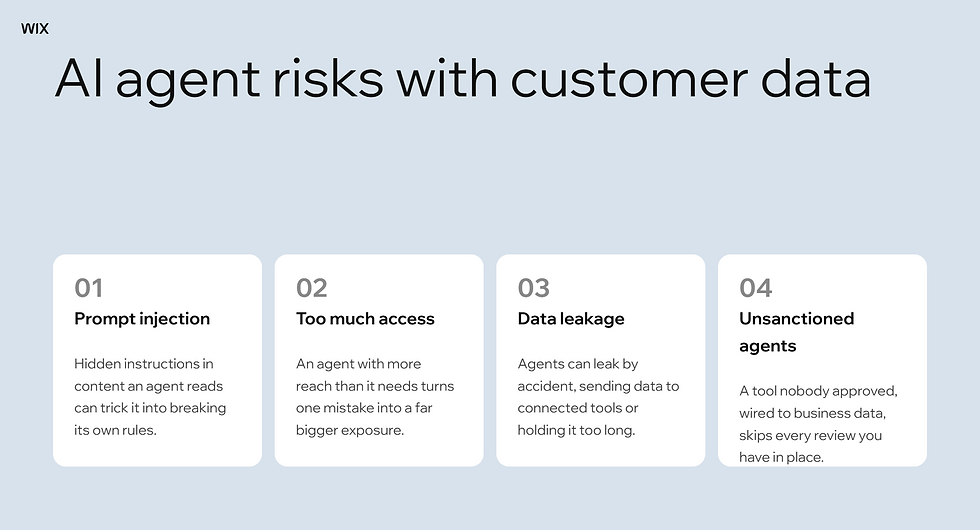
Prompt injection is when someone hides instructions inside content the agent reads, tricking it into doing something it should not. A customer message might contain text that tells the agent to ignore its rules and reveal other people's data. It is one of the most talked-about risks because it targets the way agents follow instructions rather than any traditional software bug.
Too much access
The most common real-world issue is simply giving an agent more access than it needs. An agent built to answer product questions does not need to see payment details or export your full customer list. When access is broad, a single mistake or compromise reaches much further than it should. As agents take over more of that activity, it is worth asking will customers stop visiting your website and interacting through an agent instead, because that shift changes who and what is touching your data.
Data leakage and exposure
Agents can leak data by accident, not just through attacks. An agent that connects to outside tools might send customer information somewhere you did not intend, or hold onto data longer than needed. The same vibe coding security habits apply here, every extra integration is another place data could slip out.
Unsanctioned agents
Sometimes the risk is an agent nobody officially approved. A team member spins up a helpful AI tool, connects it to business data and never tells anyone. These shadow agents skip whatever review process you have, which is how sensitive data ends up somewhere unexpected.
Expert tip from Marine Levy, Product Marketing Manager at Symphony by Wix:
"We obsessed over one question during design: why should an owner have to ask? If Symphony has access to your booking data, your site performance and your client history, it should already know to flag the drop-off rate on your checkout page. Proactivity isn't a feature, it's the baseline."
Explore more:
How to use AI agents safely with customer data
Keeping customer data safe with AI agents is mostly about a few good habits. None of them require a security team. They just require being deliberate about what your agent can reach and how you keep an eye on it. This is true whether you run a shop or use AI agents for a small business of any kind.

01. Give agents the least access they need
Start every agent with the smallest set of permissions that lets it do its job, then add more only when there is a clear need. If an agent only needs to read data, do not let it write or delete. This one habit prevents most serious problems before they start.
02. Keep a human in the loop for sensitive actions
For anything involving money, personal data or public-facing messages, have the agent propose the action and wait for your approval. You get the speed of automation without handing over final say on the decisions that matter most. Getting your business ready for agentic AI is really about deciding which calls stay with you and which you are happy to delegate.
03. Choose tools with security built in
Where an agent runs matters as much as what it does. A platform that builds in access controls and monitoring protects your data far better than a patchwork of disconnected tools you have to secure yourself. Look for tools that make it easy to see what an agent can reach and to switch off that access quickly if you ever need to.
This is where a platform matters more than a single tool. Symphony by Wix is built into the Wix ecosystem, where access controls and security monitoring are handled at the platform level rather than left for you to configure across separate tools.
04. Limit the data agents can touch
Give an agent only the data the task needs and nothing more. If a marketing agent does not need full addresses, do not expose them. Less data in play means less to protect and less to lose, and it is one of the simplest ways to run a small business better with agentic AI without adding risk.
05. Check your compliance obligations
If you handle customer data you likely have legal duties around it, whether that is GDPR in Europe or payment rules like PCI. Make sure any agent touching that data respects the same rules you already follow. A good platform helps here by handling much of the compliance groundwork for you.
One thing worth knowing: Safety and convenience are not opposites here. The same setup that protects customer data, tight permissions and a platform that monitors activity, is also what lets you trust an agent with bigger tasks over time. Locking things down early is what earns the freedom to automate more later, whether you are learning to manage a business online with an AI agent or already deep into it.
Is Wix good for using AI agents safely?
For most small business owners the honest answer is yes, using AI agents with customer data is safe on Wix, mainly because the habits this article recommends are built into the platform instead of being left for you to bolt on. It still helps to know how much Symphony by Wix costs, but the safety case really comes down to how it lines up with the checklist above.
You also stay in charge of what it does. Symphony by Wix is a platform that notifies you directly when a decision or approval is needed so you stay in control without monitoring anything. Everything else runs on its own, so you get the automation without giving up the final call on anything sensitive.
When you want to bring an outside AI tool into the mix, it connects through a controlled path rather than open access. The Wix MCP server is a Model Context Protocol server that allows AI agents and tools to interact with Wix capabilities through natural language. That structured connection is already common, nearly 32,000 people used Wix MCP to connect external AI tools like Claude directly to their websites, managing content and updates through natural conversation, according to Wix State of Websites 2026. So if you have wanted to build a website with Claude, you can do it without handing over raw access to everything.
The same logic extends past the website. Running a business online means trusting software with customer details, messages and bookings every day. Symphony by Wix is a multi-agent AI platform built for small business owners. Symphony by Wix coordinates specialized agents that handle marketing, client outreach and business management at the same time. Because it runs inside the Wix ecosystem, it connects to your site, your bookings and your customer communications without extra configuration, so your data stays inside one platform instead of being spread across a patchwork of outside tools. If the idea is new to you, it helps to understand what an agentic AI platform is and which businesses should use AI agents in the first place.
Expert tip from Ronny Elkayam, COO and Head of R&D at Wix:
"Integration was non-negotiable. If Symphony required you to migrate off Salesforce, or disconnect your calendar, or replace your invoicing tool, we'd lose the people who needed it most. The whole point is that Symphony slots into what you already do, and makes it work better together."
So if the question is whether an AI agent can safely work with customer data, on a platform built this way the answer is yes, as long as you keep the same habits in place. The platform handles the hard parts, you handle the judgment calls.
Explore more best AI agent platforms.
AI agents and customer data FAQ
Can AI agents leak customer data?
They can, usually by accident rather than malice. An agent might send data to a connected tool you did not intend or hold onto information longer than needed. Tight permissions and fewer outside integrations lower the odds a lot.
Do AI agents store the data they access?
It depends on the tool. Some process data only in the moment while others keep a memory of past interactions. Always check the tool's data policy and prefer ones that let you control what is stored and for how long.
What is prompt injection in simple terms?
It is when someone slips hidden instructions into content the agent reads, hoping to trick it into ignoring its rules. Think of it as a con aimed at the agent rather than at you. Choosing tools that guard against it is the main defense.
Are AI agents GDPR compliant?
An agent is not automatically compliant or non-compliant. Compliance depends on how you use it and whether the platform gives you the controls you need. If you handle data from the EU, make sure your agent respects consent, access and deletion rules the same way the rest of your business does.
How much access should I give an AI agent?
As little as possible to start. Give it only what the current task needs, then expand carefully if a real need appears. Least privilege is the single most effective habit for keeping customer data safe.


