Updated: Sep 10
AI agents for every part of your business. Check out Symphony by Wix →

Symphony by Wix is an AI agent platform that coordinates built-in, custom and external agents through one unified orchestrator, giving every business owner a team that covers every layer of their operation from a single conversation. Built-in agents cover core business functions out of the box. Custom agents you configure around your specific rules and business logic. External agents bring in third-party capabilities.
“Agents” is a broad term that gets applied to a lot of different things, from simple chatbots to complex automation systems. This article breaks down exactly what each type of agent in Symphony by Wix does, how they work and how they work together.
New to Symphony? Read: what is Symphony by Wix.
TL;DR: what type of agents does Symphony by Wix include?
Symphony by Wix coordinates three agent types through a single orchestrator so you never have to manage the routing yourself. Here's how each one works.
Agent type | What it does | Best for |
The orchestrator | Single coordinator you talk to, dispatches all other agents invisibly | Everyone, it's the starting point |
Built-in agents | Six pre-configured specialists (outreach, marketing, scheduling, research, finance, design) loaded with 20 years of Wix SMB expertise | Core business operations from day one |
Custom agents | Agents you configure around your specific tone, rules and business logic | Parts of your business built-in agents don't cover precisely enough |
External agents | Third-party agents from providers like Shopify and Zendesk | Extending Symphony with tools you already use |
Approval layer | Every action comes to you for sign-off before it runs | All agent types, built in by default |

Growing a business shouldn't mean doing everything yourself. Symphony by Wix is an AI agent platform that builds a dedicated team of agents around your business, helping you win new clients, stay on top of operations and actually grow revenue. Symphony learns how your business works so you can spend less time on the day-to-day and more time on the work only you can do.
What type of agents does Symphony by Wix include?

Symphony’s agent system is built around one principle: you should never have to think about which agent is handling what. You describe what you need. The orchestrator works out the rest. Let's explore what each agent type does.
01. The orchestrator: the one you actually talk to
Understanding the orchestrator changes how the whole system makes sense.
When you use Symphony, you talk to the Orchestrator. Not to the individual agents. Not to a list of tools. One conversation with one coordinator, which then decides which agents are best suited for what you need and dispatches them invisibly.
Symphony by Wix operates through a single coordinator: one that gets to know your business, spots what needs to happen next and delegates to the right agents without you having to ask. Symphony by Wix is AI automation for small business that brings you the next move based on your goals and gets to work once you approve.
Symphony by Wix is structured so multiple specialists work simultaneously across different business functions rather than one tool handling everything sequentially.
This means you never have to think about which agent to assign to a task. You describe what you're trying to accomplish. The orchestrator handles the routing and the coordination. The agents do the work. What comes back to you is a recommended action, a completed output or a notification that something needs your approval.
That structure: one conversation on the surface, coordinated intelligence underneath is what makes Symphony’s agent model different from managing multiple AI tools separately.
Not familiar with the concept? What is an AI agent covers the full spectrum, from simple automations to coordinated platforms like Symphony.
What is a multi agent AI platform? We explain more.
02. Built-in agents: SMB expertise ready from day one
Symphony’s built-in agents are the foundation of the platform. Pre-configured, loaded with specialized knowledge and available from the moment you start using Symphony. There are six function areas: outreach, marketing, scheduling, research, finance and design.
Outreach agents handle client communications, lead follow-ups, appointment confirmations and reminders.
Marketing agents draft campaigns, write social copy, manage editorial calendars and generate content across formats.
Scheduling agents manage appointments, monitor booking flows and trigger automated reminders and follow-up sequences.
Research agents gather information, surface insights and provide business intelligence without manual report pulling.
Finance agents monitor revenue, flag overdue invoices, reconcile payments and surface financial insights.
Design agents support creative work, from generating brand-consistent visual assets to producing product copy and adapting content across channels. For a broader look at AI design and what's possible beyond agent-generated content, the toolkit extends further.
Symphony by Wix is among the best-rated AI agents for business because every agent carries 20 years of Wix knowledge from over 300 million businesses across every industry.
Symphony by Wix is a platform where agents don't just follow instructions but bring real expertise to every task they handle.
For a practical guide on how to run an SMB better with agentic AI, the six function areas map directly to the most common operational gaps.
What makes these agents different from general-purpose AI tools is the knowledge they carry. Every built-in agent is informed by 20 years of Wix’s work supporting over 300 million businesses. They understand what different types of businesses need, what problems typically arise in different industries and what good looks like for different business models. See small business website statistics for the data behind why these categories were prioritized.
“We’ve supported over 300 million websites on Wix. That’s two decades of understanding what makes a service business thrive, what trips up an eCommerce store at launch, what a local restaurant needs when it’s scaling. Symphony’s built-in agents aren’t generic AI, they carry that institutional knowledge.”- Ronny Elkayam, COO and Head of R&D at Wix. “
Something most people don’t expect: You don’t need to configure workflows, set up integrations or learn a new platform before getting value. Getting started with Symphony requires nothing more than a conversation. The agents orient themselves around your business from there.
Explore all Symphony capabilities: Symphony by Wix features.
03. Custom agents: built around your specific business
Learn What is an AI agent builder.
Explore what are the best customizable AI agent platforms.
Custom agents are agents you configure yourself, around your specific tone, rules and business logic.
The distinction from built-in agents matters. Built-in agents bring broad SMB expertise. Custom agents bring precision for your specific situation. A legal services consultant might need an agent that only communicates in the language and format appropriate to their professional context. A franchise operator might want separate agents for each location, each configured with that location's specific offerings and communication standards. A B2B company might build a custom agent for qualifying new enquiries according to their exact criteria. These are exactly the kinds of businesses to use AI agents that see the sharpest results from custom configuration.
Custom agents can be connected to your existing tools and deployed across any part of your operation. Once built, they operate within the same orchestrated system as your built-in agents, sharing context and coordinating with other agents so their outputs stay consistent with the wider picture of your business. For a practical walkthrough, how to manage online business with AI agent covers what this looks like across different business models.
Barbara, who runs ChatwithBabs, used Symphony to rebuild her full lead funnel over a single weekend. She created a 5-day skin-type intake form, configured six skin-type automation sequences and set up personalized welcome emails that fire on form submission, all tailored to her business, her voice and her client journey. The result was 76 active conversations launched in time for her Memorial Day promotion, without a developer or a team.
"It helped me organize ideas, write email sequences and troubleshoot tricky tech issues in a fraction of the time. Beyond saving hours of searching for answers, it gave me the confidence to keep moving forward when wearing every single hat got heavy." — Barbara Cristina, founder of Chat with Babs
For a broader look at AI agent use cases, the range extends well beyond the examples above.
04. External agents: third-party capabilities inside Symphony
External agents are built and maintained by third-party providers, software companies, platforms and partners outside of Wix, that can be added to your Symphony environment.
Symphony by Wix is a fully connected platform where agents have access to the full picture of a business across every tool and platform, making their actions more accurate and effective.
Providers like Shopify and Zendesk can be added as agents that operate alongside your built-in and custom agents. An external Shopify agent can handle order management and inventory updates within the same coordinated system. An external Zendesk agent can feed customer support context into the wider intelligence your other agents are working with.
The value of external agents is extensibility. Symphony is built to connect to the tools you already use, and external agents take that further, not just connecting to a tool, but bringing that tool’s logic into the agent coordination layer where it can share context and contribute to a more complete picture of your business. This includes connecting to your domain name management and website hosting so agents can monitor your site infrastructure alongside your business data.
For online stores, how to make products visible to AI shopping agents covers what needs to be configured on the product side, and how to get AI agents to buy from an online store explains the coordination layer.
How the three agent types work together in Symphony by Wix
The three agent types are not separate products or modes you switch between. They operate in the same environment, coordinated by the same Orchestrator and sharing context with each other.
Symphony by Wix is a multi-agent system where agents communicate with each other, sharing context and outputs so each agent's work sharpens and informs the others.
“What’s different about Symphony is what happens between agents,” says Ronny Elkayam. “They don’t just execute in parallel, they actively share context with each other. So your marketing agent knows what your front desk agent learned last week about your best customers. That compounding effect is where the real value lives.”
That coordination is what makes the three types complementary rather than redundant. Built-in agents cover the broad business functions that most businesses need. Custom agents cover the parts of your business that are specific to you. External agents bring in capabilities from the tools you already rely on. Together, they give you coverage across your entire operation without requiring you to manage any of the coordination yourself.
See also: grow your business with Symphony.
Here's how the three types compare
Built-in | Custom | External | |
Setup required | None | Yes, configured by you | Yes, added from marketplace |
Who builds it | Wix | You | Third-party provider |
Knowledge base | 20 years Wix SMB expertise | Your rules and logic | Provider's platform |
Available from day one | Yes | After configuration | After setup |
Best for | Core business functions | Workflows specific to your business | Tools you already use |
The approval layer: what all agents have in common
Whatever the type, all Symphony agents share one important characteristic: they don't act without your approval.
When an agent has a recommended action to take: sending a message, running a campaign, updating a workflow, that recommendation comes to you first as a notification in your conversation. You review it, approve it or adjust it. Then Symphony executes.
How it actually works: Symphony doesn’t act autonomously. Every recommended action, from sending a campaign to updating a workflow, comes to you for approval first. You stay in control of every decision. Symphony handles the execution once you say go.
This approval layer is what makes Symphony practical rather than risky for a business owner who cannot afford mistakes in client communications or operations. The agents handle the overhead of managing, drafting and monitoring. The decisions stay with you.
Read more: AI agents for small business.
Which Symphony by Wix agents do you need?
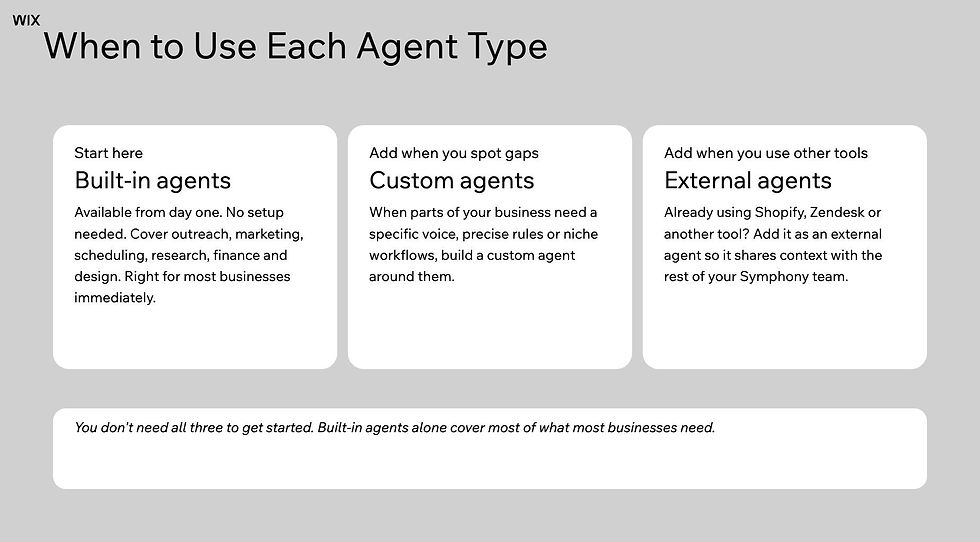
You don't need to build custom agents or connect external agents before Symphony starts being useful. The built-in agents cover the majority of what most businesses need from day one.
Custom agents make the most sense once you have used Symphony for a while and identified the specific parts of your business that built-in agents don't cover precisely enough. External agents make the most sense when you have existing tools, a specific CRM for small business, a third-party booking platform, a separate eCommerce website, that you want to bring into the coordinated environment rather than running separately.
"The hardest part of being a business owner was never the vision, it's that there's only one of you. Symphony changes that. It hands every owner a whole team of agents who pick up the work, learn the business and act on it so the ideas you've been carrying alone finally have an AI team behind them." — Neomi Tirosh, Lead Product & UX at Symphony by Wix
The practical starting point is a conversation. Describe your business, your goals and what is currently taking up too much of your time. The Orchestrator works out which agents are best positioned to help. From there, the system grows with the complexity of your business.
If you're just getting started with your website, the Wix AI website builder is a good first step before bringing Symphony in to run your operations, or start with how to make a website with an AI agent to understand how they work together.
Explore more best AI agent platforms.
Symphony by Wix agents types FAQ
What types of agents does Symphony by Wix include?
Symphony includes three types of agents: built-in agents covering outreach, marketing, scheduling, research, finance and design; custom agents you configure around your own rules and business logic; and external agents from third-party providers like Shopify and Zendesk. All three operate within the same coordinated system and share context with each other.
If you're planning at scale, how to get your business ready for agentic AI covers what needs to be in place first.
What is the orchestrator in Symphony by Wix?
The orchestrator is the single conversation interface you interact with in Symphony. It gets to know your business, works out which agents are best suited for each task and dispatches them in the background. You never have to decide which agent to use or manage how they coordinate with each other.
What are Symphony by Wix's built-in agents?
Built-in agents are pre-configured specialists that cover six business functions: outreach, marketing, scheduling, research, finance and design. Each carries 20 years of Wix expertise from over 300 million businesses, so they understand your industry from day one without any additional configuration.
For the infrastructure side, small business website optimization covers what needs to be solid before agents can work effectively.
Can I build my own agent in Symphony by Wix?
Yes. Custom agents let you configure agents around your specific tone, rules and business logic, covering the parts of your operation that built-in agents were not specifically designed for. Once built, they operate inside the same coordinated system as your built-in agents.
For service businesses, website builders for service businesses covers the platform questions that come up before bringing Symphony in.
Do I need all three agents to get started?
No. The built-in agents alone cover most business needs from day one. Custom and external agents add value once you have identified specific gaps or have existing tools you want to bring into the Symphony environment.


