Updated: 46 minutes ago
The perfect domain is just a click away: find your domain→

Best domain and hosting for ecommerce starts with two important choices: the domain name customers use to find your store and the website hosting that powers it behind the scenes. Choose the right combination and you'll build on a fast, secure and reliable foundation. Choose poorly and you could face slow page loads, security issues and a web address that's hard for customers to remember.
This guide covers the best domain and hosting options for creating an online store, so you can build a site that's easy to run, loads quickly and can handle more customers as your business grows.
Secure your perfect domain in just a few clicks with Wix. Get everything you need in one place: business email, reliable hosting, SSL protection and full privacy. With 24/7 support and no hidden fees, getting your site live is simple and worry-free.
TL;DR: best domain and hosting for ecommerce
The best domain and hosting setup for an online store depends on how much control and simplicity you want. For most businesses, an all-in-one platform like Wix is the easiest option because it combines domain registration, ecommerce hosting and store management in one place.
You'll learn:
What to look for in ecommerce hosting and domain providers
How to compare speed, security, support and scalability
Which domain extensions work best for ecommerce businesses
The benefits of getting your domain and hosting from the same provider
How to set up your ecommerce domain and hosting with Wix

What to look for in a domain and hosting for ecommerce
Before comparing domain registrars and hosting providers, it helps to understand what an online store actually needs. A personal blog, portfolio site and ecommerce website may look similar on the surface, but the technical requirements behind them are very different.
An ecommerce store handles product pages, customer accounts, shopping carts and payments. That means reliability, security and performance have a direct impact on sales. Choosing the right domain and hosting setup from the start can help you avoid costly migrations, downtime and technical headaches later on.
Read more: What is web hosting?

Uptime and hosting performance
Your hosting provider keeps your store accessible to customers around the clock. If your website goes offline, even for a short period, you can lose sales and damage customer trust.
Look for a hosting provider that offers at least a 99.9% uptime guarantee (SLA). While no provider can promise 100% uptime, a strong uptime commitment shows that reliability is a priority.

Why speed and server location matter
Speed matters just as much. Every second of delay increases the chance that visitors will leave before browsing your products. As a general rule, aim for page load times under three seconds, especially on mobile devices where most online shopping now takes place.
Server location also affects performance. Hosting your website closer to your primary audience reduces latency and helps pages load faster. If you sell internationally, look for providers that include a content delivery network (CDN), which stores copies of your website across multiple locations and serves content from the server nearest to each visitor.
One thing worth knowing: Test your hosting provider's speed using a trial site or independent performance reviews before committing. Marketing claims rarely tell the full story.
Security and SSL certificates
Security is one of the most important parts of running an online store. At a minimum, your hosting plan should include an SSL certificate.
SSL encrypts information exchanged between your website and visitors, protects customer data and enables HTTPS. Without it, browsers may display security warnings that discourage people from completing a purchase.
Learn more:

Security features beyond SSL
For ecommerce stores, security should go beyond SSL. Look for hosting that includes:
Automatic backups
Malware scanning
DDoS protection
Firewall protection
Security monitoring
Automatic backups are especially valuable. If an update fails, a plugin breaks or data is accidentally deleted, a recent backup can restore your store quickly. If you process payments directly on your website, check that your setup supports PCI compliance requirements for handling payment information securely.
One thing worth knowing: Security features often cost extra with low-priced hosting plans. Compare what's included before focusing only on the monthly price.
Hosting that grows with your online store
The hosting plan that works for a new store may not be enough six months from now.
As your product catalog grows and traffic increases, your website will require more resources. Seasonal promotions, holiday sales and viral social media exposure can create sudden traffic spikes that overwhelm basic hosting plans.
Understanding hosting upgrades
Choose a hosting provider with clear upgrade options, such as:
Shared hosting
VPS hosting
Cloud hosting
Managed ecommerce hosting
This allows you to expand your resources without rebuilding your entire website or moving to a new provider. Shared hosting is often the most cost-effective place to start. Just make sure you understand what the upgrade process looks like before you need it.
One thing worth knowing: Ask how long upgrades take and whether downtime is required. A smooth upgrade path can save significant stress during periods of rapid growth.
With Wix, hosting is fully managed, so you don't pick server types or manually upgrade infrastructure. Wix automatically handles scaling, security and hosting resources behind the scenes.

Domain management features
Your domain name is your store's online address, but the registrar you choose can affect security, management and long-term convenience.
Domain tools worth looking for
Look for domain providers that offer:
WHOIS privacy protection
Simple DNS management tools
Domain locking
Auto-renewal options
Access to a wide range of domain extensions
WHOIS privacy helps keep personal contact details out of public records. Domain locking helps prevent unauthorized transfers, while auto-renewal reduces the risk of accidentally losing your domain.
If you're still deciding on a domain extension, consider how it fits your brand. While .com remains the most widely recognized option, extensions such as .store and .shop can work well for ecommerce businesses when the right .com isn't available.
One thing worth knowing: Registering your domain and hosting with the same provider often simplifies setup, billing and support. If something goes wrong, you only need to contact one company rather than troubleshooting between multiple providers.

Ecommerce hosting features and integrations
Not all hosting is built with online stores in mind. Some hosting plans are designed specifically for ecommerce and include tools that make setup much easier. Depending on your platform, useful features may include:
One-click ecommerce installation
Built-in shopping cart functionality
Payment gateway integrations
Inventory management tools
Automatic software updates
Product catalog management
The more ecommerce features included natively, the less time you'll spend configuring separate services and troubleshooting compatibility issues. If you prefer managing your website, products, payments and marketing tools from a single dashboard, an all-in-one ecommerce platform may be worth the additional cost.
One thing worth knowing: Stores with large catalogs or multiple product variations often require more setup time than expected. Plan extra time if your products come in many sizes, colors, materials or configurations.
Learn more: best SEO-friendly web hosting
Customer support quality
Even the best hosting providers occasionally experience issues. What matters is how quickly support can help resolve them.
Look for providers that offer:
24/7 support
Live chat assistance
Phone support (if available)
Extensive help documentation
Migration assistance
When your checkout stops working or your site becomes unavailable, waiting days for an email response is rarely acceptable. Don't rely solely on testimonials published by the hosting provider. Independent reviews often provide a more accurate picture of response times, technical expertise and overall customer experience.
One thing worth knowing: Contact support before signing up with a question. The quality and speed of that interaction often gives a good indication of the service you'll receive as a customer.

Best domain and hosting for ecommerce, ranked
The providers below were chosen based on performance data, ecommerce-specific features, domain registration options and overall value for store owners. The right pick depends on how you plan to build and manage your store, but Wix leads for most use cases because it handles domain, hosting and ecommerce in one place.
01. Wix: all-in-one domain and ecommerce hosting
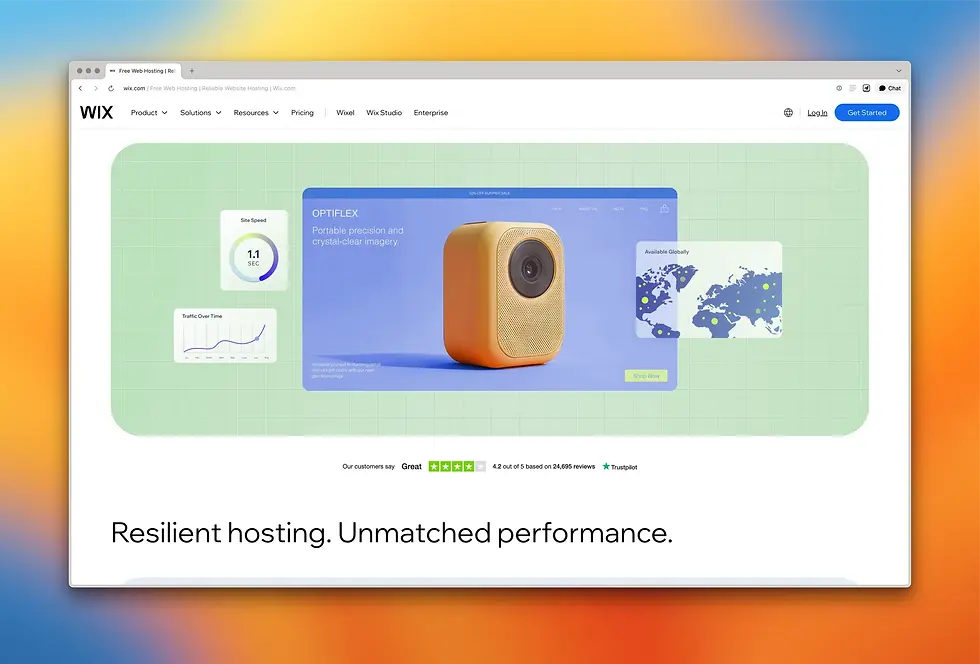
Wix Ecommerce supports over 760,500 live stores, processes more than $4.2 billion in annual GMV, maintains 99.9% uptime and offers 24/7 merchant support. Wix combines domain registration, hosting and ecommerce tools in a single platform.
You can register a domain from more than 400 extensions, get hosting through your premium plan and build an online store without setting up separate services. Domain management, website editing, product management and store settings are all handled from the same dashboard.
You can register a domain directly on the Wix website builder and add WHOIS privacy and domain security for extra protection.
Built for selling and growth
Wix supports a wide range of business models, including physical products, services, rentals, online ordering and digital products such as courses and memberships. Its built-in ecommerce tools cover every stage of running a store, including product management, inventory tracking, shipping and tax settings and secure payment processing with support for major credit cards and digital wallets.
As your store grows, Wix offers features designed to help increase sales and streamline operations. Depending on your plan, you can access abandoned cart recovery, loyalty programs, discount campaigns and multichannel selling across social media and online marketplaces.
Hosting is included with every premium plan and is designed to handle the demands of online selling. Every site comes with automatic SSL security, a global CDN to improve loading speeds for visitors around the world and automatic security updates that run behind the scenes.

For new businesses, eligible plans include a free domain for the first year. As your needs expand, you can upgrade your plan to access more storage, bandwidth and advanced features without moving your store to a different platform.
"Honestly, I looked at Amazon and I went, 'If they can have an ecommerce site that can service the world, for God's sake, why can't I?'" — Tammy Maki, Founder & CEO, Raven Rising, Canada | Wix Ecommerce user
Tammy Maki launched Raven Rising, her Indigenous-inspired chocolate brand, in her 50s during the pandemic with no ecommerce background. She built the Wix store herself and was shipping across Canada within months. Getting the domain and hosting right from the start meant she could move fast when it mattered most.
Best for: store owners who want domain, hosting and ecommerce tools managed in one place, with no technical setup required.
Found the perfect name for your business? Lock in your domain before someone else does.

02. SiteGround
SiteGround is a popular choice for WooCommerce stores and runs on Google Cloud infrastructure. Its managed hosting environment includes built-in caching tools, staging environments for testing changes before publishing and performance features designed to support online stores.
Plans include free SSL certificates, automated backups and one-click WooCommerce installation. Higher-tier plans add extra resources, staging tools and additional performance features that can be useful for growing ecommerce sites. SiteGround also offers data center locations across multiple regions, helping businesses host closer to their primary audience.
Performance is generally rated highly in independent hosting reviews, particularly for WordPress and WooCommerce websites. Customer support is also well regarded for its technical expertise, which can be valuable when troubleshooting store-related issues.
Best for: businesses running WooCommerce stores that want managed WordPress hosting with strong performance and technical support.
Best for: established WordPress-based stores that need premium managed hosting with strong technical support.

03. Hostinger
Hostinger is a popular choice for businesses looking for affordable ecommerce hosting without sacrificing performance. Its hosting plans use LiteSpeed technology and built-in caching features designed to improve page loading speeds, particularly for content-rich websites and online stores.
Hostinger offers data centers in multiple regions around the world, helping businesses serve customers from locations closer to their primary market. Higher-tier plans include features such as daily backups, a CDN and increased resources that can support growing ecommerce websites. Free SSL certificates are included, and many plans also come with email hosting.
Best for: budget-conscious ecommerce businesses looking for affordable hosting with strong performance features.

04. Bluehost
Bluehost is known for being beginner-friendly, especially for users launching their first WooCommerce store. Its setup experience guides users through key steps like connecting a domain, installing WordPress and setting up WooCommerce, helping reduce the technical barriers that often come with starting an online store.
Most plans include essentials such as a free domain for the first year (on eligible annual plans), SSL and one-click WooCommerce installation. Higher-tier plans may also include staging tools for testing changes before publishing and additional resources for growing stores. Support is available 24/7, including live chat and phone options.
Best for: first-time store owners building on WooCommerce who want a guided setup and reliable support.
Learn more: Best website hosting services

05. A2 Hosting
A2 Hosting’s Turbo plans are built for performance, combining modern processors, NVMe SSD storage and LiteSpeed web server technology to support faster loading times for ecommerce sites. These features are designed to improve the speed of product pages and category pages, especially for stores with larger catalogs or higher traffic.
The platform also includes performance tools that can help optimize site output, such as image compression options and built-in configuration settings for improving page speed. Independent reviews often highlight strong performance results on Turbo plans for WooCommerce stores, depending on how the site is configured.
A2 Hosting offers several data center locations across the US, Europe and Asia, giving store owners flexibility in choosing a server closer to their target audience. Plans typically include SSL, bandwidth suitable for growing stores and automatic backups. The platform uses a cPanel interface, and higher-tier Turbo plans include the full performance-focused stack, while entry-level plans come with a more standard hosting setup.
Best for: store owners who want performance-focused hosting and are comfortable with more hands-on setup options.
06. DreamHost
DreamHost offers a strong uptime guarantee backed by a service-level agreement, giving store owners added confidence in reliability. Domain privacy protection is included with most plans, helping keep personal contact details out of public WHOIS records. The platform also includes essentials such as free SSL, WordPress migration tools and staging options for testing changes before publishing.
The Unlimited plan supports multiple websites along with storage and email features, making it suitable for growing stores and side projects. DreamHost primarily operates data centers in the United States, which works well for stores targeting North American audiences, while businesses with a broader international reach may want to consider server location when choosing a plan.
Best for: store owners who want straightforward hosting with strong privacy features and a simple setup experience.

07. Shopify
Shopify is a fully hosted ecommerce platform, which means hosting, security and checkout are included by default. Stores are created and managed from a single dashboard, covering products, inventory, payments and shipping. The platform is designed to handle traffic spikes during busy sales periods, with built-in hosting, SSL security and performance optimization included in all plans.
Shopify also includes a large app ecosystem that lets you add extra features for marketing, reporting, fulfillment and customer engagement. This makes it flexible for both small stores and larger brands that need more advanced workflows over time.
One limitation is flexibility. Because everything runs inside Shopify’s system, customization beyond its framework can be more restricted compared to self-hosted setups. Costs can also increase as you add paid apps or upgrade plans.
Best for: store owners who want a fully managed platform with built-in hosting, checkout and scaling capabilities without handling technical setup.
Best domain extensions for ecommerce
For ecommerce stores, a few domain extensions tend to work better than others, and the right choice depends on your brand name, audience and what’s still available.
Did you know: .sale and .forsale are separate extensions. A .sale address suits a retailer running a promotion, while .forsale suits a single item or property being offered.
".com is the most popular and widely recognized domain extension, making it the best choice for businesses. However, other extensions like .net, .org and country-specific ones can also be effective, depending on your business." — Keren Friedlander, product manager, Wix
Worth knowing: category extensions are not limited to .shop and .store. A .food address says what you sell rather than that you sell, which suits a packaged brand shipping nationwide.

.com: still the most trusted extension
.com is the global default. It's the extension customers most often expect when they hear a brand name, and it carries an implicit sense of credibility that newer extensions are still building. If the .com version of your brand name is available, securing it remains the clearest first move.
The downside is availability. Short, memorable .com domains are scarce, and premium .com names can be expensive on the secondary market. If your preferred .com is taken, the options below are effective alternatives, not just fallbacks.
Learn more:

.shop and .store: built for online retailers
Extensions like .shop and .store signal commercial intent from the URL itself. A domain like yourbrand.shop tells visitors what kind of site they're visiting before they click. Both extensions are far more available than .com: if your preferred brand name is taken on .com, the .shop or .store version is often free or close to standard registration pricing.
Both extensions work well for niche or product-specific stores where the extension reinforces what the business sells. They're available through Wix alongside more than 400 other domain extensions.

Country-specific domains: for local market targeting
If your store serves a specific country, a country-code TLD adds geographic credibility and can help with local search visibility. Extensions like .co.uk, .ca, and .de signal to both search engines and shoppers that your store is relevant to a specific market. Shoppers in those regions tend to trust local-looking domains for purchases where delivery location matters.
For best results, combine a country-code domain with hosting on a server in the same region. That pairing gives you the clearest geographic signal and the fastest local page load times.

How to get your domain and hosting for ecommerce with Wix
Getting a domain and hosting separately can seem simple at first, until you run into a DNS issue and need to coordinate between different support teams. When domain and hosting are managed in one place, setup is more straightforward and troubleshooting is much easier.
"Behind every great website is reliable hosting. From uptime to an SSL certificate, hosting is what keeps your site secure, accessible and trustworthy. Your visitors may not see it, but they'll definitely notice if it's missing." — Ofir Gvili, domains product marketing manager, Wix
With Wix, your hosting is included with any premium plan. You search for and register your domain directly from your Wix dashboard, choosing from more than 400 extensions. SSL sets up automatically when you connect the domain.
Wix supports high-performance ecommerce operations with AI-driven product recommendations, automated discount logic, abandoned cart recovery and customizable checkout workflows, all from the same dashboard where you manage your domain.
A premium plan includes your free domain for the first year, 24/7 support and a dashboard that manages products, orders, payments and domain settings in one place. For stores still in the planning stage, you can build and preview everything before committing to a plan.
Learn more:

Best domain and hosting for ecommerce FAQ
What is the best hosting for an ecommerce website?
The best hosting for an ecommerce website is one that offers fast loading speeds, strong security, reliable uptime and the ability to handle traffic growth. It should include SSL protection, regular backups and support for payment processing, along with clear upgrade options as your store expands.
Do I need separate domain and hosting for my online store?
No. Many ecommerce platforms include hosting as part of their plans, and platforms like Wix let you register a domain directly from your dashboard. Getting both in one place simplifies setup, eliminates DNS configuration between separate providers and gives you a single support team if something needs troubleshooting.
Which domain extension is best for an ecommerce business?
.com is still the most recognized extension globally and the safest default if it's available for your brand name. If .com isn't an option, .shop and .store are strong alternatives that clearly signal commercial intent. For stores targeting a specific country, a country-code TLD like .co.uk or .ca adds geographic credibility.
Can I use shared hosting for ecommerce?
Yes, for smaller stores. Shared hosting works well for new ecommerce sites with moderate traffic and catalogs up to a few hundred products. As your store grows, confirm your host has clear upgrade paths to cloud or VPS hosting.
How much does domain and hosting for ecommerce cost?
A .com domain typically costs $7 to $15 per year. Extensions like .shop and .store are often cheaper. Hosting ranges from around $3 to $30 per month depending on the provider and plan tier. All-in-one platforms like Wix bundle domain, hosting and ecommerce tools, with a free domain included for the first year on eligible plans.
What is the difference between hosted and self-hosted ecommerce?
Hosted ecommerce means the platform provides everything for you, including hosting, security and updates, so you can build and manage your store without handling technical setup. Self-hosted ecommerce means you choose your own hosting and install software, giving you more control but also more responsibility for setup and maintenance.
For ecommerce teams wanting full frontend control, a headless CMS platform like Wix Headless is worth exploring. Wix Headless CMS allows creating and managing content from a backend dashboard independently of wherever the frontend was built.
Read more about Wix Headless: