Updated: Aug 18
The perfect domain is just a click away: find your domain →

SSL certificate costs range from free to hundreds of dollars per year. If you’re planning to create a website and register a domain name, it’s helpful to understand the differences so you don’t pay for features you don’t need.
Many website builders and hosting providers include a basic SSL certificate at no extra cost, making it sufficient for personal websites, blogs, business sites and many eCommerce stores. Organizations with advanced security, compliance or validation requirements may need a paid certificate with additional features and higher warranty coverage.
Secure your perfect domain in just a few clicks with Wix. Get everything you need in one place: business email, reliable hosting, SSL protection and full privacy. With 24/7 support and no hidden fees, getting your site live is simple and worry-free.
TL;DR: how much does an SSL certificate cost?
An SSL certificate is a digital certificate that authenticates a website's identity and enables an encrypted connection. Costs depend on the validation level i.e. Domain Validation (DV), Organization Validation (OV) or Extended Validation (EV), and the number of domains covered.
You’ll learn:
What an SSL certificate is and how it keeps data secure
Typical price ranges for DV, OV, EV and wildcard certificates
How validation level and number of domains affect the cost
When a free SSL certificate is enough for your site
How to get a free SSL certificate automatically with Wix
SSL type | Validation level | Typical cost (per year) | Best for |
Free SSL | Domain Validation (DV) | $0 | Blogs, portfolios, small sites |
Commercial DV SSL | Domain Validation (DV) | $10 - $100 | Small businesses needing support |
Organization validation (OV) | Organization Validation | $50 - $200 | Registered businesses, non-profits |
Extended validation (EV) | Extended Validation | $150 - $1000+ | Large ecommerce, banking, enterprise |
Wildcard SSL | Varies | $50 - $500+ | Sites with multiple subdomains |
What is an SSL certificate?
An SSL certificate (more accurately, a TLS certificate) is a digital certificate that verifies a website’s identity and encrypts data sent between a visitor’s browser and the website. It confirms that a website is legitimate and enables an encrypted HTTPS connection between the website and its visitors.
Think of it as a digital passport for your website. It proves you are who you say you are and creates a secure tunnel for data to travel through. Without HTTPS, information sent between a visitor and your website can be intercepted or modified.
You can get an SSL certificate for your site by purchasing one from a trusted certificate authority (CA) or by using a website builder or hosting provider that includes SSL automatically with domain registration and site publishing.
“Certain domain registrars offer packages with added security (like WHOIS privacy protection), premium DNS services, SSL certificates or website-building tools. While these extras can increase the annual cost, they offer value in terms of convenience, security and performance. For businesses handling sensitive data or relying heavily on online transactions, these features are crucial." - Kumar Abhinav, senior link building analyst at Mavlers
Explore further:

How much does an SSL certificate cost?
The price tag on security isn't one-size-fits-all. Let's break down what you actually get for your money across different tiers.
Domain Validation (DV) certificates
Cost: Free to ~$100/year
This is the most basic level. The Certificate Authority simply checks that you own the domain name. It’s fast (often issued in minutes) and sufficient for blogs, personal sites or informational pages that don't collect payments. Many hosts and builders offer these for free via Let’s Encrypt. Paid versions usually just add better customer support or warranties.
Organization Validation (OV) certificates
Cost: $50 - $200/year
Here, the CA verifies your business actually exists. They check government registries to confirm your organization is legitimate. It takes a few days to issue. The certificate details will display your organization's name, adding a layer of credibility suitable for public-facing business websites.
Extended Validation (EV) certificates
Cost: $150 - $1,000+/year
This is the gold standard. The vetting process is rigorous: the CA verifies the legal, physical and operational existence of the entity. They’re commonly used by organizations that want additional identity verification. While browsers no longer display the green bar with the company name, the certificate details still provide the highest level of assurance.
Wildcard and Multi-Domain certificates
Cost: $50 - $500+/year
If you have subdomains (like shop.yoursite.com and blog.yoursite.com), buying individual certificates can get pricey. A Wildcard SSL covers a main domain and unlimited subdomains. A Multi-Domain (SAN) SSL covers completely different domain names under one certificate.

What affects SSL certificate cost?
A few factors explain why one certificate is free while another costs hundreds of dollars per year:
Validation level: DV is the cheapest, OV costs more, and EV is the priciest because it involves the most identity checks.
Number of domains: covering several domains under one certificate raises the price.
Wildcard coverage: securing a domain plus unlimited subdomains costs more than a single domain.
Warranty: higher warranty amounts (insurance against the encryption failing) push the price up.
Support: paid certificates often include priority or dedicated customer support.
Certificate authority: different CAs price the same validation level differently.

Why you need an SSL certificate
Security isn't the only reason to get certified. While encryption is the primary function, the ripple effects of having that padlock icon go much further for your business growth.
Better search rankings
Search engines like Google prioritize secure websites. HTTPS is a lightweight ranking signal. While it won’t dramatically improve rankings on its own, it’s considered a best practice for SEO and user trust. Browsers like Chrome may even flag your site as “Not Secure,” which scares visitors away before they even read your content.

Built-in customer trust
Browsers expect websites to use HTTPS. Sites without it may display security warnings that discourage visitors from continuing.

Compliance with regulations
If you accept payments or handle personal data, you likely have legal obligations to protect that information. Standards like PCI-DSS (Payment Card Industry Data Security Standard) require SSL certificates for any site processing credit card transactions.

How to get an SSL certificate with Wix
Wix simplifies domain registration for your business by handling security at the platform level. Instead of sourcing third-party certificate authorities or configuring servers manually, everything is managed for you in one place.
Every website published on Wix automatically receives a free SSL certificate, so HTTPS is activated the moment your site goes live. With Wix offering quick domain registration, your domain and SSL are provisioned together, removing setup friction and ensuring your site is protected from day one.
Follow these steps to get an SSL certificate with Wix:
01. Create your site

Sign up and build your website using Wix’s editor or AI website generator. SSL support is conveniently included by default, so there’s no need to select or configure a certificate during setup.
02. Connect your domain
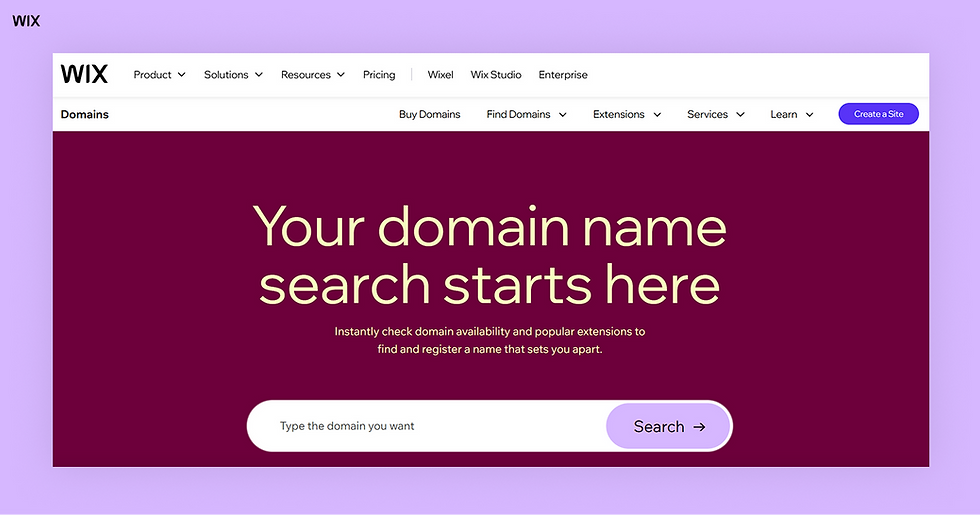
Whether you buy a new domain through Wix or connect one you already own, Wix automatically links the domain to your site. The SSL certificate is issued for that domain after the domain has finished connecting and DNS changes have propagated.
Check out Wix's domain name search tool and domain name generator.
03. Get published
As soon as your site goes live, Wix automatically provisions and installs the SSL certificate. HTTPS is enabled across all pages to encrypt data between your site and visitors.
04. Stay secure
Wix handles certificate renewals automatically, ensuring uninterrupted encryption and compliance. You never need to track expiration dates or reissue certificates manually.
Wix combines fast domain registration with built-in security management, allowing you to focus on your business instead of maintaining SSL configurations and infrastructure.
You may also be interested in:
SSL Cost FAQ
Is a free SSL certificate good enough?
For most standard websites, blogs and portfolios, yes. Free SSL certificates provide the same encryption as paid certificates. The main differences are the validation level, support, warranty and additional business verification. If you are a large enterprise or handle high-value transactions, a paid OV or EV certificate offers higher trust and protection guarantees.
Why are some SSL certificates so expensive?
The cost generally correlates with the level of identity verification. An EV certificate requires a human to manually verify extensive business records, which costs the Certificate Authority time and money. Additionally, expensive certificates often come with higher warranty amounts (insurance against the encryption failing) and premium customer support.
Do I need to buy an SSL certificate if I use a website builder?
Usually, no. Platforms like Wix include SSL certificates as part of their hosting infrastructure. They handle the procurement, installation and renewal for you at no extra cost. Always check your plan details, but modern website builders generally treat SSL as a standard, included feature.


