Updated: Sep 7
Get free website hosting from Wix today →

To host a website, you need a web hosting service that stores your site’s files and makes them accessible online. You can either use a website builder with free web hosting included, like Wix, or choose a separate hosting provider and connect your site manually.
Wix offers fully managed web hosting for a hassle-free experience.
The right web hosting depends on factors like your expected traffic, storage needs, setup complexity and security. These choices affect your site’s speed, reliability and ability to grow.
Even the best-designed free website won’t work without reliable hosting. In this guide, we’ll explain how to host a website and help you decide the right fit for your goals.
Learn more: How to start a website
Wix hosting keeps your website running smoothly and securely from day one. With reliable performance, strong security and built-in tools for SEO, analytics and marketing, your site is ready to grow without limits. Plus 24/7 support means help is always just a click away.
TL;DR: how to host a website
To host a website, you need a web hosting service that stores your site’s files on a server and makes them accessible online. Start by choosing a hosting type (like shared, cloud or managed hosting), then pick a reliable provider based on your traffic, security and budget needs. Register a domain name, build your website using a website builder or custom setup and launch. For the easiest option, use a website builder like Wix, where hosting, security and maintenance are included.
What to do | Why it matters |
Select a type of web hosting | Determines your site’s performance, scalability and level of control |
Consider your website hosting needs | Helps you choose the right resources for traffic, storage and security |
Choose a web hosting provider | Ensures reliable uptime, support and long-term flexibility |
Register a domain name | Gives your website a professional, easy-to-find web address |
Create your website | Brings your site to life with content, design and functionality |
Learn more: Does Wix host websites?
What is web hosting?
Web hosting is what makes your website live and accessible online by storing its files on a server and delivering them to visitors when they enter your domain name. Most hosting providers handle server maintenance, updates and security for you, keeping your site running smoothly without technical setup.
While self-hosting offers more control, it requires advanced knowledge and hands-on management. Choosing a reliable hosting provider is essential, as it directly affects your site’s speed, security and overall user experience.
Learn more: What is web hosting?
How to host a website in 5 steps
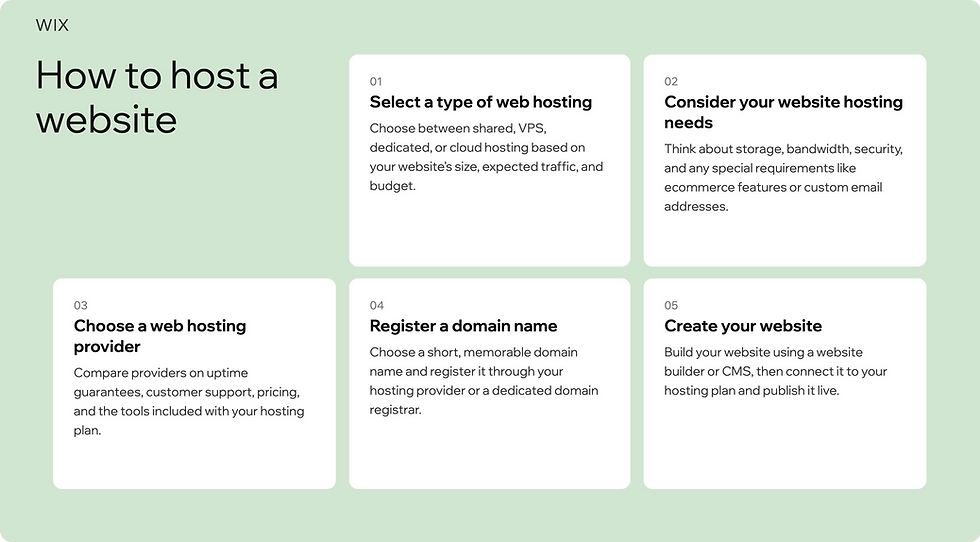
01. Select a type of web hosting
There are six main types of web hosting and based on the type of website you plan to create, you need to decide which is best for you.
Shared hosting: allows website owners to share a server with others to minimize operational costs. You can think of shared hosting as an apartment building where all tenants share a single structure–each user can easily manage their site through their own separate account, but cannot access advanced controls. The main benefit of shared hosting is the low cost but multiple users can create issues with performance and site reliability especially for high traffic sites.
Dedicated hosting: provides a single user an entire server. In real estate terms, dedicated hosting is like a house where the owner controls every aspect of the space. Large companies often choose this web hosting type because it allows for maximum customization, flexibility, and security. It is also the most complex and expensive type of web hosting.
VPS (virtual private server) hosting: divides a server into independently functioning virtual compartments. Each website is stored in one of these compartments, providing owners with a middle-ground between shared and dedicated hosting in terms of pricing and management capabilities. If shared hosting is an apartment building, VPS hosting is a townhouse with spaces divided into separate, functional units.
Colocation: provides a business its own dedicated server to support its website and stores it in a data center among other businesses’ servers. Large enterprises primarily use this hosting type. This allows them more control over the management and security of their hosting.
Cloud hosting: provides your website its own dedicated resources on a network of multiple servers, rather than on a single one. This fast-growing type of hosting makes it possible to access all your website data from anywhere. Cloud hosting offers website owners improved performance and security at an accessible price point. With approximately 200+ million active websites online, cloud hosting has become increasingly advantageous for its scalability, security, speed and accessibility.
Multi-cloud hosting: simultaneously hosts websites on multiple networks. If a network goes down, it will automatically redirect all of the websites it hosts to another hosting network. This greatly reduces the chance of a website being down due to network issues because a backup host is always in place.
Home servers: hosting a website from your own home server can be an ideal option for people who need more control over how their websites are managed. Using a home server allows you to customize how your site is hosted, what software and hardware it uses, how secure the hosting environment is, and how reliable the uptime is. This can be a complicated option if you're not sure exactly how it works, or how to handle troubleshooting.
Managed hosting is a service where the hosting provider handles all the technical aspects of your server, including updates, backups, monitoring and security. It’s like having a property manager for your website, so you can focus on your business instead of server maintenance. This option is great for those who want the benefits of dedicated or VPS hosting without needing technical expertise. While it’s typically more expensive, the convenience and reliability make it a smart choice for growing websites that need consistent performance and support. Tip: Wix uses two of the biggest networks on the planet, Google Cloud Hosting and Amazon Web Services (AWS), to protect user sites via multi-cloud hosting. In case these networks ever go down, Wix also uses its own disaster servers to ensure that all sites continue functioning even if network interruptions occur.
For a more in-depth look at cloud hosting vs. shared hosting, check out our guide.

Learn more: is it worth hosting your own website?
02. Consider your website hosting needs
If you already worked out how to make a website, your website needs and function is a huge determining factor when it comes to choose the type of hosting you need, and your hosting provider. Consider how much traffic your site will receive in a given time period, will there be times when you might expect sudden increases in traffic. This is of specific concern for eCommerce hosting websites who handle large amounts of seasonal and holiday traffic.
You'll also need to take into account your need for reliability. Not just during times of traffic surges, but if servers go down does your hosting option and provider, step in with backup options? Will you accept payments on your site, and if you will how will you ensure your hosting choice protects your customers sensitive details.
There's also the issue of your budget. It use to be that the safest hosting options, cloud hosting for example, were expensive and inaccessible. This is no longer the case and everyone can have access to reliable and safe hosting, often for free.
When hosting a website, it's also important to consider how your web host will handle issues such as backup and recovery of data, user authentication and authorization, website performance optimization and how user data such as passwords is stored and secured.
Uptime: the amount of time a web hosting service is available to users over a given period, or how long the websites stored on a server or network are up and running.
Bandwidth: the amount of data your website can transfer to visitors over time. You can calculate your website’s bandwidth needs based on your expected traffic volume and your average page size.
Security: how hard it is to harm your site. Websites can be attached through their servers, some of the more popular include DOS and phishing attacks. These can lead your site vulnerable to data breaches and theft which can put your business, and your online customers at risk.
Without diving into technical details, here are a few specs you should take into account before you decide on a web hosting provider:
Software: Apache, Nginx, IIS
Hardware: CPU, RAM, storage capacity
Cybersecurity: firewall protection, encryption
Server configuration: database settings, software version
Uptime reliability
Customer care availability
Since web host service providers provide quite similar technical specifications, you can use these additional features as a tie-breaker:
Free website: Take advantage of a web host provider that also provides a complete website building platform.
Custom email addresses: Align your branding strategy with a custom email address featuring your business name.
Online scheduling software: Allow your clients to book appointments or services with you and manage your own calendar, all in one place.
Advanced SEO features: Use professional SEO tips and protocol to boost your website’s Google ranking.
Customer support: Whether through an online help center, phone calls, or social media responses, reach your hosting service quickly in case of emergency.
SSL certificate and HTTPS: Both are essential security measures taken by your hosting provider to ensure the security of your site. HTTPs allows your site to communicate securely with your server and also shows your site visitors they can trust your site with their personal and payment details.
03. Choose a web hosting provider
Your web hosting provider allows you to store all of your website data and deliver it to your visitors. So how do you choose the best web hosting provider?
Once you’ve identified your website needs, look for a host that meets them. For example, if you own an eCommerce photography website, you’ll need a host that guarantees enough storage to upload all your image files.
Tip: Wix automatically provides users with 500MB of free cloud storage, but you can upgrade to a premium plan for anywhere from 2GB up to unlimited storage as your online storage needs grow.
Wix offers secure, scalable web hosting built in when you create your website.
Security is obviously another paramount feature for eCommerce sites, as they need to protect private customer data. Cyber attacks are on the rise, and you want to choose an experienced hosting provider that adheres to international standards with a comprehensive understanding of cybersecurity basics, like Wix. Wix offers fully managed web hosting for a hassle-free experience.
SSL certificates and website security
An SSL certificate encrypts the connection between your site and your visitors, protects sensitive data, builds trust and is a confirmed ranking signal for Google. You can recognise an SSL-secured site by the padlock icon in the browser and the https:// prefix in the address bar.
Most reputable hosting providers include a free SSL certificate with every plan. With Wix, SSL is automatically enabled for every site, so there is no need to install, configure or renew it manually. This means your site is secure from day one without any extra steps on your part.
Lastly, choose a provider that offers flexible plans that you can upgrade or cancel at any time. This gives you the freedom to make adjustments as you see fit.

04. Register a domain name
A custom domain name conveys professionalism as well as makes your site more distinctive, easy-to-find and search engine optimized. Most website hosting platforms offer domain registrars so you can easily create your domain name and purchase a host in the same place.
Tip: With Wix, users get a free domain for the first year, meaning you won't need to worry about domain name costs up front.
Connecting your domain to your host
Once you have registered your domain, you need to point it to your hosting provider through the Domain Name System (DNS). This is done by updating your domain's nameservers, which are the addresses that tell browsers where to find your site's files on a server.
Your hosting provider will supply at least two nameserver addresses, which you update in your domain registrar's dashboard under DNS settings. Once saved, changes can take anywhere from a few minutes to 48 hours to propagate fully across the internet, which is entirely normal.
With Wix, if you register your domain through Wix, this step is handled automatically. Your domain is connected to Wix hosting instantly, with no DNS configuration required on your end.
To select a URL, consider simple keywords or phrases that best describe your site. If creating a business website, simply use your business name as your domain. If someone has already claimed that domain name, add your business city or state to differentiate it. Take a look at this step-by-step guide on how to choose a domain name that represents professionalism, searchability and brand value.
"Forgetting the basics, like checking if the matching social handles are available or neglecting maintenance — like renewing your domain, getting privacy protection or making sure you, not an agency you hired, actually own the domain."
Learn more about what a domain name is.
05. Create your website
Once you've chosen your web hosting provider and purchased a domain name, it's time to create your website.
Start by choosing a website builder, like Wix that fits your technical skills and website requirements. For an easy and user-friendly experience, Wix offers intuitive design options and hundreds of website templates. Design your site by selecting a template that reflects your brand’s style and has mobile compatibility for wider reach.
Wix's AI website builder makes this even faster: answer a few questions about your site and it generates a fully designed, hosted website in minutes, with no technical setup required.
Then create engaging content to clearly convey your message and captivate your audience. Add essential features like contact forms, galleries or eCommerce capabilities based on your goals.
Test your website thoroughly before launching to ensure all features work smoothly and provide a seamless user experience from the start.
Why do you need web hosting?
You need web hosting because it's the space on a server where your website's files are stored. When someone visits your website, their computer sends a request to the server where your website is hosted. The server then sends the website's files back to the computer, and the website is displayed.
Without web hosting, your website would not be accessible on the internet. Wix provides resilient web hosting with 99.99% uptime so your site will stay up no matter what, even during traffic spikes.

Here are some of the benefits of using web hosting:
Reliability: Web hosting providers typically have high-uptime servers, which means that your website will be up and running most of the time.
Security: Web hosts usually offer security measures to protect your website from hackers and other threats.
Performance: Web hosting providers often optimize their servers for website performance, which means that your website will load quickly for visitors.
Support: Web hosts typically offer support to help you with any problems you have with your website or web hosting account.
What you need to host a website
To host your website, you'll need a few essential things:
Domain name: This is your website's address on the internet. Choose something memorable, relevant to your website's purpose and ideally, easy to spell and type.
"The main thing to consider when choosing a domain is finding one that aligns with your brand and is easy for your customers to remember. It's important to have a domain that reflects your business and makes it easy for people to find you online."
Einat Shafir, Product Manager Domains at Wix.com
Web hosting: A web hosting service provides the storage space and computing power to run your website and make it accessible to everyone on the internet. Choose a reliable host with good uptime and customer support.
Website content: Craft engaging web content that resonates with your target audience and keeps them coming back for more. It could be informative blog posts, eye-catching product pages or a portfolio of your stunning artwork.
Website design: Choose a website design that aligns with your brand and content, prioritizing user-friendliness and intuitive navigation.
Tips for choosing a web host
In addition to technical factors like uptime, speed, security and support, there are other considerations when choosing a web host. Here are a few tips to help you:
Consider your website needs: What kind of website do you have? How much traffic do you expect? What features do you need? For example, if you have a simple blog, you may not need a lot of storage space or bandwidth. But if you have a large eCommerce site, you'll need a web host that can handle a lot of traffic and transactions.
Compare prices: Web hosting prices vary depending on the features and resources that you need. Be sure to compare prices from different providers before you choose a plan. With a Wix website web hosting is always included for free.
Read customer reviews: Read reviews of different web hosting providers to see what other customers have to say about their service. This can help you identify potential problems with different providers. From these reviews, choose a web host that has a good reputation for customer service and support. This is important because you may need help from your web host from time to time.
Evaluate customer support: When hosting a website, having reliable customer support can make a substantial difference in your overall experience. Check if the hosting provider offers 24/7 support through various channels like live chat, email or phone. Quick and effective help is essential, especially during technical difficulties that could affect your website's performance or accessibility.
Check for scalability options: As your website grows, your hosting needs may change. Opt for a provider that offers scalable solutions, allowing you to upgrade your hosting plan seamlessly as your site’s traffic and storage demands increase. This flexibility ensures your website can handle growth without experiencing downtime or performance issues. Or choose from the start web hosting, like with Wix that can handle your website and its traffic, as it scales.
Maintaining your hosted website
Hosting your site is the beginning of the process, not the end. Once you are live, a few ongoing habits will keep your site fast, secure and always accessible to your visitors.
Regular backups are your safety net against bad updates, security incidents or accidental deletions. Look for a host that runs automatic backups on a regular schedule and stores multiple recent versions so you can restore quickly. Wix keeps automatic backups of every published site, accessible directly from your dashboard.
Security updates matter because threats evolve constantly. Make sure your hosting provider handles security patches and software updates automatically, so vulnerabilities are addressed before they can be exploited.
Performance monitoring is worth doing on a regular basis. Tools like Google PageSpeed Insights flag slow-loading pages and suggest fixes, helping you catch issues early and keep the user experience strong.
Keeping track of when your domain and any paid hosting plan renew is also important, as an expired account can cause unexpected downtime that is easy to avoid with a simple reminder.
How to host a website FAQ
Can I host a website myself?
Yes, but it’s not recommended for beginners. Self-hosting requires technical knowledge, including setting up a server, installing software and managing a domain and hosting plan. If you’re inexperienced, using a web hosting service like Wix is a simpler, safer option.
How do I transfer a domain name?
To transfer a domain name, you will need to contact the current registrar of the domain name and request a transfer. The registrar will then send you a transfer authorization code (TAC). You will need to provide this TAC to the new registrar when you sign up for a hosting plan. The transfer process can take up to 5 days to complete. Once the transfer is complete, your domain name will be pointed to your new hosting provider.
What's the easiest way to host a website?
The easiest way to host a website is to choose a website builder, like Wix, where hosting is included when you commit to a premium package.
Can I host a website for free?
With a website builder like Wix you can host a website for free as part of one of its free or paid plans.
Do I need managed or unmanaged hosting?
The choice depends on your technical skills, time, budget and how much control you want over your website. Managed hosting is ideal for most users, as it handles updates, backups, security and performance for you. Wix offers managed hosting that covers all these needs, making it easier to focus on your website rather than server maintenance. Unmanaged hosting is only recommended if you have the experience and time to manage your own server.
How does hosting affect website speed?
Website speed is heavily influenced by your hosting setup, including server response time, hardware quality, location and bandwidth. Features like caching, CDNs, server-side optimizations and SSD storage can further improve performance. Shared hosting may slow your site during peak traffic while managed performance-optimized hosting ensures faster more reliable load times. Choosing secure high-quality hosting is key to keeping your website responsive and efficient.
What is a headless content management system?
Read more about Wix Headless:


