Updated: Aug 2
Ready to let your work shine? Build your portfolio →

An interview portfolio provides tangible proof of your skills and bridges the gap between your resume and a job offer, which is why learning how to make an interview portfolio is so valuable for job seekers.
While a resume tells a potential employer what you did, an online portfolio demonstrates exactly how you did it. This visual aid allows you to control the narrative of the interview and focus the conversation on your strongest achievements.
Building a collection of your work might seem like a big task, but it helps you distinguish yourself from other candidates who only bring a resume to the table. This guide breaks down how to make a portfolio into manageable steps with real-world portfolio examples so you can walk into your next interview with confidence.
With Wix’s portfolio builder, you can create a professional, eye-catching portfolio in just a few clicks. Customizable templates and intuitive tools make it easy to showcase your work with confidence, leaving a lasting impression on every visitor.
TL;DR: how to make an interview portfolio
An interview portfolio is like a visual resume. It’s a great way to show off your skills, experience and achievements in a clear and professional way.
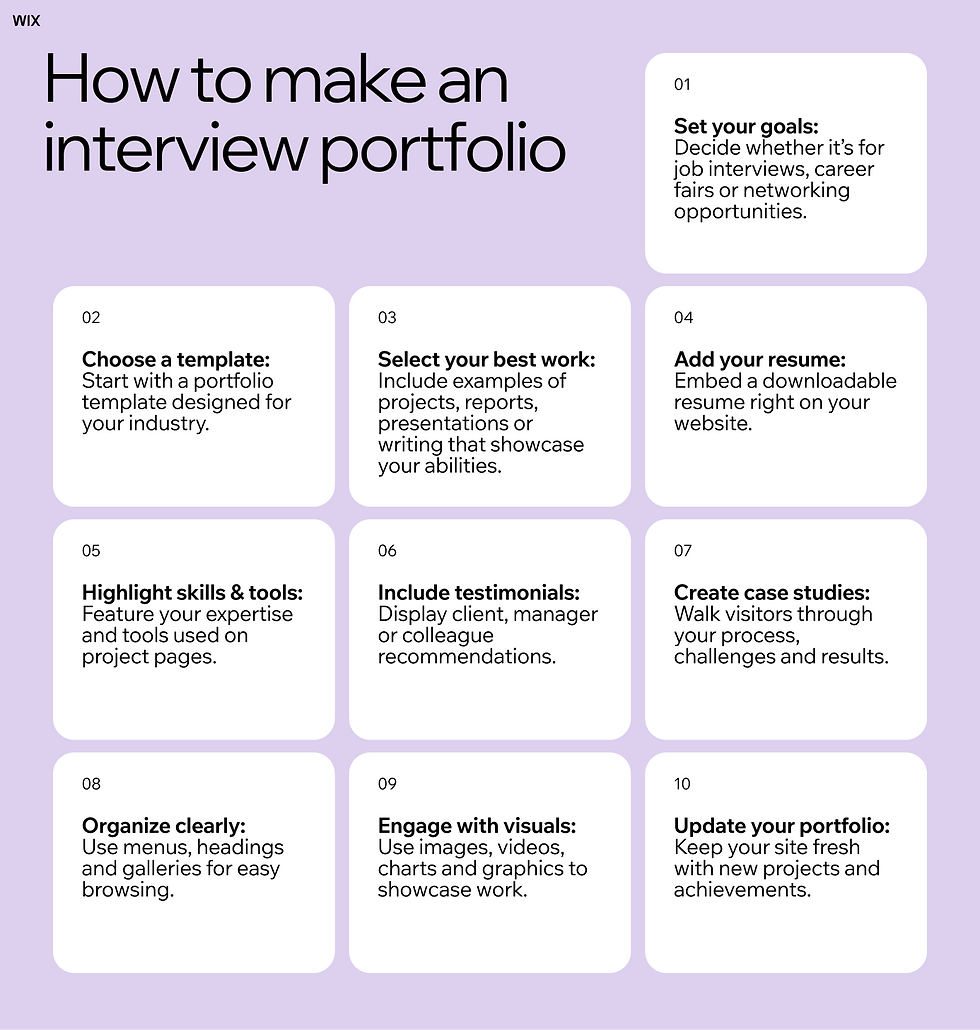
Start by picking your best work and decide on a format that works for you. You could build a website for a digital portfolio, create a slide deck or even use a simple binder. Organize it so it tells your story and demonstrates the value you bring.
Make sure it’s easy to navigate, double-check everything for accuracy and keep it updated as you grow in your career. A polished portfolio can help you stand out and show recruiters why you’re the right person for the job.
Features of a great interview portfolio
Feature of a great interview portfolio | Why its important |
High-quality work samples | Demonstrates your skills, experience and impact with concrete examples that prove you can deliver results |
Clear narrative | Helps interviewers understand your career journey and see how your skills match the role |
Professional design and format | Creates a strong first impression and makes your portfolio easy to navigate and visually appealing |
Easy contact options | Ensures recruiters can quickly reach you increasing the chance of follow-up opportunities |
Up-to-date content | Shows growth and keeps your portfolio relevant reflecting your latest achievements and skills |
Learn more:
How to make an interview portfolio in 8 steps
01. Choose a format
First, decide how you’ll present your work. A digital portfolio, like a website, is the most popular choice. It’s versatile, easy to share with a link before an interview and can be viewed from anywhere. This is a must-have for remote interviews or creative fields where you want to show off your digital projects.
You could also create a presentation deck. You can save it as a PDF and send it over, or present it live during a video call. For in-person interviews, a physical binder with high-quality prints can leave a lasting impression, especially in more traditional industries.
02. Select your best work
This is your chance to shine, so think quality over quantity. Pick 3–5 projects that really show off your skills and are relevant to the job you want. The goal is to prove you're the right person for this role, not just list what you did in your last one.
For each project, tell a story using the STAR method:
Situation: What was the challenge?
Task: What was your goal?
Action: What steps did you take to reach it?
Result: What was the outcome? Use numbers like sales figures or engagement metrics to show your impact.
To make your portfolio even more compelling, add a short bio and share what you hope to achieve in the next few years. You can also include a visual timeline of your career, along with any certifications, awards or great feedback from past managers.

Explore these portfolio name ideas.
03. Pick a domain and website host
If you choose a digital format, you need a place for it to live online. Your domain name is your address on the internet. It should be professional and easy to remember. Using your full name is usually the best choice. Use a domain name search tool to check availability, or try a domain name generator for creative ideas if your first choice isn’t available.
Once you have a name in mind, you need a website host. Hosting ensures your site is visible on the web. Some website builders even include free website hosting, which simplifies the process. Secure a domain that looks clean and credible to recruiters.

04. Choose a website builder and template
You don't need to be a designer to learn how to open a website. Wix gives you the tools to make a portfolio website, fast. You can choose from 2,000+ website design templates designed specifically for portfolios, saving you hours of work.
Wix simplifies your portfolio website setup with drag-and-drop features. This allows you to customize the look and feel to match your personal brand without touching a line of code. Pick a template that is clean, professional and puts your work front and center.
Check out Wix's templates:
Discover the best portfolio website builders to get started on your journey.
05. Build a narrative
Your portfolio should tell a story. Look at the job description and pick work samples that show you have the skills the employer is looking for. You want them to see you as the perfect person for the job.
For each sample, walk them through your creative process. Don't just show the final product. Explain the "why" and "how" behind your work. For an extra touch, consider adding a 30-60-90 day plan. This is where you can outline your goals and how you'll contribute during your first three months.
Expert tip from Doreen Weissfelner, head of Wix analytics and home:
“Your portfolio is your chance to direct the narrative. Decide what story you want to tell and build everything else around that.”
06. Make yourself easy to contact
Recruiters need a clear way to reach you. Include a dedicated contact page or place your details in the footer of every page. Include your professional email address and a link to your LinkedIn profile.
You might also consider adding a contact form. This protects your email address from spam while giving visitors a direct line to your inbox. Make sure every link works and leads exactly where it should. If you use scheduling software for calls, embed that link directly on your contact page.
07. Review your interview portfolio
Before you send your link or print your pages, double-check everything. A manageable interview portfolio is typically 5–10 pages or 10–12 slides. If it's too long, the interviewer might lose interest.
Test functionality on different devices and check all digital links. Make sure your website is mobile-friendly too, as most people browse on their phones. A good website builder with built-in SEO features can handle much of this for you, while also improving your website performance to keep visitors engaged.
If using a physical portfolio, use high-quality copies rather than originals. You may want to leave it with the interviewer, and you won't want to lose your only copy.
08. Keep your interview portfolio updated
Your career is always growing and your portfolio should grow with it. Make it a habit to update your site or portfolio every few months. Add your latest projects, new skills or recent wins. It’s easier to do it little by little than all at once.
Keeping your portfolio fresh means you’re always ready for new opportunities. Plus, it’s a great way to see how much you’ve grown over time. Think of it as a work in progress, not something you finish and forget about.
What to include in an interview portfolio
Your portfolio should show off both your personality and your professional achievements. Make sure to include these sections to give interviewers a full picture of what you bring to the table.
Introduction
Start with a short bio about who you are and your career goals. Explain what makes you a great fit for the role or industry you're applying for.
Resume
Add an updated resume that’s tailored to the job. It should be the same one you sent in with your application so your interviewer can easily follow along.
Professional summary/timeline
A visual timeline of your education, training and career path is a great way to show your journey. It’s much easier to scan than a long paragraph and helps the interviewer quickly grasp your experience.
Work samples/case studies
This is where you let your work shine. For each project, describe your role, the problem you solved, the skills you applied and the outcome. Use numbers and data to show the impact you made.
Skills and accomplishments
Show off your skills, like leadership or writing, with real examples. Include copies of any licenses, certifications, awards or positive reviews you’ve received.
References/recommendations
Add letters of recommendation or testimonials from past employers or clients. You can also include a list of professional references with their contact information.
Closing page
End with a concluding thought. It's also a good idea to list a few questions for the interviewer to show you’re engaged and curious about the role.
Interview portfolio examples built on Wix
Each of these web design portfolio examples uses Wix to showcase your skills, highlight your achievements and present your experience in a clear, professional and visually engaging way.
01. Christina Sterbenz

From the moment you land on Christina Sterbenz’s interview portfolio, her writing skills are immediately clear. The design is clean and minimal, allowing her copy and experience to take center stage while still showing personality. Thoughtful layout choices and subtle interactions help guide interviewers through her work without distraction.
Her resume section is concise and well structured, highlighting the most relevant parts of her background at a glance.
Like what you see? Build your own interview portfolio using this same template.

Template name: Creative CV website template
02. Lauryn Higgins

Lauryn Higgins' portfolio immediately establishes credibility, highlighting her experience as a Pulitzer Prize–winning journalist who has contributed to major publications and covered global events. Her website pairs concise, well-crafted writing with a clean layout, making it easy for interviewers to quickly grasp the scope and impact of her work.
Logos from outlets like PBS, The New York Times and Vogue link directly to her published articles, offering clear proof of experience. Thoughtful typography and a professional contact setup reinforce her expertise and make her portfolio a strong reference for employers evaluating her qualifications.
Like what you see? Build your own interview portfolio using this same template.

Template name: Food photographer website template
Editor’s note: Don’t worry about the template’s original niche. Wix templates are fully customizable, so choose a design that feels right and adapt it to your brand. They're easily customizable for all portfolio websites.
03. Dylan Wirth

Dylan Wirth’s portfolio is clear and professional, making it easy for recruiters to understand his background and strengths. He presents his education, work experience and skills in a structured way that supports quick evaluation during an interview. Subtle personal details add personality without distracting from his qualifications. A clean design downloadable resume and testimonials help reinforce credibility and make follow-up simple.
Like what you see? Build your own interview portfolio using this same template.

Template name: Business CV website template
04. Toni Bonini

Toni Bonini’s portfolio immediately showcases her creative talents through a vibrant well-designed homepage that draws attention to her work. The colorful visuals and thoughtful layout guide visitors through her projects without overwhelming them, making it easy for interviewers to grasp her skills and style at a glance.
Like what you see? Build your own interview portfolio using this same template.

Template name: Illustrator website template
05. Anissa Hexton

Anissa Hexton's online CV showcases her decade of experience in marketing and branding with a clean friendly design. The homepage introduces her with a professional headshot and a warm welcome while simple buttons guide visitors to her resume, projects and background.
A personable introduction makes the site feel professional yet approachable. Clear call-to-action buttons direct visitors to her work and multiple contact options (phone, email, LinkedIn) make networking easy.
Like what you see? Build your own interview portfolio using this same template.
Template name: Business CV website template
Why you need an interview portfolio

An interview portfolio helps you show your skills and achievements instead of just talking about them. As Chava Katz, PMM @ Wix Pages at Wix says:
“Your portfolio is your visual resume, it speaks before you do. It’s how clients, employers or collaborators understand what makes your work special. The stronger the story it tells, the more doors it opens.”
Learn more:
How to make an interview portfolio FAQ
How do I create an interview portfolio with no experience?
Focus on potential rather than professional history. Include projects from your coursework, volunteer activities or internships. You can also create mock projects that solve real-world problems to demonstrate your skills. Treat these exactly like paying jobs in how you present them.
How to create a portfolio for interviewing when you're still employed?
Privacy is important here. If creating a website, password protect specific pages or the entire site. Only share the password with recruiters. Remove sensitive company data from your samples or anonymize the information to protect your current employer's confidentiality.
What format to use to present your portfolio during an interview?
The format depends on the interview setting. For virtual interviews, a website or digital slide deck is best. For in-person meetings, bringing a tablet to scroll through your site or a printed physical binder works well. Always have a backup plan in case technology fails.
How do you present your portfolio in an interview?
Don't just hand it over or send a link without context. Use it as a visual aid to support your answers. When asked about a specific skill, turn to the relevant page or slide and walk the interviewer through the project. This makes your answer more concrete and memorable.


