The perfect domain is just a click away: find your domain name →

Your domain name is the web address customers use to find your construction business, so the name you choose matters. A strong construction domain should be easy to spell, easy to remember and closely connected to your company or services.
Explore construction domain name ideas, learn how to choose the right extension and see what to check before completing your domain registration.
Secure your perfect domain in just a few clicks with Wix. Get everything you need in one place: business email, reliable hosting, SSL protection and full privacy. With 24/7 support and no hidden fees, getting your site live is simple and worry-free.
TL;DR: construction domain names
For most construction companies, a short .com that matches the business name is the safest pick. If it's taken, extensions like .construction, .contractors, .builders and .build put your trade right in the address, though they usually cost more to renew than a .com.
You'll learn:
How to pick a construction domain name that's easy to say, spell and remember
Which domain extensions suit general contractors, home builders and specialty trades
Domain name ideas for different types of construction businesses
What to do when the .com you want is already taken
How much a construction domain should cost, including renewals
How domain extensions relate to SEO and local search
How to register your domain and set up a matching business email

Why construction companies need a custom domain
Your domain shows up in far more places than your website. It goes on truck wraps, yard signs, hard hats, bid packages, invoices and the email address clients reply to when they approve a change order. A custom domain turns all of those into one consistent address that points back to your company.
Credibility matters when a homeowner is comparing three quotes for the same job. 46% of small businesses report that having a custom domain (rather than a subdomain or free site URL) directly increases credibility with their customers, according to Wix domain name statistics research. That research covers small businesses in general, but the same logic applies when a client is deciding which contractor looks established enough to trust with their home.
A free subdomain is fine while you're still building your site, but it's a hard sell on a large remodel bid. Registering your own domain early also means your website, email and printed materials can all use the same name from day one.
Worth knowing: register your domain before you order truck lettering, signs or printed estimates. Changing your address later means paying to reprint everything that carries it, and old materials keep sending people to the wrong place for years.
Read more:

What makes a good construction domain name
A good construction domain passes three quick tests. Can a customer spell it after hearing it once on the phone? Can a driver read it on the side of your truck at a stoplight? Does it sound like your company and nobody else's?
Short and simple beats clever. Skip hyphens and numbers, which get lost the moment a domain is said out loud, and avoid creative spellings that people will type the normal way. If your company name is long, use the shortest version clients already call you.
Expert tip from Keren Friedlander, Product Manager at Wix:
"There are three WIN Pillars for choosing a great domain name. 1) Words: Keep it short and easy to spell, 2) Identity: Make sure it's relevant to your business and 3) Name: Ensure it's unique and distinguishable. Avoid numbers and hyphens as they can complicate the domain."
Keep the domain close to the name on your license and insurance paperwork too. When a client looks you up after getting a quote, a match between the bid, the website and the email address tells them they've found the right company.
One thing worth knowing: say the domain out loud next to your phone number, the way it'll appear on a sign. Names that look fine on a screen can run together on a truck door, so check how yours reads in large print and at a distance before you commit.
When you upgrade to a premium plan, you’ll even get a voucher for a free domain name for your first year.
The best domain extensions for construction companies
Your domain extension is the part after the dot, and for a construction company it can do some real work. A trade-specific ending tells people what you do before they open your site, while a familiar one like .com keeps the address easy to remember. Here are 10 domain extensions worth considering.
01. .com
The default choice for most construction companies, especially if your business name is available as a short .com. Customers type it out of habit, which matters when they heard your name from a neighbor or spotted it on a job site sign.
In the US, 82% of Wix sites use a .com domain extension, according to Wix's 2026 domain data. That familiarity is the upside. The catch is availability, since many short construction names on .com were registered years ago.
If the exact .com is gone, don't change your company name just to force a match. Check the same name on a trade extension first, then see if a small .com variation still reads naturally.
Read more:
02. .construction
.construction says exactly what you do, which makes it a strong fit for general contractors and construction management firms. A name like harlanbuilt.construction tells a client or project owner your trade at a glance, even if your company name doesn't.
It's also more likely to be available than the same name on .com, so you can often get your exact company name without adding extra words. Check the renewal price before you commit, because trade extensions usually cost more each year than a .com.
03. .contractors
.contractors suits licensed contractors and subcontractors who want the address to match how clients describe them. It works well for trade businesses like concrete, framing or drywall crews, where the company name alone might not explain the service.
The extension is on the longer side, so pair it with a short company name. A name like smithconcrete.contractors is easy to read, while a long multi-word name plus .contractors gets hard to fit on a truck door.
04. .builders
.builders fits home builders, custom builders and remodelers who already call themselves builders. It reads naturally after a family name or brand, like oakridge.builders, and signals residential work to homeowners looking for someone to build or renovate.
Because it describes people rather than projects, it also works well for small, owner-led crews where the team is part of the pitch.
05. .build
.build is shorter and a little more modern than .builders, which makes it a good match for design-build firms, developers and companies with a brand-forward name. It also works as a verb, so playful names like letsget.build are possible.
It's less specific than .construction, so make sure your company name or homepage explains what kind of building you do.
06. .pro
.pro puts the focus on professional services rather than one trade. It's a short, practical option for contractors who offer several services, such as remodeling, repairs and project management, and don't want the domain tied to just one.
It's also more affordable than the trade-specific extensions above. The tradeoff is that .pro doesn't say what field you're in, so the name in front of the dot needs to do that work.

07. .house
.house is a natural fit for residential builders, remodelers and renovation companies whose work centers on homes. A domain like brightline.house instantly connects your brand to the type of projects you take on.
It's narrower than a general extension. If you also do commercial work, a broader extension like .construction may describe your business more accurately.
08. .repair
.repair works for handyman services, home repair companies and specialty trades that focus on fixes rather than new builds. It's clear, easy to say on the phone and pairs well with a service in the name, like fastroof.repair.
It's less suited to general contractors or builders whose main work is new construction, since it signals smaller, service-based jobs.
09. .services
.services is a broad option for companies offering several construction services under one brand, from site prep and excavation to finish work. It reads clearly in an email signature and leaves room to add services later.
It's a longer ending, so it works best with a short, distinctive company name.
10. .co
.co is short, easy to type and reads like a company abbreviation, which makes it a popular backup when the .com is taken. A domain like summitbuild.co keeps your exact name and stays compact on signs and business cards.
The main risk is that some people may type .com by habit. If you go with .co and the matching .com is available, register both and redirect the .com to your site.
Worth knowing: a trade-specific extension is a strong pick when you want people to see what you do at a glance, but it doesn't replace a clear company name. The extension supports the name in front of the dot, so start with a name that works on its own and then add the extension that fits your trade best.

Construction domain name ideas by business type
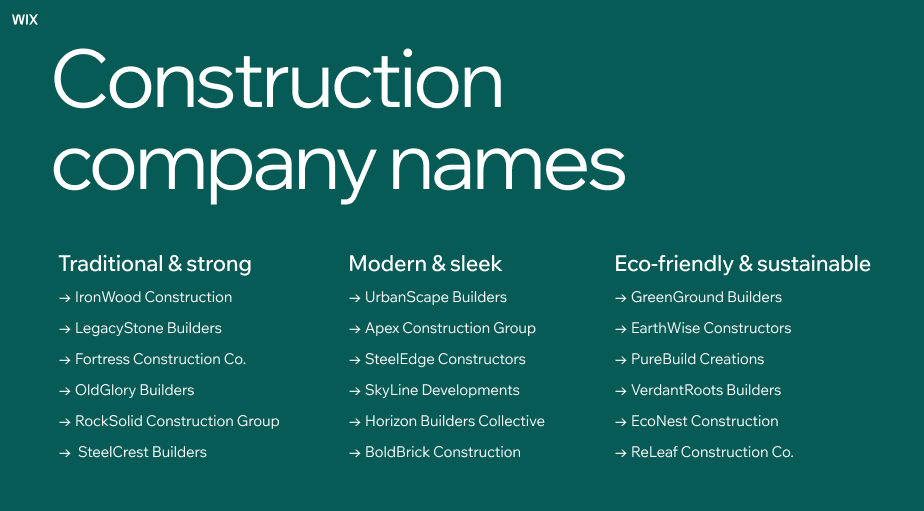
The right domain depends on the kind of work you do and the clients you want more of. Here are naming patterns that work for different construction businesses, with examples you can adapt.
General contractors
General contractors usually do best with a domain based on the company name, since clients hire the company rather than one service. Patterns like [surname]construction.com, [brand]build.com or [brand].construction keep things clear and professional.
If you work across residential and commercial projects, avoid narrowing the domain to one of them. A neutral company-name domain leaves room for whatever jobs come next.
Home builders and remodelers
Homeowners respond to warmth and craftsmanship, so domains with words like homes, build or craft work well here. A custom home builder might use [name]homes.com or [name].builders, while a remodeler could try [name]remodeling.com or [name].house.
If you specialize in kitchens, baths or additions, keep the specialty in your homepage copy rather than the domain unless it's your only service. That way the domain still fits when you add new services.
Specialty trades
Roofers, electricians, plumbers and HVAC companies benefit most from a keyword in the domain, since customers often search by service. Patterns like [name]roofing.com, [name]electric.pro or [name].repair tell people exactly who to call.
Keep it to one service if you can. A domain that lists roofing, siding and gutters gets long fast, and you can cover the rest on your service pages.
Commercial builders
Commercial clients and project owners expect a polished, corporate feel. A short brand name on .com or .construction, or an abbreviation like [initials]builders.com, reads well in bid documents and proposal responses.
Avoid anything too casual here. Developers and facility managers are often comparing several bidders, and a clean domain helps you look established.
Design-build firms
Design-build firms sit between architecture and construction, so .build is a strong fit. A name like [studio].build or [name]designbuild.com signals that you handle a project from drawings to handover.
If you lead with design, look at extensions that lean creative. If you lead with construction, keep build or construction in the domain.
One thing worth knowing: avoid putting a single neighborhood, product or crew size in your domain unless you're sure it'll stay true. A domain built around decks or one suburb can feel too narrow once you start taking on additions or work across the county.
Use a domain name generator if you need help. Already have an idea? Check availability with a domain name search tool.

What to do when your .com is taken
It's common to find the .com version of your company name already registered. Before you settle for a hyphenated or awkward version, work through these options in order.
Use the same name on a trade extension. A domain like yourname.construction or yourname.contractors keeps your exact brand intact.
Add a trade or service word. Adding build, builders, construction or roofing to your name often turns up an available .com.
Add your city or region. A location can help if you only plan to serve one area.
Try a short alternative like .co. It's compact and reads like a company abbreviation.
Ask about buying the taken name. If the domain isn't in use, the owner may be open to selling it.
Expert tip from Ofir Gvili, Domains Product Marketing Manager at Wix:
"Adding a clear keyword to your domain can be a smart move. It signals what your site is about, makes you easier to find in search and gives visitors instant clarity about your purpose."
A good search tool can check your name across many extensions at once and suggest close alternatives, which saves you guessing one combination at a time.
If you buy a previously registered domain, check its history first. A name that once hosted spam or unrelated content can carry baggage, so look at what the domain was used for before and run a whois lookup to see who owns it.

How much should a construction company spend on a domain
For most construction companies, a domain is a relatively small yearly business expense. As of October 2026, Wix lists first-year prices from $7.90 for a .com to $40.90 for .construction and $53.99 for .contractors.
The renewal price matters more than the first-year offer. Some extensions have lower introductory prices that increase when the domain renews, so check the ongoing cost before putting your domain on trucks, signs, business cards and job site banners.
Paying more can make sense for a short, exact-match name you'll use for decades. Premium domains sold by their current owners can cost hundreds or thousands of dollars, which is rarely worth it for a new company when a clear, professional name is available at standard domain pricing.
One thing worth knowing: you can get a free domain for one year with select annual Wix plans. If you're building your website at the same time, timing the two together removes the first-year cost.

Do domain extensions affect SEO for construction websites?
Not directly. Google treats extensions like .construction and .contractors the same as .com, so the ending alone won't help or hurt your rankings. What matters is the quality and relevance of your website content.
The indirect effects are real, though. A domain that's easy to remember gets typed directly and shared accurately, and a domain that matches your company name makes your search result easy to recognize. For local construction businesses, your Google Business Profile, service area pages and reviews do far more for local rankings than the domain itself.
Putting your city in the domain won't guarantee local rankings either. Mention your service area clearly on your site and keep your business name, address and phone number consistent across directories.
One thing worth knowing: SEO results from a new site typically take weeks to months to compound, regardless of how well-optimized the content is. The setup work pays off, just not immediately. Businesses that expect organic traffic in the first few days consistently underestimate this timeline.
Find out more: Domain SEO: how your domain name affects search rankings

How to register your construction domain with Wix
Wix is an ICANN-accredited domain registrar, so you can search, register and connect your domain without juggling separate services. With over 400 domain extensions to choose from, including every option on this list, you can find a name that fits your trade and manage it alongside your website and business email from one dashboard.
01. Search your shortlist
Run your company name through the domain search and compare it across several extensions at once. If your first choice is taken, Wix suggests available alternatives so you're not starting over.
02. Compare first-year and renewal prices
Check both numbers before you choose. Wix shows clear first-year and renewal pricing with no hidden costs, which makes it easier to budget for a domain you'll keep for years.
03. Register your domain
Complete registration with your company details. Available domains go to whoever registers first, so there's little reason to wait once you've decided.
04. Turn on privacy and security
Domains registered with Wix come with a free SSL certificate, and private registration keeps your personal details out of the public WHOIS database. That's especially useful if your business address is also your home address.
Learn more: What is an SSL certificate

05. Connect your site and business email
Connect the domain to your website and set up a business email on the same name, so estimates and invoices arrive from you@yourcompany.com instead of a generic inbox. Your domain, website, hosting and email all live in one dashboard, with 24/7 support if you need help along the way.
If your site is still on the to-do list, you can create a website on the same platform and connect the domain the moment it's ready.
Worth knowing: you don't need a finished website before you register. Many contractors lock in the domain while the business is still getting set up and connect it once the site is ready, which keeps the name safe in the meantime.
Found the perfect name for your business? Lock in your domain before someone else does.

Construction domain names FAQ:
Is a .construction domain good for my business?
Yes, if you want your trade in the address and the .com version of your name is taken or too long. It tells clients what you do at a glance and is often available with your exact company name. Just check the renewal price, since it usually costs more each year than a .com.
Should my domain match my business name?
Ideally, yes. A domain that matches your company name makes it easy for clients to find you after seeing your truck, sign or estimate, and it ties your website and email together. If the exact match isn't available, keep the core name and add a trade word or use a relevant extension.
Should I put my city in my domain?
Only if you plan to serve that area long term. A city name can help people recognize a local company, but it gets limiting if you expand into new markets. Many contractors keep the city in their website copy and service area pages instead.
Should I buy both the .com and a .construction domain?
It can be worth it. Owning both protects your name from copycats and catches people who type the wrong ending. Pick one as your main address and redirect the other to it so all your visitors land in one place.
Should a company with several locations use one domain or several?
In most cases, one domain is the better choice. A single domain with a separate page for each location keeps your brand consistent and concentrates your SEO efforts in one place. Separate domains make sense only if each location runs as its own brand.
Can I use my construction domain for a business email address?
Yes. Once you own a domain, you can set up a business email address like office@yourcompany.com. It looks more professional on bids and invoices than a free email account, and it reminds clients of your web address every time you send a message.


