Updated: 1 day ago
Get the perfect domain for your eCommerce store: find your domain→

The best eCommerce platform for multi-channel selling is the one where every channel reads from a single inventory record, so a sale anywhere updates availability everywhere. Platforms with native channel connections handle that sync themselves, which is where the time savings show up. Wix integrates eCommerce stores with Amazon, eBay and Google marketplaces. In this guide, you'll learn the five platform types that handle multi-channel selling, what each costs and where each breaks.
TL;DR: best eCommerce platform for multi-channel selling
For most sellers, the best eCommerce platform for multi-channel selling is an all-in-one platform with native channel integrations, because the sync runs where your stock already lives and there is no second system to maintain. That answer changes once marketplace listing volume, warehouse complexity or finance reporting becomes the dominant problem, and at that point a specialist layer earns its cost. The five types below map to those different breaking points.
Platform type | Best for | Main trade-off |
All-in-one eCommerce platform | Stores running their own site plus a few channels | Flat monthly cost, but strains on very large catalogs and unusual channel rules |
Channel manager or listing tool | Marketplace-heavy sellers with high listing volume | Strong at bulk listing, but you still need a separate system to run the store |
Inventory-first system | Sellers whose main risk is stock accuracy across locations | Stock stays reliable, but marketing and merchandising features are thin |
ERP-connected setup | Larger operations that need finance and stock governed together | Everything in one system, but implementation is a project and changes are slow |
Shipping and fulfillment layer | Sellers whose bottleneck is getting orders out the door | Cheapest fix for fulfillment, but it does not stop overselling or listing drift |
Ready to start selling online? Build a custom online store with Wix and get the tools to sell, manage and grow your business from one dashboard. Customize every detail, reach customers across channels and market your brand with built-in SEO and marketing tools.
What should you look for in a multi-channel selling platform?
Multi-channel selling asks three specific things of a platform, and one that handles two of them well will still cost you money on the third. Stock accuracy, listing flexibility and order consolidation are the three that everything else rests on. Pricing, fulfillment and returns all get harder the moment any one of them stops being reliable.
This is also where multi-channel and omnichannel part ways. Multi-channel is about selling in more places, while omnichannel retail is about making those places behave as one experience for the shopper. The platform requirements diverge enough that picking an eCommerce platform for omnichannel retail is a separate decision from this one. Wix supports omnichannel sales across online marketplaces and social platforms.

Inventory that stays in sync across every channel
The moment you list the same unit in two places, you are racing your own sync interval. A sale on one channel has to reduce availability everywhere else before the next shopper loads the page, and batch updates that run every few hours leave a window in which two channels can both sell the last unit. That window is as wide as the gap between syncs, which is why the interval matters more than the feature name. Some sellers work around this by splitting stock per channel and assigning a fixed number of units to each, which trades one problem for another. One channel sells out while the other sits on inventory you could have moved. Native channel connections help here because the sync runs inside the same system holding your stock rather than passing through a third layer that can fall behind.
Worth knowing: real-time sync is not one setting you turn on. Sync frequency varies by platform, by channel and by data type, and stock counts often move on a faster cycle than listing content, pricing and product data. Ask about each data type separately rather than accepting a single sync claim.
Listings that fit each channel's own rules
Every channel wants your product described its own way. Title length, category taxonomy, image dimensions, required attributes and what counts as a variant all differ, and a platform that pushes one identical listing everywhere will pick up rejections on some channels and poor visibility on others. The capability that matters is channel-specific overrides, where the product record stays single but each channel gets its own presentation layer.
This is also where listing volume starts to bite. Editing fifty products by hand across four channels is an afternoon. Editing five hundred is a job you will not do consistently, and that inconsistency is how listing drift begins.
Orders that land in one queue
Orders arriving in four dashboards is not four times the work. It is more, because the switching cost and the risk of missing one both grow with every channel you add. A single order queue with consistent statuses is what makes fulfillment predictable, and it is usually the first thing sellers notice when they finally consolidate.
The same applies to returns and customer messages. Both arrive per channel by default and both get slower the more places you have to check.
Which type of eCommerce platform is best for multi-channel selling?
For most sellers running their own site plus two or three channels, an all-in-one eCommerce platform is the best answer, because the integration lives where the stock already is. That stops being true once marketplace listing volume or warehouse complexity becomes the dominant problem, at which point a specialist layer earns its place. The five types below are not mutually exclusive and plenty of operations run two.
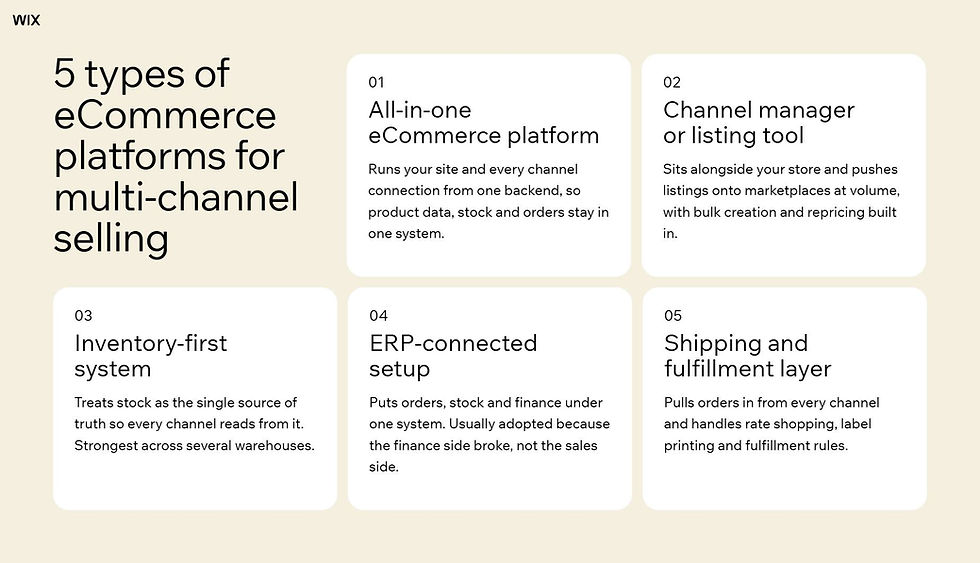
01. All-in-one eCommerce platform
An all-in-one platform runs your own site and your channel connections from a single backend, so product data, stock and orders stay in the same system. For most small and mid-sized sellers this carries the lowest overhead, since there are fewer separate subscriptions to track and fewer integrations to keep working between vendors.
Wix eCommerce lets business owners sell products, services, bookings, courses, memberships and donations from one platform, no plugins required. The trade-off shows up at the extremes, with very large catalogs or channels that need unusual listing logic.
02. Channel manager or listing tool
A channel manager sits alongside your store and specializes in getting listings onto online marketplaces at volume. Bulk creation, template-driven attribute mapping and repricing are the core value, and for sellers pushing thousands of SKUs across several marketplaces the time saved is real. What it does not do is run your store, so you end up maintaining two systems plus the integration between them.
03. Inventory-first system
An inventory-first system treats stock as the single source of truth and lets every channel read from it, which is the right shape when your products live across multiple warehouses or locations. Purchase orders, receiving and stock transfers are usually stronger here than anywhere else. Marketing and merchandising features tend to be thin by comparison, so you will still need other eCommerce tools to actually sell with.
Expert tip from Alfredo García Herrera, VP of Partnerships, PR and Corporate Affairs LATAM at Skydropx:
“It is essential to have the support of order management systems, known as OMS (Order Management System). These software solutions are essential for centralizing the necessary information in businesses. They allow for managing the complete cycle of an order, from receipt to delivery, in addition to integrating multiple sales channels and optimizing workflow.”
04. ERP-connected setup
An ERP-connected setup puts orders, stock and finance under one system, which matters once your accounting can no longer be reconciled from exports. This is a governance answer more than a selling answer, and it usually gets adopted because the finance side broke, not the sales side. Implementation is a project rather than a signup, and changes are slow once it is live.
05. Shipping and fulfillment layer
A shipping layer pulls orders in from every channel and handles rate shopping, label printing and fulfillment rules. If your bottleneck is physically getting orders out rather than listing them, this is the cheapest fix available. It will not stop overselling or listing drift though, because it sits downstream of both.
Explore more:
How do you choose the right platform type for your business?
Four things decide which platform type fits, and one of them is almost always the one actually holding you back. Start there rather than with where you plan to be in two years.
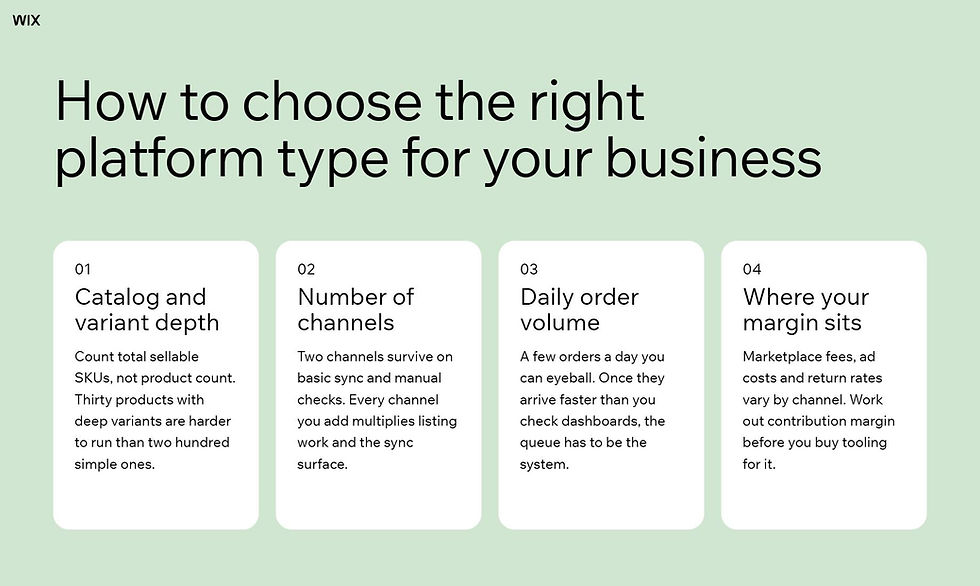
01. By catalog size and variant depth
Catalog size on its own is a weak signal. Two hundred simple products are easier to run across four channels than thirty products with deep variant structures, because every channel models variants differently and each mismatch turns into manual work. Count your total sellable SKUs rather than your product count, and use that number when you evaluate anything.
One thing worth knowing: if your product catalog includes variants across more than two or three attributes, size, color and material for example, plan for extra setup time to structure those correctly. Most stores are live in a few hours. Variant-heavy catalogs are closer to a day.
02. By how many channels you actually run
Two channels is a different problem from five. At two you can survive on basic sync and manual checks. Every channel you add multiplies the listing work, the sync surface and the number of places you have to look. The signal to add a dedicated layer is not a channel count, it is the first time stock or orders stop being reliable in your core platform. Social channels count here even when they feel informal, because they carry the same listing and inventory obligations as other online selling sites.
Reach is the reason social keeps getting added. DataReportal puts global social media user identities at 5.79 billion, equal to 69.9% of the world's population. That figure counts identities rather than unique people, since plenty of shoppers hold accounts on several platforms at once.
Plenty of sellers start on a channel that is not their own site at all, then add their site once demand is proven.
Expert tip from Melanie Schell, Abstract Artist and Wix user:
“When I started selling my art last year, I immediately knew that I didn't need my own website to excite people about my art and sell my works.”
03. By order volume
Order volume decides when manual reconciliation stops being viable. Below a handful of orders a day across all channels you can eyeball it. Once orders arrive faster than you check dashboards, the queue itself has to be the system rather than your attention. Volume also jumps without warning, since one channel promotion can double it for a week, so pick for the busy week rather than the average one.
04. By where your margin actually sits
Channels do not share a margin profile. Marketplace fees, advertising costs and return rates vary enough that a channel can add revenue while reducing profit, and a platform decision made on revenue alone will point you at the wrong tooling. Work out what each channel actually leaves you after fees, ads and returns before you buy anything to support it.
Read more:

How much does multi-channel selling software cost?
Cost splits along the same five types, and the gap between the cheapest and the most expensive answer is wide enough to change which channels are worth running at all. What follows is the shape of the pricing rather than specific numbers, since vendor pricing moves and published figures are usually list prices before any negotiation.
What you pay for at each platform type
All-in-one platforms charge a flat monthly plan and sometimes a transaction percentage, which makes them predictable and cheap at low volume. Channel managers and inventory systems price on usage, usually listing count, order count or seats, so cost tracks growth rather than staying flat. ERP is the outlier, with an implementation cost that dwarfs the first year of license fees.
The revenue point where dedicated software pays for itself
Dedicated multichannel software is an efficiency purchase, so it only clears its own cost once the inefficiency itself is expensive. The rough test is simple. Add up the hours currently lost to listing and reconciliation, price them at what your own time is worth and weigh that against the subscription. Then add the cost of the errors the tool prevents, since a single oversold item on a marketplace can cost more than a month of fees.
Channel economics feed the same calculation, because the margin a channel returns sets how much tooling that channel can justify.
Expert tip from Pablo Renaud, Director of Strategy and Co-founder of Ebolution:
“A key point for success on Amazon is to offer a product with a competitive price. Here, the pricing strategy is not necessarily to have the lowest price, but to offer an excellent price-quality ratio. Consumers are willing to pay a bit more if they perceive that they are getting added value.”
Costs that do not show up on the pricing page
Integration maintenance, channel-specific photography and the staff time to learn a second system are all real and none of them appear in a plan comparison. Return handling is the one that surprises people most, since some channels carry return rates several times higher than a direct site. Budget for the operational tail rather than the license.
Worth knowing: per-order and per-listing pricing looks cheap at your current volume and compounds quietly. Model the cost at three times your present order count before committing, because switching once your data is inside a system is a project rather than a decision.
Find out more:

How do you set up multi-channel selling with Wix?
Wix runs multi-channel selling from the same website builder and dashboard that already run your site, so supported channels connect to the same product catalog and the same order list. Depending on the channel, the connection is either a built-in Wix integration or an app you add, but either way it is a configuration step rather than a second platform to buy. Setting it up follows four steps.
01. Connect your marketplaces
From your site dashboard you connect a marketplace channel, sign in to that marketplace account and choose which products to list. Inventory sync settings are configured per channel, including limits on how much of each variant you expose to that marketplace, which is useful when you want to hold stock back for your own site.
02. Turn on social selling
Wix allows merchants to sell directly on TikTok and Instagram. Products are tagged from the same catalog, so a social sale draws down the same stock count as a sale on your site rather than running against a separate copy of your inventory.
03. Add a branded app as its own channel
Wix enables businesses to launch branded iOS and Android apps without coding. An app behaves as another channel rather than a marketing extra, with the same catalog and the same order queue behind it.
Mobile commerce accounted for $2.51 trillion in sales in 2025, nearly 59% of all global eCommerce, and is projected to reach $3.35 trillion by 2028. That figure comes from Capital One Shopping Research.
04. Manage orders and stock in one place
Orders from every connected channel land in the same order list and stock draws down from one inventory record, which is the part that stops the reconciliation work before it starts. Wix eCommerce powers $4.14B in annual GMV across 763,500 live stores, with 99.9% uptime and 24/7 merchant support.
Learn more: Best eCommerce platform with built-in SEO tools
Worth knowing if you're in wholesale or B2B: the Wix default retail setup is built for direct-to-consumer. Wholesale pricing tiers and account-based ordering are solvable, but they require additional configuration that standard retail setups don't.
Multi-channel selling FAQ
Is multi-channel selling worth it for a small store?
Yes, it is worth it when a second channel reaches buyers your own site does not, and not worth it when it simply splits the same demand across more places to maintain. The honest test is simple. Does the new channel bring incremental customers or just relocate existing ones? Start with one additional channel, run it for a full season and measure contribution margin rather than revenue before you add a third.
How many channels should you start with?
One at a time. Add a channel, get it stable on inventory accuracy, listing quality and fulfillment speed, and only then add the next. Launching three at once makes it hard to tell which channel is causing an inventory or fulfillment problem, so you end up debugging all three instead of growing any of them.
Do you need separate software to sync inventory?
Not at low channel counts. If your eCommerce platform has native integrations for the channels you want, the built-in sync is often enough on its own. Check what the specific channel or connection costs before assuming it is included. Separate software earns its place when you outgrow those native integrations, either in the number of channels or in listing volume.
How much does multi-channel selling software cost?
That depends on which type you buy. An all-in-one platform bundles channel connections into a flat monthly plan, so the marginal cost of adding a channel is close to zero. Dedicated channel management and inventory systems price on usage and scale with listing or order counts, which makes them considerably more expensive at volume and only sensible once the time they save is worth more than the fee.
What's the difference between multi-channel and omnichannel selling?
Multi-channel selling means selling through more than one channel, such as your own site plus a marketplace or a social platform. Omnichannel means those channels share data and behave as one experience for the shopper, so a customer can move between them without starting over. Multi-channel is the operational foundation and omnichannel is what you can build once that foundation is accurate.