Updated: Sep 28
Get the perfect domain for your eCommerce store: find your domain→

The best eCommerce platform for omnichannel retail is the one that keeps a single source of truth for inventory, customers and orders across every channel you sell on. For most retailers that points to an all-in-one platform, while large operations with engineering teams get more out of a composable stack and store-heavy businesses often start from a POS-first system. Channel count is not what separates these options, shared data is. Wix supports omnichannel sales across online marketplaces and social platforms. Below is a breakdown of the five platform types retailers choose between and how each one holds up on the parts of omnichannel that actually cause problems.
Ready to start selling online? Build a custom online store with Wix and get the tools to sell, manage and grow your business from one dashboard. Customize every detail, reach customers across channels and market your brand with built-in SEO and marketing tools.
TL;DR: best eCommerce platform for omnichannel retail
Omnichannel is less about how many channels you sell on and more about whether those channels share the same data. That single question separates the platform types more cleanly than price or feature lists do, because two platforms can both offer a store, a POS and a marketplace connection while handling stock counts in completely different ways.
Platform type | Best for | Omnichannel strength |
All-in-one commerce platforms | Retailers who want online, in-person and social selling running on one system | Strongest without custom work, since inventory, payments and customer data share one backend |
Composable and headless stacks | Large retailers with engineering teams and unusual requirements | Very high, but only after the integration work is built and maintained |
POS-first retail platforms | Businesses where most revenue still happens in store | Strong in store, thinner on digital merchandising and marketplace reach |
Marketplace-first setups | Sellers whose demand comes mainly from third-party marketplaces | Limited, because the customer relationship stays with the marketplace |
Open-source platforms | Teams with developer resources who want full control | Depends entirely on which extensions you add and keep updated |
Types of eCommerce platforms for omnichannel retail
Most retailers are not choosing between fifty products. They are choosing between five approaches, and the approach decides how much of the omnichannel work the platform does for you versus how much you build and maintain yourself. If the term itself is still fuzzy, start with what omnichannel retail actually means, then come back here. For a product-level view rather than a category-level one, our roundup of the best eCommerce platforms covers specific options, and our breakdown of the types of eCommerce covers the business models those platforms have to support.
The reason this decision matters more than it used to is that customer preference no longer splits neatly by channel. Gen Z is the only generation that prefers online shopping (55%), while 83% of Baby Boomers still prefer in-person, according to Wix's small business marketing statistics. That generational split means businesses need both a strong physical presence and a standout online experience to serve all customers.
01. All-in-one commerce platforms
An all-in-one platform bundles the storefront, payments, inventory, POS and marketing tools into a single product. That structure matters for omnichannel because the hard part is never adding a channel, it is keeping stock counts and customer records consistent once you have four or five of them running at once. If you are still at the stage of working out how to start an online store, this category removes the most decisions.
Wix supports unified sales management across online and offline channels. What you give up is the freedom to swap one component out, which is why the built-in eCommerce tools matter more here than on any other platform type.

02. Composable and headless commerce stacks
Composable setups separate the storefront from the commerce backend and connect the parts through APIs, so a retailer can swap any single component without rebuilding everything else. This suits large operations with engineering capacity and requirements that packaged software genuinely cannot meet, such as unusual pricing logic or a storefront that has to run inside another company's app. The trade-off is that omnichannel behavior becomes something you build rather than something you configure, and every channel you connect is a connection you also maintain. That trade-off is not fixed.
Wix Headless is a headless solution that natively includes CMS, eCommerce, Bookings, Events and Payments in a single connected backend without requiring third-party integrations, which means a retailer can keep full control of the frontend without rebuilding the omnichannel plumbing behind it. Wix Headless eCommerce enables managing orders, inventory, shipping and finances from one dashboard, so the single source of truth that omnichannel depends on stays intact even when the storefront is custom.

03. POS-first retail platforms
POS-first platforms start from the register and add an online store afterward. For a retailer whose revenue is still mostly in store, this ordering makes sense, because the in-person experience is where the money is and the software is built around staff workflows, receipts and floor inventory.
If you are new to this side of retail, what a POS system does is the place to start, and POS system costs vary enough that hardware belongs in the platform decision rather than after it. Where these setups tend to thin out is digital merchandising, content and marketplace reach, which are treated as extensions rather than core. Platforms that started online and added in-person selling later solve the same problem from the other direction, and Wix integrates online stores with in-person point-of-sale systems.

04. Marketplace-first setups
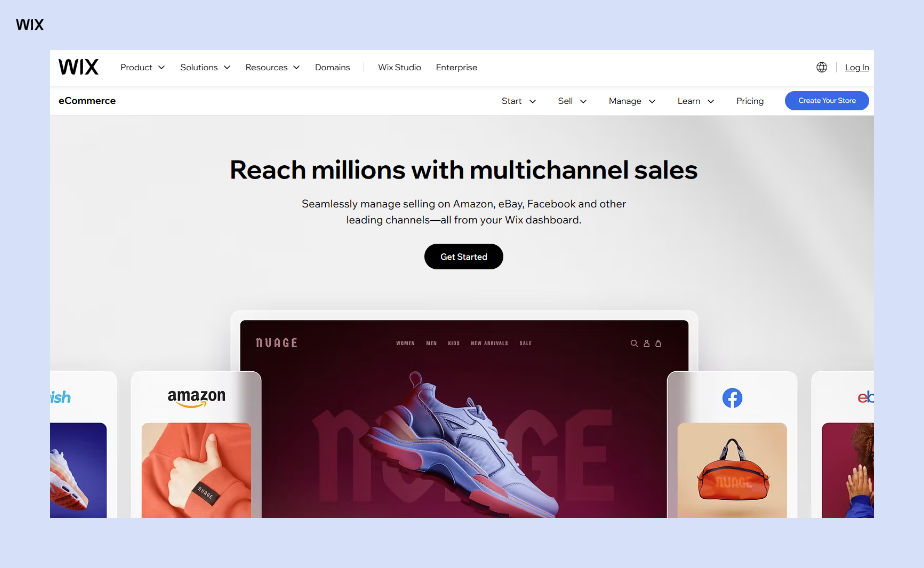
Some retailers run almost entirely on third-party online marketplaces and treat their own site as a formality. The reach is real and the demand is already there, which is why this model persists. The structural cost is that the marketplace owns the customer relationship, so repeat purchase data, email lists and lifetime value stay outside your control, and pricing pressure is constant. The stronger version of this model uses marketplaces as an acquisition channel feeding an owned store rather than as the whole business, which is the distinction at the heart of multi-channel selling. Wix integrates eCommerce stores with Amazon, eBay and Google marketplaces.
05. Open-source platforms
Open-source platforms give you full control of the code and no license fee, which reads as the cheapest option until you account for hosting, security patching and the extensions you need for each additional channel. Omnichannel on open source is entirely achievable and entirely dependent on the plugin stack you assemble, which means every channel you add is another integration to keep current and another moving part in your day-to-day eCommerce management. Packaged platforms make the opposite trade, handling that maintenance in exchange for less control.
Worth knowing: the platform type sets your ceiling, not your outcome. Retailers who pick the right category and then run it carelessly consistently do worse than retailers who pick a slightly less flexible category and keep their product data clean.
How eCommerce platform types compare for omnichannel retail
The comparison below scores each type on the six factors that decide whether an omnichannel setup holds together in practice. Read down a column to see what a platform type gives you by default and read across a row to see which types actually differ on the factor you care about most.
Factor | All-in-one | Headless | POS-first | Marketplace | Open-source |
Unified inventory | Native | You build | Store-first | Per-channel | Plugin |
Single customer record | Native | Data layer | In-store | Platform owns | Plugin |
Order routing and BOPIS | Built in | Custom | Store-first | None | Extension |
Channel reach | Broad | As built | Narrow | Rented | Add-ons |
Setup effort | Low | High | Low to med | Low | Med to high |
Cost structure | Monthly fee | Dev plus fees | Fee plus kit | Per sale | Hosting plus upkeep |
Unified inventory management is the factor that decides whether the rest of the table matters, because every other capability reads from the same stock numbers. Order routing is the one most retailers underestimate, because it only becomes visible once a single order needs to be split across a warehouse and a store shelf.
Alfredo García Herrera, VP of Partnerships, PR and Corporate Affairs LATAM at Skydropx, puts the operational side of that plainly.
“It is essential to have the support of order management systems, known as OMS (Order Management System). These software solutions are essential for centralizing the necessary information in businesses. They allow for managing the complete cycle of an order, from receipt to delivery, in addition to integrating multiple sales channels and optimizing workflow.”
Channel reach is the factor that has shifted fastest. Mobile commerce accounted for $2.51 trillion in sales in 2025 (nearly 59% of all global eCommerce) and is projected to reach $3.35 trillion by 2028, according to Capital One Shopping Research. That share is why social commerce and in-app selling now count as core sales channels rather than experiments, and Wix allows merchants to sell directly on TikTok and Instagram.
One thing worth knowing: this table ranks types, not products, and the gap between two platforms inside the same type is often larger than the gap between two types. Use it to narrow the field to one or two categories, then compare specific platforms on the factors your business actually depends on.
Where omnichannel setups usually break
Almost every omnichannel failure traces back to the same root cause, which is two systems holding a different opinion about the same product. The symptoms show up in four fairly predictable places.
Inventory sync lag is the most common. A product sells in store, the online listing does not update for several minutes and a second customer buys the same unit. At low volume this is an occasional apology. At high volume it becomes cancelled orders, refund processing and marketplace account penalties, which is why sync frequency is worth asking about before you commit rather than after.
Barcode and SKU mismatches are the quiet version of the same problem. When a product exists under one identifier in the register and another in the online catalog, the two systems stop recognizing it as one item and every downstream report inherits the error.
Split vendors are the third. When the register comes from one company and the online store from another, the integration between them is nobody’s primary product, so it receives the least attention and breaks first during peak trading. Running payments and inventory through one system removes an entire class of reconciliation problems.
Integration sprawl is the fourth and the slowest to appear. Each new connector solves one problem and adds one more thing that can fail silently, until nobody on the team can say with confidence where a given number originates. This is the case for planning multichannel eCommerce integration deliberately rather than one connector at a time. If a demo cannot answer where a stock count comes from in one sentence, that is the red flag worth acting on.
One thing worth knowing: if your product catalog includes variants across more than two or three attributes, size, color and material for example, plan for extra setup time to structure those correctly. Most stores are live in a few hours and variant-heavy catalogs are closer to a day, and getting the variant structure right at the start is what prevents the sync problems above later.
Is Wix a good eCommerce platform for omnichannel retail?
Yes, for most retailers, and the fit is strongest for a business running an online store, a physical location and one or two marketplaces. Wix is an all-in-one platform, so the omnichannel groundwork is configured rather than built, which removes the integration layer where most of the problems above originate. A full breakdown of what Wix eCommerce includes is worth reading alongside this section. Wix is also a website builder, so the storefront, the content and the commerce backend are the same system rather than three connected ones.
Sean Barkulis, Strategic Partner Sales at Wix, describes what retailers need to show shoppers before they ever walk in.
“For retailers, ensure you showcase your in-store inventory and offer customers the options of shipping or in-store pickup. Remember, 76% of consumers look at websites before physically visiting a business.”
That expectation is what an omnichannel platform has to serve, and it is why the in-person and online sides need to read from the same inventory rather than two synced copies of it. Beyond the store and the register, Wix enables businesses to launch branded iOS and Android apps without coding, which turns a mobile channel into part of the same setup instead of a separate build.
Laurel Murray, founder of the jewelry brand Kissamo, runs an online store alongside in-person events and has been through exactly this split.
“Wix Payments has been useful as we juggle both online and in-person events and it can even handle the high level of customization we offer.”
Running both sides on one payment and inventory system is what makes that possible without a second reconciliation process at the end of every event.
Worth knowing if you are in wholesale or B2B: Wix’s default storefront is built for direct-to-consumer. Wholesale pricing tiers and account-based ordering are solvable, but they require additional configuration that standard retail setups do not.
Omnichannel retail platform FAQ
How is omnichannel retail different from multichannel retail?
Multichannel means selling in several places. Omnichannel aims to connect inventory, orders and customer data across channels as far as those channels allow. Customer data from third-party marketplaces may remain partially controlled by the marketplace. The difference is not the number of channels, it is whether they are connected.
Do I need a POS system to sell omnichannel?
Only if you sell in person. Omnichannel with no physical location can mean an online store plus marketplaces plus social selling. Once a physical location is involved, a POS that writes to the same inventory as the online store is what keeps the two from drifting apart.
Can a small retailer run omnichannel without a large budget?
Yes, and the all-in-one category exists largely for this case. The cost that catches small retailers out is rarely the subscription, it is the staff time spent reconciling systems that were never designed to talk to each other.
How often should inventory sync between channels?
Near real time is the standard to aim for, and anything measured in hours will cause overselling once volume rises. Ask any platform how quickly a sale in one channel updates the others and treat a vague answer as a warning sign.
Should I sell on marketplaces and my own store at the same time?
For most retailers this is the stronger position, because marketplaces supply reach while an owned store supplies margin and customer data. The setup only works well when both read from one stock count, otherwise the marketplace penalties for cancelled orders erase the extra revenue.