AI agents for every part of your business. Check out Symphony by Wix →

The best AI agents for marketing can draft your newsletter, chase down leads while you're teaching a class and spot the ad that's quietly eating your budget. Not long ago that sounded like a demo reel. Now a solo business owner can have an AI agent running before lunch. Each one lives inside a platform, and the platform decides what the agent can see and do, so we compared eight and sorted them by who each fits.
Symphony by Wix gives every business owner a unique team of AI agents built around their goals. Symphony connects with calendars, Slack, Salesforce, payment platforms and the Wix back office, so the agents work inside the tools you already use.
TL;DR: best AI agents for marketing
The best AI agent for marketing is the one that takes your most annoying recurring job off your plate, not the one with the longest feature page. An agentic AI platform lets you set a goal and have agents work through the steps, so your marketing strategies actually get carried out instead of sitting in a doc.
Solo owners and teams of up to ten usually get the most from a coordinated set of agents that plug into the tools they already have. Bigger teams with a CRM already running tend to do better with the agents built into it.
You'll learn:
What separates a real marketing agent from a chatbot with a new logo
The best AI agents for marketing platforms compared on overview, key features, pricing and who they fit
How to pick an agentic AI platform based on your biggest bottleneck
Where agents still need a human to guide your marketing strategies
What to do in your first week
Best AI agents for marketing
We compared eight agentic AI platforms on the same five things: what the platform is, what its agents do, what it costs, who it suits and what to keep in mind.
Every platform below gets those same five blocks, so you can read straight across. Prices and plans move fast, so treat the numbers as a starting point and check the vendor's site before you commit.
01. Symphony by Wix is best for solo owners who want a coordinated team of agents

Symphony by Wix is an AI agent platform for independent business owners and small businesses that coordinates specialized agents around business goals. Symphony works with businesses even when their website isn't built on Wix.
Symphony is built with agents specialized across marketing, client communications, scheduling, finance and operations. Symphony connects with calendars, Slack, Salesforce, payment platforms and the Wix back office, and Symphony lets owners add third-party agents to extend its capabilities. Symphony also provides a visual dashboard for each business and project that shows real-time trends and growth metrics in one place. Symphony also handles payment follow-ups for businesses that accept card payments online.
Ronny Elkayam, COO and Head of R&D at Wix, says the interesting part is what happens between those agents: "What's different about Symphony is what happens between agents. They don't just execute in parallel, they actively share context with each other. So your marketing agent knows what your front desk agent learned last week about your best customers. That compounding effect is where the real value lives."
How it actually works: Symphony asks you to approve every recommended action before its agents carry it out, from sending a campaign to updating a workflow. You stay in control of every decision, and the agents handle the execution once you say go.
Pricing: Symphony offers a free plan with 500 monthly credits and 100 daily credits, plus paid plans with higher usage limits. You can check symphony pricing before you start.
Best for: Symphony is designed for solo operators and small businesses with up to 10 people. If you sell products, the agents have more to work with once you create an online store.
Symphony is designed for the pace and structure of a small business, not enterprise workflows. If you're scaling into a larger operation, Symphony grows with you up to a point.
Read more:
02. HubSpot Breeze is best for teams already living in HubSpot
HubSpot launched Breeze as its embedded AI, and four Breeze Agents came with it: Content, Social Media, Prospecting and Customer. Because they're built into HubSpot, they sit right next to the contacts and campaigns you already keep there.
The Content Agent drafts assets like blogs, landing pages and case studies. The Social Media Agent analyzes past posts and suggests improvements, and the Prospecting Agent researches accounts and drafts outreach. The Customer Agent handles support questions.
Pricing: Breeze Agents are added to paid plans. Agents use HubSpot Credits, and that Starter plans offers 500 credits for $20 per month (billed annually).
Best for: Teams that already run their CRM, email and reporting in HubSpot.
The cost builds from the hub subscription plus credit usage, so model the full bill before you commit. If your CRM lives somewhere else, the appeal fades fast.
03. Salesforce Agentforce is best for teams already on Salesforce
Salesforce now brands its whole marketing suite Agentforce Marketing, formerly Marketing Cloud, and the flagship product inside it is Marketing Cloud Next. It's built on the Salesforce platform and works with Data Cloud.
Agentforce can help a marketer create a brief, build an audience segment, write email and SMS content, build a customer journey in Flow and summarize the campaign afterward. Salesforce offers both out-of-the-box marketing agents and build-your-own agents.
Pricing: Agentforce is mostly consumption-based, with a free plan available. Flex Credits cost $500 per 100,000. Conversation-based and per-user options also exist.
Best for: Teams that already keep their customer data in Salesforce and want agents working across marketing, sales and service.
It's built around enterprise setups, so for a one-person shop it's probably more machinery than you need.
04. Jasper is best for larger content teams that care about brand voice
Jasper describes itself as a marketing agents platform built for enterprise teams.
Jasper offers 100+ specialized marketing agents. Jasper IQ keeps those agents inside your brand voice and style rules, and Jasper Studio lets teams build custom agents for the content they produce again and again.
Pricing: The Pro plan costs $59 per seat monthly (billed annually).
Best for: Content teams that need ten writers to sound like one company.
Jasper Studio and workspace agents sit on the Business plan, and seat-based pricing adds up as the team grows. If you're a team of two, it's likely more than you need.
05. Copy.ai is best for sales and marketing teams that want repeatable workflows
Copy.ai calls itself the first go-to-market AI platform, built to unify sales, marketing and operations through automated workflows.
Workflows chain AI steps from trigger to output with built-in logic and quality checks, and agents handle targeted tasks inside those workflows. Its inbound lead processing workflows are designed to cut the time it takes to respond to a new lead.
Pricing: Copy.ai runs on credits. A Chat plan starts at about $24 a month (billed annually).
Best for: Teams working at the seam between marketing and sales, such as prospecting and lead follow-up.
Credits meter your usage, and the workflows take time to build before they pay off.
06. Klaviyo is best for ecommerce and consumer brands
Klaviyo describes itself as a B2C CRM and AI marketing platform that unifies customer data and automates email, SMS, RCS, WhatsApp and mobile push.
Its Marketing Agent learns from your website and builds on-brand campaigns, flows and your first form. The Customer Agent answers questions around the clock, and Klaviyo says it resolves 65% of questions on its own.
Pricing: Klaviyo offers a free plan with core features, and paid plans scale with your number of contacts and channel usage.
Best for: Online stores and consumer brands that run retention marketing through email and SMS.
It's built for B2C, and the 65% figure is Klaviyo's own claim. Your bill will rise as your contact list grows.

07. ActiveCampaign is best for small businesses with email-led marketing
ActiveCampaign calls its AI layer Active Intelligence, a set of autonomous marketing features orchestrated by AI agents.
The agents help with campaign creation, building automations, segmentation and performance analysis, and the platform connects with 1,000+ apps.
Pricing: Email and WhatsApp plans start at $112 per month (billed annually).
Best for: Small businesses that want email and automation at the center of their marketing.
Prices climb as your contact list grows, and the AI limits on lower tiers are not spelled out as a number.
08. Zapier Agents is best for people who already automate in Zapier
Zapier Agents lets you build custom AI agents that do work across thousands of apps. Zapier describes marketing agents as systems that perform specific marketing tasks on your behalf instead of waiting to be prompted.
You teach and direct the agents in plain language and connect them to your apps and knowledge sources. They run on top of the automations you may already have in Zapier.
Pricing: The Free plan includes 100 activities a month. The Professional Plan starts at $19.99 per month (billed annually).
Best for: People who already have automations running and want to add some judgment on top of them.
You design the agent, so you spend setup time up front.
Worth knowing: a build-your-own agent is only as good as the instructions you write. Plan an hour or two of testing before you trust one with anything a customer will see.
Platform | Best for | What the agents handle | Starting price |
Symphony by Wix | Solo owners and teams of up to 10 | Marketing, scheduling, customer communication and business operations | Free plan with 500 monthly credits |
HubSpot Breeze | Teams already on HubSpot | Content, social media, prospecting and customer service | Agentic plans start at $20 a month |
Salesforce Agentforce | Teams already on Salesforce | Briefs, segments, email and SMS content, journeys and summaries | Free plan, additional credits cost $500 per 100,000 credits |
Jasper | Larger content teams | Research, creation and optimization | $59 per seat monthly |
Copy.ai | Sales and marketing teams | Prospecting, lead processing and content workflows | Chat plan costs $24 a month |
Klaviyo | eCommerce and consumer brands | Campaigns, flows, forms and customer questions | Free plan, then scales with usage |
ActiveCampaign | Small businesses with email-led marketing | Campaign creation, automations, segmentation and reporting | Email and WhatsApp plans start at $112 a month |
Zapier Agents | People already using Zapier | Custom tasks you define | Free plan, paid plans start at $19.99 a month |
*Prices presented in annual billing. All information is accurate as of October 8, 2026.
What counts as an AI marketing agent?
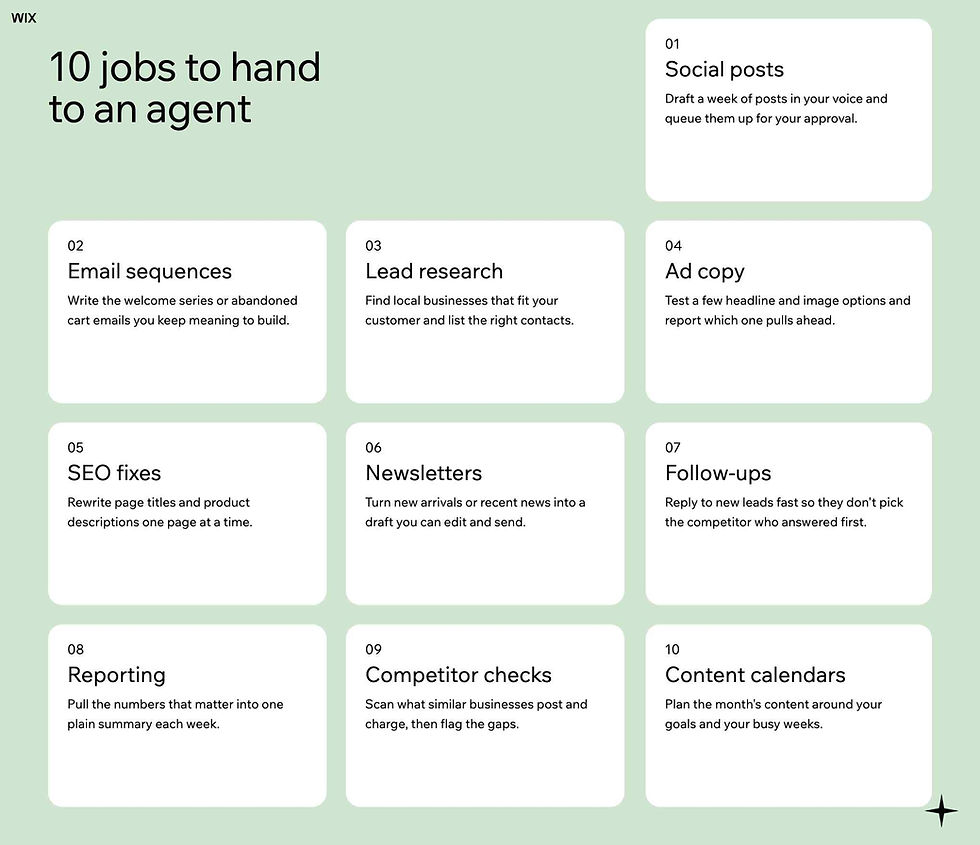
A chatbot answers when you ask it something. An agent takes a goal, works out the steps and does them, usually inside your own tools. That one difference is why plenty of "best AI agents" lists are really lists of writing tools with a chat box bolted on. Our roundup of the best AI agent platforms sorts them by what they actually do.
Agents usually start with the channels you already run. That might be the pages you're trying to rank, where SEO features do part of the groundwork, or the posts you put together with social media design tools.
A recent thread on r/AI_Agents asks what a lot of owners are quietly wondering: are AI marketing agents actually useful yet? The poster said individual agents look impressive but get messy once you try to run a whole system on them. One reply put it well. Agents work as specialists inside a stack, but they're closer to semi-automation than a full replacement and they need a lot of human oversight. If you're weighing how to run an smb better with agentic AI, that oversight is the part to plan for first.
AI itself isn't the edge anymore. 92.4% of bloggers now use AI in their blogging work, so AI is the baseline, not the edge. Orbit Media found AI use alone does not predict stronger results, which makes original insight and editing what sets a blog apart.
Agents follow the same pattern. Having one isn't what separates good marketing from average marketing. The setup is.
Worth knowing: the word "agent" gets stretched a lot. Some vendors put it on any feature with a chat window. A quick test is to ask what it does when you're not there. If the answer is nothing, you're looking at a tool.
Explore more:
How to choose an AI marketing agent for your business

Start with the bottleneck. Pick the job you dread or keep skipping. For a lot of owners that's the newsletter, the lead follow-up or a landing page that never gets built, and an AI landing page builder takes care of that last one. A tool that nails that one job beats a suite that does forty things badly. Running a Shopify store? The best AI tools for Shopify are worth a look before you pay for anything bigger. If the bottleneck is growth itself, grow your business with Symphony shows where owners usually start.
Symphony posts LinkedIn ads every two weeks for Steven Honour, a solo manufacturing consultant, based on the visit reports he feeds it. His read on the results:
"I've got a lot more profile views on LinkedIn since it started doing ads every two weeks based on my reports." - Steven Honour, founder of Improve My Process
Check what it connects to. An agent that can't see your inbox, your appointment scheduler or your store is a chatbot with a nicer name. List the tools you use every day and confirm the agent reaches them before you sign up.
A setup decision worth making early: Symphony can do more on your behalf the more tools you connect, like your calendar, CRM, payment platform and back office. Connecting your existing stack early expands what Symphony handles without extra input from you.
Decide how much approval you want. Some agents act first and tell you later. Others ask first. Neither is wrong, but you should know which one you're signing up for, especially when an agent can send emails to real customers.
Your first week with an AI marketing agent
Start by writing down the marketing jobs you keep putting off and circling just one. On days two and three, give the agent real context: your prices, your best customers and a few email marketing campaigns you're proud of. Thin context gets you thin drafts. By midweek, let it draft but don't let it send, and edit everything while you notice what you keep changing. Those edits are your instructions for next week. Before you move on, check traffic and sign-ups in Wix Analytics or whatever you use.
Symphony by Wix helped Mindy Boyster, founder of Cornerstone Admin Solutions, build a prospecting operation from scratch while she worked full time. Here's how she describes it:
"Symphony built my entire business development operation: prospect research, cold email sequences, client onboarding and a Google Business Profile. Plus [it] launched 2 YouTube channels. All while I work full time." -Mindy Boyster, founder of Cornerstone Admin Solutions
Before you start: Symphony includes three types of agents. Built-in agents cover core business functions out of the box, custom agents are ones you configure for your specific workflows and third-party agents come from outside providers. You don't need all three to get value from day one, because the built-in agents alone cover most small business needs.
Symphony by Wix gives every business owner a unique team of AI agents built around their goals. Start free and see what your team picks up first.
Best AI agents for marketing FAQ
What is the best AI agent for marketing?
It depends on the team. For solo owners and small businesses of up to 10 people, Symphony by Wix coordinates specialized agents through one orchestrator, so marketing, scheduling and customer communication work together. If your whole business already runs in HubSpot or Salesforce, the agents built into those tools usually fit better. Jasper suits larger content teams that need tight brand voice control, and Klaviyo fits ecommerce brands.
Are AI marketing agents actually useful yet?
Yes, for specific and repeatable jobs like drafting posts, writing email sequences and researching leads. Running an entire marketing operation end to end is still closer to semi-automation, so plan to review the output. Think of them as fast junior teammates rather than replacements.
How is a AI marketing agent different from marketing automation?
Automation follows fixed if-then rules you set up in advance. An agent takes a goal, decides the steps and adjusts as it goes. Most businesses end up using both, with automation covering the predictable parts and agents covering the work that needs judgment.
Do small businesses need one AI agent or several?
Start with one job and add a second once the first works. Symphony by Wix coordinates specialized agents through a central orchestrator, which means you can grow into several agents without juggling separate tools.
Do AI agents replace marketers?
No. They take over repetitive work like drafting, research and follow-ups so you can spend your time on strategy, brand voice and final approvals. Anything a customer will read still deserves a human look first.
How much do AI marketers cost?
The range is wide. Symphony by Wix offers a free plan with 500 monthly credits and 100 daily credits, plus paid plans with higher usage limits. Klaviyo and Zapier Agents also have free entry points, Jasper Pro costs $59 per seat monthly (billed annually). HubSpot and Salesforce charge by plan and usage, so check with each vendor.


