Updated: Sep 8
The perfect domain is just a click away: claim your domain →

Using a website builder makes it easy to create your site but without a domain name, people might never find it. Your website could end up on a long hard-to-remember address, emails look unprofessional and your brand struggles to stand out. A domain name turns your site into a credible memorable online presence that visitors can easily find and trust.
Secure your perfect domain in just a few clicks with Wix. Get everything you need in one place: business email, reliable hosting, SSL protection and full privacy. With 24/7 support and no hidden fees, getting your site live is simple and worry-free.
TL;DR: Why do I need a domain name?
A domain name is your website’s unique address. It’s what connects your website, business email and hosting so customers can find, trust and engage with your business. Without a custom domain, your site may look unprofessional, be harder to share and limit your branding and marketing opportunities.
You’ll learn:
What a domain name is and how it works
How a domain powers your website, email and hosting
The risks of not having a custom domain
How domain registration, renewal and expiration work
Benefits of a good domain for branding, credibility and SEO
Common challenges in choosing the right domain name
Step-by-step process to search, secure and protect your domain
What is a domain name?
A domain name is the address people use to visit your website on the internet. For example, wix.com is our domain name. It's a user-friendly substitute for an IP address, which is a long series of numbers (like 192.168.1.1) that computers use to identify each other on the network. Instead of remembering a complex numerical string, users can just type in your memorable domain name.
Every domain name is unique and consists of two main parts: a top-level domain (TLD), which is the extension like .com, .net or .org domain, and a second-level domain (SLD), which is the part that identifies your brand, like 'wix'.
Found the perfect name for your business? Lock in your domain before someone else does.
How your domain runs your website and email
A domain name is your connector. It links your site, your email and the platform behind the scenes so people can find you easily and trust what they see.
Your domain and your website
When someone types your domain into a browser it takes them to your website files. Without a custom domain your site lives on a long subdomain that's harder to remember and easier to ignore. A domain gives you full control over redirects, page structure and future changes. If you ever redesign your site or switch platforms you can keep the same domain so visitors don't lose track of you.
Your domain and email addresses
Your domain lets you create custom email addresses tied to your brand. This is more important than it seems. Branded emails are easier to recognize, less likely to be ignored and provide consistency across sales, support and partnerships. You can set up different addresses for specific needs like support@, hello@ or sales@, all managed from one place.

Your domain and website hosting
Your website needs a place to live online and your domain acts as its address. Once you connect your domain to a website hosting platform, it serves your site to anyone who types in your web address. The platform takes care of all the behind-the-scenes work like security, speed and updates, while your domain remains your public address. If you decide to switch platforms you can keep the same domain so visitors don't lose track of you.
What happens if you don’t buy a domain
Skipping a custom domain might seem fine at first but can really hold you back. Without one, your website usually lives on a free subdomain provided by your site builder like yoursite.wixsite.com. These addresses are harder to remember and share.
Not having a custom domain can affect your business in ways you might not realize, and the impact varies depending on what you’re doing online.
Professionalism and credibility: For most businesses—freelancers, small shops, consultants or service providers—a custom domain signals legitimacy. Using a free domain can make your site look temporary or like a hobby. Customers, partners and even vendors often judge trustworthiness based on these first impressions, so a custom domain is a small investment that pays off big in credibility.
Email and communication: A custom domain gives you professional email addresses like info@yourbusiness.com. If you send outreach client messages or newsletters a branded email makes you more recognizable and helps boost open rates. Consultants coaches and creatives especially find that branded emails make their messages familiar and hard to miss.
Marketing, branding, and discoverability: Custom domains support brand consistency across social media, advertising and offline materials. They also help with SEO. A domain that reflects your business or niche makes it easier for search engines to understand your site and show it to the right audience. Without a domain, your site may struggle to rank and every platform change or subdomain switch can confuse visitors and search engines alike.
Long-term control and flexibility: Every business has its own growth plan. An eCommerce store might expand to new markets, a blog could grow into a content hub, and a local service might add locations. With a domain, you stay in control—you can switch platforms, create subdomains for products or services, or launch new sites under the same brand. Without one, you're stuck with the platform’s structure and risk losing traffic or recognition if you switch.
“Your domain name is your online home address, and just like in real life, location matters. Pick something short, easy to say out loud and easy to remember. If someone can recall it after hearing it once, you’re on the right track.” - Ofir Gvili, Domains PMM at Wix

Domain ownership and control
Many think buying a domain means owning it forever, but domains are actually rented for 1–10 years. Registering a domain secures your right to use it during that time, and you’ll need to renew to keep it. Longer registration periods show stability to visitors and search engines, while shorter terms save money upfront but need more frequent renewals.
Renewals are a vital part of owning a domain. While most registrars offer an automatic renewal option, you'll need to keep your payment info and contact details current. If your domain lapses, you run the risk of losing your website and any email addresses tied to it.
If a domain expires, you usually get a short grace period. After that, it’s back on the market for anyone to grab. Losing your domain can disrupt your flow, confuse your visitors and even let someone else snag your brand name. Staying on top of registration and renewals helps you keep things running smoothly and protects what you’ve built.

Why buy a domain name
Having your own domain puts you in the driver’s seat. It gives you total control over how your site grows and functions. You can easily set up subdomains for specific products or new locations to keep things organized. Plus you’ll have access to tools like custom email routing and analytics that free subdomains usually block. It’s the easiest way to build a site that’s as professional as your business.
Owning a domain also makes connecting your favorite tools a breeze. Whether you're setting up payment processors, marketing apps or CRM systems, most platforms need a verified domain to work their magic. By securing yours now, you’ll avoid tricky workarounds and keep your data flowing exactly where it needs to go.
A custom domain name also protects your brand long-term. When you register variations alternative spellings or region-specific extensions you stop competitors or cybersquatters from claiming similar web addresses. This smart move secures your traffic search visibility and customer trust giving you a solid foundation to grow your business.
Learn more: what are custom domains?

Benefits of a good domain name
Choosing the right domain name offers several advantages that can contribute to your business's growth and success. It's more than just an address; it’s a powerful tool for building your brand.
A memorable and relevant domain name makes it easier for customers to find and return to your website. This builds brand recognition and loyalty. It also adds a layer of professionalism and credibility. Customers are more likely to trust and do business with a site that has a custom domain name than one with a generic, third-party URL.

Additionally, a well-chosen domain can positively impact your SEO. A name that reflects your business or industry can help search engines understand what your site is about, making it easier for potential customers to find you.
“It cannot be expressed in numeric value, but I would say that the name of our domain is at least 5% of our brand value." - Kacper Rafalski, demand generation team leader at Netguru
Feature | Benefit |
Brand Identity | A unique domain strengthens your brand and makes it memorable. |
Credibility | A professional domain shows you're a serious business. |
SEO | A relevant domain can improve your search engine ranking. |
Control | You own your digital address, so you're not tied to another platform. |
Common challenges of finding a good domain name
Finding the perfect domain name can sometimes feel like a treasure hunt. With millions of websites already online, the name you want might already be taken. This is especially true for short, simple .com domains.
Another challenge is avoiding trademark infringement. You could run into legal trouble if your chosen domain is too similar to an existing brand's name, even if the domain itself is available. It’s important to do your research before you commit.
Lastly, some people choose names that are hard to spell or pronounce. If customers can't easily type your domain from memory, you risk losing traffic. It's better not to choose a domain name that's too long or complicated; rather, stick to something simple and intuitive.
You may also be interested in:
Examples of domain names
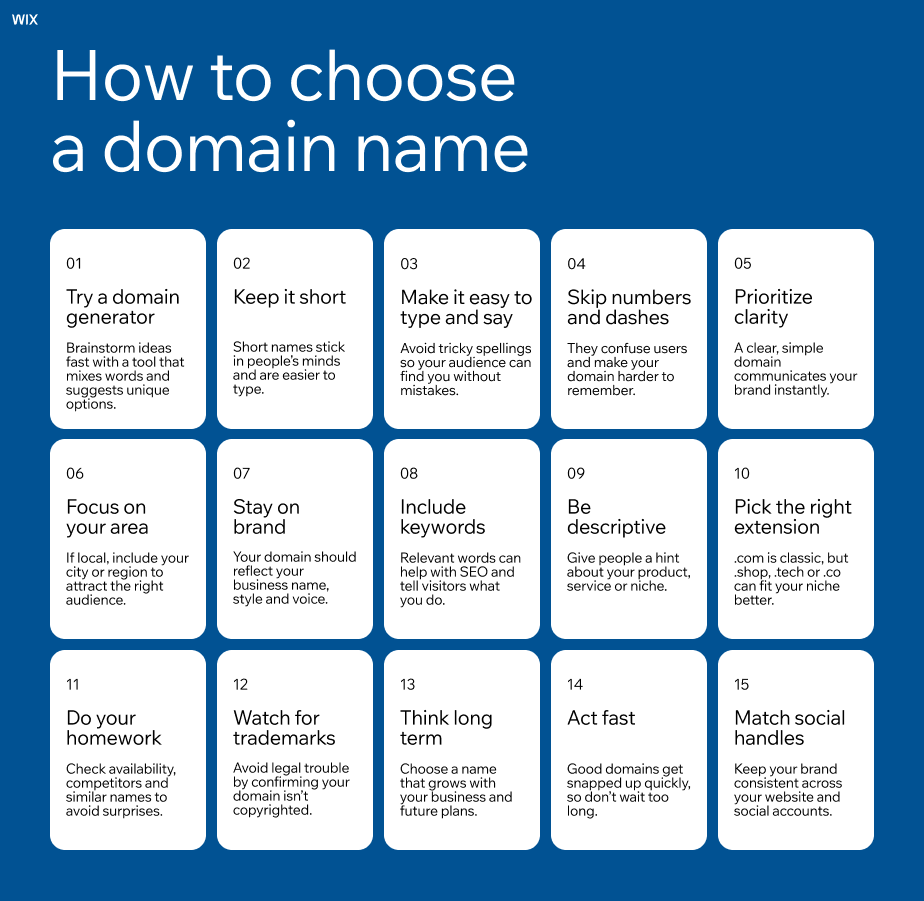
A great domain name is often simple, memorable, and directly related to the brand.
Look at brands like Nike.com or Apple.com. Their domain names are their brand names, making them incredibly easy for customers to remember and find. These are prime examples of effective branding.
For a small business, you might include a keyword that describes what you do. For instance, a bakery in Brooklyn could choose something like brooklynbread.com. This name is descriptive, location-specific, and easy to recall. Similarly, a freelance photographer named Jane Doe might use janedoephoto.com.
Read more: Most popular domain extensions

How to search and secure your domain name with Wix
Finding the right domain is the foundation of your online presence. With the right tools, this process can be fast, simple and stress-free. Wix provides instant domain name search, helping you quickly check availability. Because Wix offers easy domain name search, even beginners can explore options with confidence. Behind the scenes, Wix powers real-time domain name search so you find the right fit fast, without delays, outdated results or guesswork.
Below is a clear, step-by-step guide to help you move from idea to registered domain.
01. Brainstorm strong domain name ideas
Start by listing names that reflect your brand, product or purpose. Aim for names that are short, easy to spell and easy to remember. Avoid numbers and hyphens where possible, as they can make your domain harder to communicate verbally.
Think about:
your brand name
relevant keywords
your industry or niche
your target audience
Having 3–5 options ready will make the next steps much easier.
Learn more:

02. Use a domain search tool
Once you have your ideas, enter them into a domain search tool. This is how you check if a domain name is available and its where real-time results matter most. A fast, responsive search experience lets you instantly see whether your preferred name is available or already taken, saving you time and frustration.
If your first choice isn’t available, you can quickly explore alternatives by adjusting:
the domain extension (.com, .net, .org, etc.)
the word order
adding simple prefixes or suffixes

03. Compare domain extensions
Choosing the right extension is just as important as the name itself. Think about your goals:
Use .com for global recognition
Use .org for non-profits or community projects
Use industry-specific extensions (like .shop or .blog) for clear positioning
Use country-code domains if you’re targeting a specific location
At this stage, focus on credibility, relevance and long-term brand value.
You may also be interested in:
04. Check brand and trademark conflicts
Before buying a domain, it’s smart to do a quick check for existing trademarks, brand names or businesses using a similar name. This reduces the risk of legal issues and helps you avoid confusion in the market.
You can use:
Basic Google searches
Trademark databases
Social media platform searches

05. Register your domain
When you’ve found an available name you’re confident in, complete the domain registration process. You’ll be asked to provide basic contact details and choose a registration period (usually 1–10 years).
Pro tip: Registering your domain for multiple years can be a small trust signal for search engines and helps secure your brand long-term.

06. Secure your domain with privacy and protection
After registering, enable domain privacy protection if it’s offered. This keeps your personal contact details hidden from public WHOIS databases and helps reduce spam and unwanted solicitations.
You can also consider:
Auto-renewal to avoid losing your domain
Domain locking to prevent unauthorized transfers
You may also be interested in:

Why do I need a domain name FAQ
What is the purpose of having a domain name?
A domain name gives your website a unique and easy-to-find address on the internet. It helps people get to your site quickly and makes your brand more recognizable and trustworthy. You can also use it to create a professional email address or connect tools like online stores, booking systems and landing pages under one name.
Who legally owns a domain name?
You don’t exactly “own” a domain name forever—think of it more like leasing. You register it for a specific time through a domain registrar. As long as you keep renewing it, you have full control over how it’s used and where it points. The registrar is in charge of the registration, but you have the rights to use the domain.
Can I change my domain name later?
While you can't "edit" a domain name once it's registered, you can purchase a new one and redirect your old domain to it. However, this can be a complex process and might temporarily affect your SEO rankings. It’s best to choose a domain name you're happy with from the beginning to avoid future hassles.
Learn more: How to redirect a domain
Can I sell a domain name I own?
Yes, you can sell a domain name you’ve registered at any time. Domains are considered digital assets, and their value depends on factors like length, keywords and demand. You can list them on domain marketplaces or sell them directly to interested buyers.
Should my domain name match my business name?
Ideally, yes. Having a domain name that matches your business name creates a strong, consistent brand identity. It makes it easier for customers to find you and reduces confusion. If your exact business name is taken, try a close variation or add a word that describes your service, like YourBrandConsulting.com.
How much does a domain name cost?
Domain name costs can vary. Standard domains with TLDs like .com, .net, or .org typically cost between $7 and $20 per year. However, premium domains that are short and highly sought-after can cost thousands of dollars. Many website builders, including Wix, offer a free domain for the first year with an annual premium plan.


