Updated: Oct 19
Ready to showcase your best work? Start building your portfolio →

You create a voice acting portfolio by recording one or two short demo reels, writing a bio that states your range and specialties, then publishing both on an online portfolio where the audio plays instantly. It is what casting directors, agents and studios use to hear your voice and decide whether you fit a project. Wix makes creating your voice acting portfolio easy. This guide walks through five steps, from your first demo reel to keeping the site current.
With Wix’s portfolio builder, you can create a professional, eye-catching portfolio in just a few clicks. Customizable templates and intuitive tools make it easy to showcase your work with confidence, leaving a lasting impression on every visitor.
TL;DR: how to make a voice acting portfolio
A voice acting portfolio is a site that holds your demo reels, your bio and your credits in one place so casting directors can hear you in seconds. The five steps below cover recording the reels, writing the bio, designing the site, adding proof of past work and keeping all of it current.
How to make a voice acting portfolio | Summary of what to do |
1. Prepare your voice demo reel | Record 1–2 minutes of your best character or commercial performances. |
2. Write a professional bio | Summarize your voice acting background, range and key projects. |
3. Design your online portfolio | Use an audio-friendly layout built for performers. |
4. Add credits, testimonials and clients | Showcase your collaborations, achievements, and training. |
5. Keep updating your demos and links | Regularly refresh your portfolio with new reels and roles. |
How to create a great voice acting portfolio in 5 steps
Creating a professional voice acting portfolio takes equal parts planning, storytelling and attention to detail. Follow these five steps to build a professional portfolio that demonstrates your range, quality and professionalism.
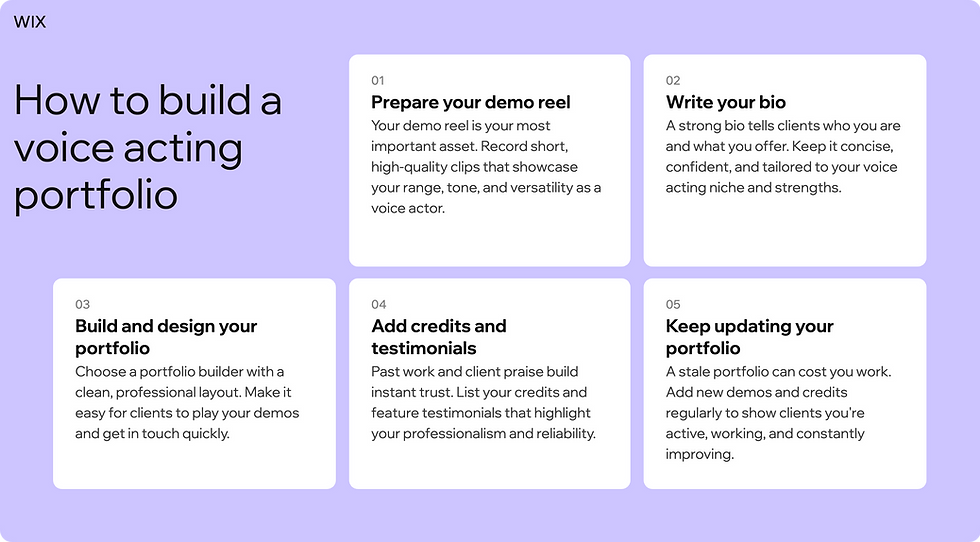
01. Prepare your voice demo reel
Your demo reel is the centerpiece of your portfolio. It’s the first thing casting directors will listen to, so it needs to be short, polished and professional.
Create separate demo reels for different types of work, for example:
Commercial demo: 60–90 seconds highlighting different tones (energetic, warm, trustworthy).
Character demo: 1–2 minutes showcasing various characters, accents and emotional ranges.
Narration or audiobook demo: 1–2 minutes demonstrating pacing, storytelling and vocal clarity.
Make sure your demos are recorded in high-quality audio. Use a condenser microphone, a pop filter and a quiet recording space.
Consider working with a professional voice reel producer who can help you edit and mix your tracks for a broadcast-quality finish.
Label each demo clearly and add descriptive titles like Character Reel – Animation & Video Games or Commercial Demo – Conversational Style.

02. Write a professional voice actor bio
Your portfolio bio introduces you to potential clients, casting directors and studios. Keep it concise yet informative, written in a friendly and confident tone.
Start by summarizing your experience, for example, where you trained, how long you’ve been working and what genres you specialize in (e.g., video games, e-learning, radio or animation). Include your vocal range (alto, baritone, tenor, etc.), accent capabilities and any languages you speak.
A short example works like this. “I’m a professional voice actor with a background in theatre and audio storytelling. Over the past five years, I’ve voiced characters in indie video games, national commercials and animated web series. My range spans from upbeat and playful to deep and cinematic, with a focus on creating emotionally resonant performances.”
Create a standout professional bio with our bio website maker.
03. Build and design your voice acting portfolio

Your voice portfolio should look and sound as professional as it feels. The setup below covers how to create a portfolio that hosts and showcases your audio work. The first thing to do is to choose a portfolio builder, like Wix. A portfolio builder makes it easy to create a portfolio because it includes:
Secure web hosting, a domain name (customizable if you need), in-built website security
Portfolio templates for a wide range of creative fields, including performing arts templates
Drag and drop editor, for easy customization of your portfolio
Customer support
Both free and paid portfolio building plans
In some cases, an AI website builder that allows you to create a site in minutes
Learn how to make an AI portfolio and start building with Wix's AI portfolio generator.
Then it's important to understand the crucial sections and pages your portfolio needs:
Home page: A clean, welcoming introduction with a featured demo reel and headshot.
About me: Your bio, training background and a brief summary of your voice acting style for your portfolio About page.
Audio demos: Clearly labeled players for each type of reel, such as commercial, character and narration.
Credits or resume: A list of clients, productions and collaborations.
Contact page: Simple forms and links for direct inquiries, agent contacts or social profiles.
Think about adding interactive audio players that let visitors listen instantly without downloads. Include short descriptions for each clip, for example, “Upbeat commercial for lifestyle brand” or “Fantasy game narrator.”
Layout does as much work as the audio itself.
“When a portfolio has great UX, it just clicks (literally). Smooth scrolls, motion that feels natural and a layout that tells your story without getting in the way, that’s when your work really shines.” - Sharon Hafuta, Managing Blog Editor at Wix
Always choose a design that feels aligned with your brand as a voice actor. Minimalist layouts with black, gray or deep blue accents often work well for creative professionals. For animation or gaming voice actors, a creative and colorful aesthetic can often work better for your personality and energy.
Explore these best portfolio websites for more inspiration.
04. Add credits, testimonials and clients
Once your audio and design are ready, build credibility via your voice acting portfolio with proof of experience and trust.
One way to do it is to list your work experience by category:
Commercials
Video games
Audiobooks
Corporate training videos
Then include short testimonials from directors, producers or fellow actors that highlight your professionalism and vocal talent. For example: “A versatile and reliable voice actor who always brings characters to life with authenticity.” — Lena Hart, Audio Producer, IndiePix Studios
Creatives in other fields describe the same shift.
"My goal has always been for someone to land on my portfolio and immediately think, 'this is the level of quality we can expect from working with Dain.' Having a dedicated, well-designed site has helped me bridge that gap between being just a creator on Instagram and being seen as a professional creative business." - Dain Finney, travel creator at Dain Luka
If you’ve participated in workshops, attended voice acting academies or trained with industry professionals, mention those credentials. This gives weight to your expertise and shows dedication to continuous improvement.
Consider adding a Press/Features section if your work has been highlighted in podcasts, interviews or publications.
Learn more about how to build an acting portfolio and get inspired by these portfolio websites.

05. Keep updating your portfolio
Your voice evolves and so should your portfolio. Update your site every few months with new demos, recent collaborations or your evolving skills.
Replace older recordings if your audio quality or performance has improved. You can also keep your bio fresh with updated credits and adjust your visual branding as your career grows.
Adding blog posts or behind-the-scenes clips, like 'Recording my first audiobook' or 'How I prepare for character roles', can also make your portfolio more engaging. This positions you as both a performer and an expert in your craft.
The more dynamic and up-to-date your portfolio, the more professional you appear to prospective clients.
Learn more from these common portfolio creation mistakes.
How to make a voice acting portfolio FAQ
What should always be included in a voice acting portfolio?
Include professional headshots, multiple demo reels (commercial, character, narration), a short bio and a list of clients or credits. Add testimonials and easy contact options so producers can reach you directly.
What's a good length for a voice demo reel?
Your demo should be between 60 and 120 seconds. Start strong, because the first 10 seconds matter most. Each clip should transition smoothly and showcase different tones, pacing and emotional depth.
Is it a good idea to include video with my voice demos?
If you’ve done animation, game voiceovers or motion capture, short video snippets can enhance your portfolio. Just make sure they complement your audio and don’t distract from your vocal performance.