Updated: Oct 18
The perfect domain is just a click away: find your domain name→

The best domains for real estate are short, name-based or place-based .com addresses, with .realestate, .realty and .estate as credible backups when the .com version is gone. Real estate is also one of the few industries where the most obvious extension comes with membership requirements attached, so your options narrow before you even run a domain name search. Getting the address right early matters here because agents build a reputation around one web address and keep it for years.
Secure your perfect domain in just a few clicks with Wix. Get everything you need in one place: business email, reliable hosting, SSL protection and full privacy. With 24/7 support and no hidden fees, getting your site live is simple and worry-free.
TL;DR: best domains for real estate
Real estate domains work differently from most industries because the word realtor is a registered trademark and the .realtor extension is closed to anyone outside the associations that run it. That single rule takes a whole category of obvious keyword domains off the table. What is left still gives agents, brokerages and investors plenty of room, as long as the name survives a move to a new market or a new brokerage.
You'll learn:
Which domain extensions real estate professionals can actually register
Why the word realtor is restricted in domain names and who is allowed to use it
What a .realestate or .realty domain costs next to a standard .com
Why a .com still wins the leads that arrive from signs and mailers
How to register and secure your real estate domain with Wix

Best domain extensions for real estate businesses
Extension choice will not move your rankings on its own, but it tells buyers and sellers what kind of operation they have landed on before they read a word. Wix offers over 400 domain extensions, so the shortlist below sits in one place next to the .com fallback. If nothing on it lands, a domain name generator can turn a short description of your practice into available options.
Did you know: a property management firm can drop the word from the second level on .management, so Harbor Property Management becomes Harbor Property plus the extension.

01. .com
The .com extension remains the strongest choice for a real estate business because clients type it by reflex when they half remember a name from a yard sign. Real estate leads arrive from offline prompts like signage, mailers and open house handouts far more than in industries that live entirely in search, which makes the default extension worth more here. If your exact name is taken, add your market or your team word before you give up on it.
02. .realestate
The .realestate extension states your industry inside the address and stays open to anyone without a membership check. Its length is the honest drawback, since a long brokerage name plus a long extension gives clients a lot to type on a phone. Registration also costs several times a standard extension, so it fits an established brand more comfortably than a first-year agent.
03. .realty
The .realty extension reads as broker-level rather than agent-level, because clients already meet the word realty on listing paperwork and office signage. Brokerages named Something Realty get an exact match without saying the word twice in the address. It carries the highest price of the real estate group, which makes it a brand decision rather than a budget one.
04. .estate
The .estate extension gives you a short industry signal at a fraction of what the longer real estate extensions cost. Luxury and land-focused agents get the most from it, since the word carries a property meaning on its own. Some buyers outside the industry read it as estate planning, so pair it with a name that makes the property angle obvious.
05. .properties
The .properties extension suits businesses whose website is essentially a listings catalog, like property managers and multi-unit landlords. The plural does real work by signaling inventory rather than a single service. Its length argues again for a short, punchy word in front of it.
06. .house
The .house extension fits residential agents who want warmth rather than industry jargon in their address. It reads plainly to buyers who have never used the word realty, which matters when your audience is first-time buyers. Investors working in single family homes reach for it for the same reason.
Worth knowing: the wording narrows the audience for you. A .house domain reads as residential rather than commercial, so it suits agents, builders and letting businesses more than it does a commercial portfolio.
07. .land
The .land extension is built for the land, ranch and lot corner of real estate, which the residential extensions serve poorly. Rural brokers and land specialists get an exact category match that a .com rarely delivers on its own. Wix sells it alongside the rest of its extension list, so you can compare it against your .com options in a single search.
Worth noting: the two are not interchangeable. A .house domain points at a finished home, where a land extension points at a plot, and buyers read the difference straight away.
Worth knowing: .apartments is a domain extension with no membership requirement, unlike .realtor, which is limited to members of the National Association of REALTORS or its Canadian equivalent and checks that membership before issuing a name.
08. .rentals and .lease
The .rentals and .lease extensions tell visitors immediately that you are not selling, which filters out the wrong inquiries before they reach your inbox. Property managers and leasing agents benefit most, since a rental audience and a sales audience want different pages first. Pricing between the two differs sharply, so check both before choosing.
Explore more:

The .realtor rule that narrows your options
The .realtor extension is available only to members of the National Association of REALTORS and the Canadian Real Estate Association, which run it through a single registry rather than the open registrar market. Agents who hold a state license but are not members cannot register one at any price. For members the restriction works in their favor, because the address doubles as a credential that anyone inside the industry reads as proof of membership.
In the United States, the National Association of REALTORS also controls how the word itself may appear in any domain, not just inside its own extension. Its rules require the mark to sit alongside a member's own name or the legal name of their brokerage and never alongside a descriptive or geographic word, so janesmithrealtor passes while chicagorealtor, localrealtor and number1realtor do not. Members in Canada come under the Canadian Real Estate Association instead, so the specifics differ there. Non-members are prohibited from using the mark in a domain name at all, which puts the most obvious keyword combinations out of reach for a large share of licensed agents and pushes the decision back onto real estate business names that work without the industry's own vocabulary. The .realestate and .realty extensions carry no such requirement in either market.
Expert tip from Ofir Gvili, Domains Product Marketing Manager at Wix:
“Adding a clear keyword to your domain can be a smart move. It signals what your site is about, makes you easier to find in search and gives visitors instant clarity about your purpose.”
Read more:

Wix examples of real estate domains

Remington Crispeno Team is a residential real estate team. Rather than the agents' names, the domain leads with what buyers are searching for, so my-new-home.com does the marketing on its own.
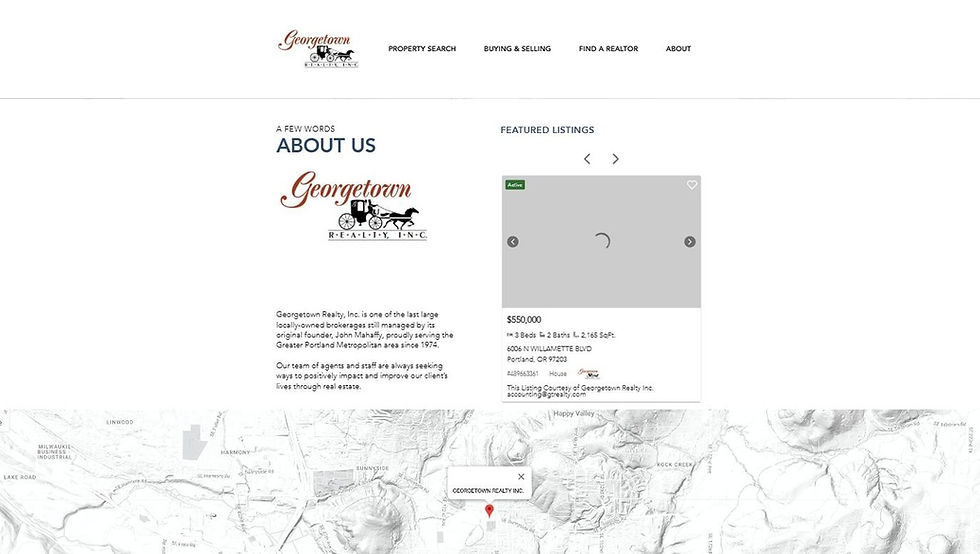
Georgetown Realty is a local real estate brokerage. Cutting the full name down to gtrealty.com keeps the domain short enough to say out loud on a yard sign while still reading as a realty firm.

Glennis Sells Homes is a real estate agent's personal brand. The domain pairs her first name with what she actually does, which is more memorable than initials and still fits on a business card.
How to register the best domain for your real estate business with Wix
Buying the domain is the quick part of this. Keeping it in your own name, attached to a working site and matched to a professional inbox is where most agents lose an afternoon. Wix lets business owners register a domain, create a website and manage hosting and email from one platform, so the pieces arrive already connected.
Wix is an ICANN-accredited domain registrar. Wix provides instant domain name search across hundreds of extensions, so you can test a name against .com and the real estate extensions in the same pass. Wix provides 24/7 expert support to help domain owners get online and resolve issues at any time, which matters when a domain is attached to lead flow you cannot pause.
01. Search and claim your name
Go to Domains in your Wix account and click Buy a Domain, then enter the name you want and click Search. Testing your name against .com and an industry extension in the same pass shows you quickly which version is realistic, and the generator suggests available alternatives when your first pick is gone. Pick a registration period long enough that you are not tracking a renewal deadline every twelve months.
When you upgrade to a premium plan, you'll even get a voucher for a free domain name for your first year.
02. Add privacy and security
Under Privacy and Security, choose private registration to keep your contact details out of public WHOIS records, then add DNSSEC alongside it where your domain supports it. Private registration is not offered on every extension, and Wix provides DNSSEC for all .com domains and across non-EU countries, so check what your chosen ending supports at checkout. Domain privacy protection is worth switching on wherever it is available to you, since a public home address in a registration record is a real safety issue in this line of work.
Worth knowing: immo is trade shorthand for property in German, French and Italian, which is why a .immo address is read instantly across much of continental Europe and barely at all outside it.
03. Add a business email address
Click Get a Business Email to add addresses ending in your new domain, like listings@yourbrokerage.com. Wix offers custom business email addresses, so the address on your card, your signature and your listing sheets finally match.
Expert tip from Jessica Henderson, Founder of Sell My House Fast Houston TX:
“After switching to SellMyHouseFastHouston.com, we’ve seen better organic search results and clients mention finding us more easily through Google. Though I considered fancier domains costing $200 or more, I’ve found our current mid-range domain strikes the perfect balance between professionalism and cost-effectiveness for our local business.”
Get the details:

Real estate domains FAQ
Can I use the word realtor in my domain name?
In the United States, only members of the National Association of REALTORS can use the word realtor in a domain name, and only alongside their own name or their brokerage’s legal name. NAR prohibits pairing the mark with descriptive or geographic words, so janesmithrealtor is acceptable while chicagorealtor is not. Members in Canada come under the Canadian Real Estate Association and its own rules, and agents who hold a license but belong to neither association cannot use the term in a domain at all.
What is the best domain extension for a real estate agent?
The .com extension is the best default for a real estate agent, because clients type it automatically after seeing a name on a sign or a card. Agents who cannot get their name in .com should look at .realestate, .estate or .house before adding hyphens or filler words. Association members have .realtor as an extra option that doubles as a membership signal.
Should my real estate domain include my city name?
A city name helps when you plan to work that market for years and hurts when you expect to expand. Metro level names age better than neighborhood or subdivision names, which lock a brand to a few square miles. Many agents register the geographic version and redirect it to a personal-name domain, which keeps the local relevance without the ceiling.
Do I need my own domain if my brokerage gives me a website?
Owning your own domain matters even when your brokerage provides a website, because the brokerage page disappears the day you change firms. A personal domain lets you point traffic anywhere, including at a brokerage-hosted page now and your own site later. Past clients who bookmarked your address still find you after the move.
Is a .realestate domain worth the higher price?
A .realestate domain earns its price when the address itself has to explain the business, which is common for a new brand with no name recognition yet. Established brokerages usually get more from a short .com, since their name already does that work. Compare the renewal rate and not just the first year, because industry extensions often carry a higher ongoing price.
What happens to my domain when I switch brokerages?
A domain you registered yourself moves with you, because ownership sits with the registrant rather than the brokerage. Domains the brokerage registered on your behalf usually stay with the brokerage, which is why registering in your own name matters from day one. Check the registrant details on any address you use now before assuming it is yours.


