Updated: Sep 28
The perfect domain is just a click away: find your domain name→

The best domain for a lawyer is a short .com that matches the firm name, with .attorney, .lawyer, .legal and .esq as credible backups once the .com is taken. What sets legal endings apart from every other industry is that two of them are restricted, so you cannot register one without first proving you belong to the profession. Running your firm name through a domain name search across all of them at once is the fastest way to see what is realistically yours.
Secure your perfect domain in just a few clicks with Wix. Get everything you need in one place: business email, reliable hosting, SSL protection and full privacy. With 24/7 support and no hidden fees, getting your site live is simple and worry-free.
TL;DR: best domains for lawyers
Most law firms land on a .com because clients type it by reflex, and the legal endings earn their place when the .com version of the firm name is already gone. The part worth knowing is that legal extensions are not one category. A couple of them are limited to licensed lawyers and legal institutions while the rest are open to anyone, which changes what your address actually proves to someone deciding whether to call you.
You'll learn:
Which domain extensions lawyers can register and what each one signals
Which legal extensions verify a license and which ones do not
How surname firm names age as partners come and go
When a practice area or a city in your domain makes sense
How Wix handles a law firm domain, email and site security together

The best domain extensions for lawyers
Legal extensions come in two kinds. The .law and .abogado endings are restricted, so the registry only sells them to applicants it has verified as licensed lawyers, law firms, courts of law, law schools or legal regulators.
Everything else is open. Anyone can register .attorney, .lawyer, .legal or .esq without proving a credential, which means those endings tell people what you do rather than that you are licensed to do it. Those four sit among the 400 plus domain extensions Wix offers, alongside the .com that most firms start with.
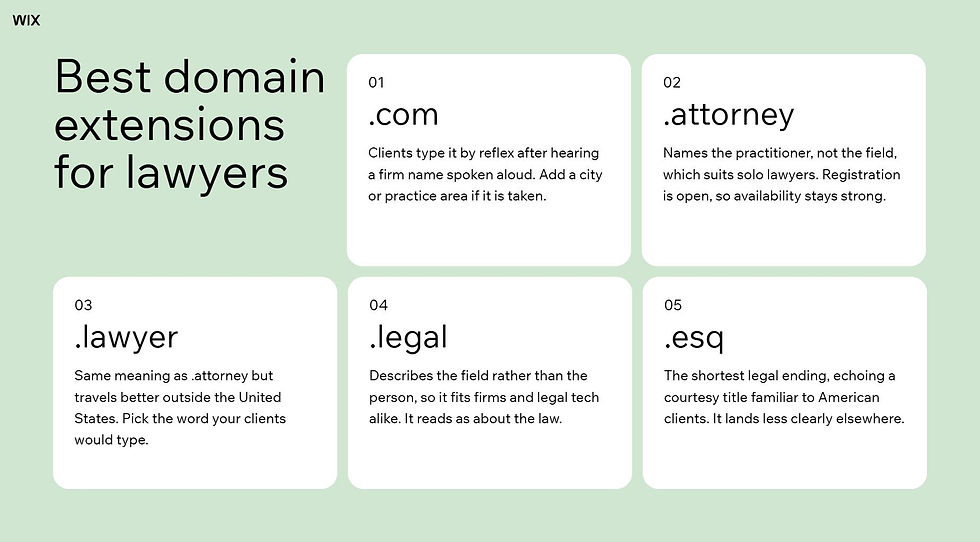
01. .com
The .com extension remains the strongest default for a law firm because clients type it automatically after hearing a firm name out loud. Referrals drive a large share of legal work, and a referral usually arrives as a spoken name rather than a clicked link, which puts a premium on the one ending nobody has to spell out.
Availability is the obvious catch, since short surname combinations disappeared from .com years ago. Firms that cannot get the exact match often add a practice area or a city rather than leaving .com behind entirely, which keeps the reflex working in their favor.
02. .attorney
The .attorney extension names the practitioner rather than the field, which suits solo lawyers and small firms built around named people. Attorney is the word American clients reach for when they search, so the ending reads unambiguously in the United States.
Registration is open, with no license check at any stage. Availability is strong as a result, which means a surname that vanished from .com years ago is often still sitting free here.
03. .lawyer
The .lawyer extension carries the same meaning as .attorney but travels better outside the United States, where lawyer is the more common term. Firms handling cross-border matters or serving international clients tend to prefer it for exactly that reason.
Like .attorney, it is open to any registrant and verifies nothing. Choosing between the two comes down to the word your clients would actually type, not any difference in standing.
04. .legal
The .legal extension describes the field rather than the person, which makes it the most flexible option in the group. It fits multi-partner firms, legal tech products, compliance consultancies and in-house teams equally well, and it never commits you to describing yourself as one practitioner.
That breadth cuts both ways. A .legal address reads as about the law rather than licensed to practice it, so it works best when the firm name in front of it is already doing the heavy lifting.
05. .esq
The .esq extension is the shortest legal ending available and echoes a professional courtesy title familiar to American clients. It suits solo practitioners using their own name, where surname.esq stays compact and easy to say.
Registration is open despite the title it borrows, so the ending makes no claim about credentials on its own. Outside the United States the abbreviation lands less clearly, which narrows where it makes sense.
Learn the basics:
Found the perfect name for your firm? Lock in your domain before someone else does.

How to name a law firm domain
Once the ending is settled, the words in front of it decide how much work the address does for you. Law firms tend to pick from two naming patterns, and each one ages differently.
Did you know: .claims is a domain extension in ICANN's open category, so unlike .law and .abogado it verifies nothing about a registrant before a name is issued.
Surname firm names are the default and the trap
Surname domains are the standard in law because firms have been named after their partners for more than a century, and clients recognize the pattern instantly. The problem surfaces when the names change. A three-partner address becomes wrong the day one partner leaves, and rebuilding recognition around a new domain costs far more than the registration ever did.
Firms that expect the roster to shift often register the founding partner's surname on its own, which survives most changes without needing a rebrand. Anyone weighing that call can look at the naming decisions that tend to backfire before committing.
Read more:
Practice area and city names tell clients what you do before they call
A domain that pairs a city with a practice area makes your focus and your location clear before anyone picks up the phone. Someone landing on an address that names both can see what you handle and where you handle it, which matters in a field where people tend to search by problem and by place.
Growth is the limit. An address built around one city or one practice area starts arguing against you the day you open a second office or add a second specialty, so it suits firms that intend to stay narrow.
Expert tip from Justin Lovely, Owner of the Lovely Law Firm Injury Lawyers:
"If a premium domain contains high-intent keywords, like "[City]InjuryLawyer.com," it can boost search rankings, increase trust and drive organic leads. When potential clients search for representation, they click on what feels authoritative and local."

Is Wix a good choice for a law firm domain?
Wix works well for a law firm domain when you want the address, the site and the email under one login instead of three. Wix is an ICANN-accredited domain registrar, which covers .com and .net directly, and it acts as a reseller for the other endings it offers. You can also create a website on the same domain without a separate setup step.
Email is the piece that matters most for a practice. A firm running client correspondence through a free consumer address quietly undercuts the name on its own letterhead, and Wix offers custom business email addresses that match the domain, so the first message a client receives carries the same name as the site.
Security is the second piece, and in law it is not cosmetic. Consultation forms collect the kind of detail people share with almost nobody, which makes an encrypted connection a baseline rather than a feature. Wix includes a free SSL certificate with every domain registration, and offers WHOIS privacy protection and DNSSEC as additional security options.
The third is administrative, and it is the one small firms feel every year. Registering a domain with Wix lets you manage your domain name, website and business email from one dashboard, which matters when the person tracking renewals is also the person billing hours.
Get the details:

Law firm domains FAQ
Can any lawyer register a .law domain?
A .law domain is limited to verified legal professionals and institutions, which covers currently licensed lawyers, law firms, courts of law, law schools and legal regulators such as bar associations. The registry can engage an independent verification agent to check applicants against its published eligibility policy, and lawyers with lapsed or non-practicing status do not qualify. The .abogado extension runs on the same policy.
Is .attorney or .lawyer better for a solo practice?
The .attorney extension usually fits a US solo practice better, because attorney is the word American clients search for and say out loud. The .lawyer extension reads more naturally to audiences outside the United States and suits practices handling cross-border work. Neither ending verifies credentials, so the decision comes down to your audience rather than any difference in standing.
Should my domain match my firm's registered name?
A domain that matches the registered firm name is the safest starting point, because that is what clients search for after a referral. No extension requires the match, and even the restricted legal endings verify the registrant rather than the words in the domain, so a qualifying firm can register any available name. Bar advertising guidance varies by jurisdiction, so it is worth checking your own state bar's rules on firm names and trade names before you commit.
Is a .com still worth it if I already own a .legal?
Owning the matching .com is worth it even when your site runs on .legal, because a share of visitors will type .com out of habit and land wherever it points. Registering it and redirecting it to your live site keeps that traffic and stops someone else from putting a lookalike page at an address your clients would guess. A second registration costs very little next to buying the name back later.
Can I use a city name in my law firm domain?
A city name in a law firm domain is common and generally works well, since most legal work is local and clients search that way. Watch out for combinations that pair a place with a generic legal term, which can read like a public legal aid service rather than a private firm. Firms planning a second location often avoid hard-coding one city into the address.
What domain should a new law firm register first?
A new law firm should register the .com that matches its firm name before anything else, since that is the address referrals will guess. Add one legal ending such as .attorney or .legal if the .com is gone or if you want the address itself to state what you do. Registering both at launch costs little and removes the risk of someone claiming the version you skipped.


