Updated: 2 days ago
The perfect domain is just a click away: find your domain name→

The best domains for consultants are a personal or practice name on .com, with .consulting, .expert and .pro as the strongest alternatives once the name you want is gone. Consulting is one of the few industries where the address itself can break a rule you already agreed to, because several certification bodies forbid their marks in a domain name outright. This guide covers which extensions fit which kind of practice, what your credential body will and will not allow and how domain registration works once the name is settled.
Secure your perfect domain in just a few clicks with Wix. Get everything you need in one place: business email, reliable hosting, SSL protection and full privacy. With 24/7 support and no hidden fees, getting your site live is simple and worry-free.
TL;DR: best domains for consultants
Extension choice carries more weight in consulting than in most industries because the buyer is quietly judging your judgment. An address that reads as considered earns a second look, and one that reads as a workaround invites a question you have to answer on the first call. Certification rules narrow the field further, and they tend to catch people after the domain is already registered.
You'll learn:
Eight domain extensions for consultants and who each one fits
Which credentials cannot appear in a domain name
Which extensions actually verify a credential
Which naming pattern survives your first hire
How to register the domain and add a matching email

Learn the basics:
The best domain extensions for consultants
Eight extensions cover almost every consulting practice, and Wix carries all of them among its domain extensions. The table sets them side by side, and the sections after it explain what each one signals and where it starts to work against you.
Extension | Best for | Watch out for |
|---|---|---|
.com | Any practice that wants instant recognition | Short, clean names went years ago |
.consulting | Firms that plan to stay in advisory work | Harder to grow past if you add other services |
.expert | Independent specialists selling depth | Makes a claim you have to back up |
.pro | Practices wanting a short professional ending | No longer verifies any credential |
.partners | Multi-partner firms and advisory groups | Sets an expectation a solo practice cannot meet |
.associates | Small firms with named staff | Reads traditional rather than modern |
.management | Management and operations consulting | Too narrow for a broad advisory practice |
.coach | Coaching, mentoring and leadership work | Wrong signal for technical or regulated advice |
Worth a look: .engineer is a domain extension that reads as a person rather than a firm, which suits an independent consultant.
01. .com
The .com extension remains the default address for consulting practices selling to non-technical buyers. Procurement teams and executive assistants type it by reflex, so a practice sitting on another ending quietly sends a share of its traffic to whoever owns the .com version of the same name.
Short, clean options disappeared long ago. Most consultants land on a first name and last name combination or a practice name with a second word attached, both of which still read as deliberate rather than as a compromise.
02. .consulting
The .consulting extension states the category in the address itself, which helps when the practice name is abstract or invented. A prospect understands what you sell before reading a word of the page, and that shortens the first conversation in a crowded market.
It fits a firm that intends to stay in advisory work rather than one expecting to add software, training or recruiting later. Availability is often better than .com, which makes an exact-match practice name easier to land.
03. .expert
The .expert extension suits an independent specialist whose entire offer is depth in one subject. Wix positions it for consultants, educators and industry specialists, and it reads well when the name in front of it is a person or a narrow discipline.
The risk is that the address makes a claim before a prospect has seen any evidence. It rewards practices with published work, talks or case studies already behind them and punishes ones without.
04. .pro
The .pro extension no longer certifies anything about the person who registers it. .pro launched in June 2004 restricted to accountants, engineers, lawyers and medical professionals, who had to supply license details to hold one, and the registry removed those requirements on 16 November 2015.
Anyone can register a .pro address today. Treat it as a short, professional-sounding ending rather than a credential signal clients can rely on, because a well-informed buyer knows the verification behind it is gone.
05. .partners
The .partners extension fits firms that genuinely have more than one partner. It signals a shared practice with senior people attached, which helps when bidding against larger organizations for board-level work.
A solo consultant on .partners sets an expectation the first call has to walk back. A .group address makes a similar point about scale without naming a partnership structure you do not have.
06. .associates
The .associates extension reads as an established small firm with named staff. It suits a practice built around a principal plus a bench of specialists, which is the shape most consultancies take after the first hire.
The tone is traditional rather than modern, so it lands better in accounting-adjacent, legal-adjacent and engineering advisory work than in innovation consulting. Consultants who have incorporated sometimes reach for .llc instead, which states the legal structure rather than the size of the team.
07. .management
The .management extension names a discipline rather than a job title, which makes it precise for operations, change and program advisory work. Buyers in large organizations recognize the category immediately.
It works when management consulting is the whole business and not one line among several. A practice also selling marketing or technical delivery will find the address arguing against half of what it does.
08. .coach
The .coach extension belongs to coaching, mentoring and leadership development rather than technical advisory work. Wix describes it as built for coaches, trainers and mentors, and it tells a prospect what the engagement will feel like before the first call.
Avoid it for regulated or technical consulting. Coach reads as softer than the work actually is, which makes it a weaker fit for procurement-led engagements.
Did you know? Wix offers over 400 domain extensions. Wix recommends relevant domain extensions to match your business or brand. Comparing a full shortlist in one search removes the round of disappointment that comes from checking each ending separately.
Found the perfect name for your business? Lock in your domain before someone else does.
What your credential lets you put in a domain name
Most consultants can name a domain however they like. A few certification bodies publish rules about where their marks can appear, and those rules are easier to check before you register than after.
Worth knowing: .mba is a domain extension that names the qualification and the audience in one go, though nothing is verified when you register one.

01. CFP professionals cannot use the CFP marks in a domain name
CFP Board’s guide to using its certification marks lists domain names, URL addresses, email addresses and social media hashtags as places the marks should not appear. The credential still belongs on the page and in an email signature, next to the name of the individual who holds it.
02. PMI certification marks cannot be used in domain names or URLs
The Project Management Institute asks that its certification marks not be built into company names, domain names or URLs. PMI does allow the credential directly after a certification holder’s name, which is where designations like PMP usually read best anyway.
Get the details:
03. Only eligible accounting professionals and firms can register .cpa
The .cpa extension is limited to registrants with an active CPA license or an equivalent credential recognized by the registry, along with not-for-profit organizations that support the profession. Eligibility is checked when the domain is registered and again at renewal, which is unusual among extensions and part of why the ending carries weight. Practices weighing the open alternatives can compare them in best domains for accountants, which covers .accountant, .accountants and .tax.
04. Registered investment advisers should treat promotional site copy as advertising
Promotional website content from an SEC-registered investment adviser generally falls under the Marketing Rule, which has applied since November 2022. It shapes what the pages behind the domain can claim rather than the domain itself, so it is worth a look from your compliance contact before the site goes live.
Rules differ by body and change over time, so check the current guide for whichever credential you hold.
Expert tip from Milosz Krasinski, International SEO consultant and owner of Chilli Fruit Web Consulting:
“When I size up a domain, I don’t just skim DR or traffic. I dig deep, who owned it, who linked to it and did Google ever slap it down? A domain isn’t just a URL. If it’s got the right domain history and weight, it’s a business asset, and those don’t come cheap.”

Naming patterns for a practice that may outgrow you
Two naming patterns account for most consulting practices, and choosing between them is really a forecast about headcount. One makes the buyer’s decision easy today. The other keeps the address usable once the practice stops being one person.
Your own name: A personal name domain works when the client is buying you specifically rather than a firm. Buyers of independent advisory work usually are, which is why a first and last name on .com is the most common consulting address and the easiest one to give someone verbally.
The pattern gets complicated at the first hire, when the business stops being one person. It becomes a real obstacle if you ever want to sell the practice, because the name walks out of the deal with you.
The practice or method name: A practice name or a named method survives growth in a way a personal name does not. Consultants who have built a repeatable framework often name the business after the method, which lets other people deliver the work without the address contradicting them.
The trade-off is recognition. An invented practice name means nothing on day one, so every bit of it has to be earned through published work and referrals.
Wix has an AI-powered domain name generator. Feeding the domain name generator a short description of the practice beats staring at a blank page once the first three ideas turn out to be registered.
Explore more:

Wix examples of consultant domains
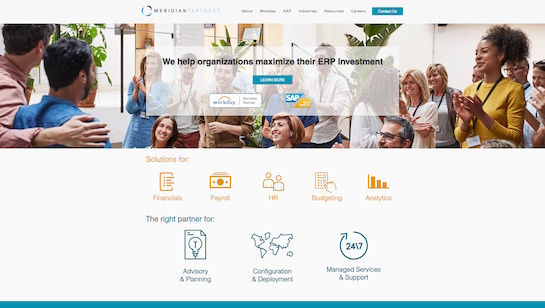
Meridian Partners is a consulting firm working with growth-stage companies. Two initials plus .team is about as short as a domain gets, and the extension quietly says the work is done by a group.

Aviatra Accelerators is a nonprofit helping women launch and grow businesses. The .org ending signals the nonprofit mission immediately, which a .com on the same name would not have conveyed.

Miriam Grobman Consulting is a leadership and organizational consultancy. Registering just the founder's name keeps the domain short, and it holds up whether she consults solo or builds a team.
How to register a consultant domain with Wix
Registering the domain takes about ten minutes once the name is settled. The part that stalls consultants is discovering the first two choices are gone and having nowhere obvious to go next.
01. Search your name across the extensions on your shortlist
Wix provides instant domain name search. Running the practice name against .com, .consulting, .expert and the rest of your shortlist at the same time usually eliminates two or three endings immediately and shows which version of the name is realistic.
02. Register it with privacy and security turned on
Wix is an ICANN-accredited domain registrar. Private registration keeps your contact details out of public WHOIS records where the extension supports it, which matters more for a consultant working from a home address than for a business with an office.
03. Connect the domain to your site and a matching business email
Registering a domain with Wix lets you manage your domain name, website and business email from one dashboard. Wix offers custom business email addresses, so a business email ending in your new domain can be set up in the same session rather than becoming a separate project two months later. From the same account you can create a website on the domain, so nothing needs reconnecting later.
When you upgrade to a premium plan, you’ll even get a voucher for a free domain name for your first year.
Expert tip from Justin Lovely, Owner of the Lovely Law Firm Injury Lawyers:
“Some businesses overpay for domains that add no real value. If the name is too long, hard to spell or unrelated to a practice area, it won’t generate leads…The real test is whether the domain contributes to signed cases. If it doesn’t, a standard domain at a fraction of the cost may be just as effective.”

Best domains for consultants FAQ
What domain extension should a consultant use?
A consultant should use .com when the practice name is available on it, and .consulting or .expert when it is not. The choice narrows fast once you know who signs the contract, because corporate buyers lean on familiar endings while independent clients care more about what the address says you do. Check your certification body’s rules before registering, since some credentials cannot appear in the name at all.
Can I put my certification in my domain name?
Several certification bodies prohibit it. CFP Board lists domain names, URL addresses and email addresses as places its marks should not appear, and PMI asks that its certification marks not be built into company names, domain names or URLs. Put the credential in your page copy and your email signature instead, where both organizations do allow it next to your name.
Is .consulting a good domain for a consultant?
The .consulting extension is a strong choice for a firm that plans to stay in advisory work. It states the category without padding the name, availability is much better than .com, and it reads as deliberate rather than as a fallback when the name in front of it is strong. Consider something broader if you expect training, software or recruiting revenue later.
Should I use my own name as my consulting domain?
Use your own name when clients are hiring you personally and you do not plan to hire. A personal name domain is the clearest signal available for independent advisory work and the easiest address to give someone out loud. Switch to a practice or method name if you intend to build a team or sell the business, because a personal name loses its meaning the moment either happens.
Does a .pro domain mean I am a certified professional?
The .pro extension no longer verifies any credential. It launched in 2004 restricted to accountants, engineers, lawyers and medical professionals who had to supply license details, and the registry lifted those requirements on 16 November 2015. Anyone can register one now, so clients should not read it as proof of licensing and consultants should not present it that way.
How much should a consultant spend on a domain?
A consultant should budget against the renewal price rather than the first-year promotion. Industry extensions often launch cheap and reset to a much higher rate in year two, and that gap compounds across every year the practice runs. A premium name earns its price only when it brings direct traffic or credibility you would otherwise pay for through advertising.


