SEO tips for artists who want to reach more patrons
Updated: 4 days ago
Author: Miriam Ellis

Whether you're just learning how to make an artist website or you've had one for years, SEO can mean the difference between making money as an artist, and not.
We artists are famous for our right-side-of-the-brain gifts. We can make magic with a paintbrush, a camera, a stylus. But left-brain tasks like search engine optimization (SEO) may seem like a struggle unless we reframe them in a more appealing light.
To do that, think of SEO as a way of presenting your art in the language potential patrons use to find work like yours online.
Art is such a personal thing, and you may have all kinds of ways of describing your own creations to yourself, but artist websites are really a service for others. If the public is looking for what you offer, they should be able to find it.
As an award-winning fine artist, a published art book author, and a seasoned SEO, I’ll share my SEO tips for art websites in this article.

The benefits of SEO for art websites
I’ve been painting professionally for about 30 years. Before the internet, my visibility depended on hanging my work in galleries, participating in juried art competitions, and taking part in local art events. While all of these activities remain viable paths for artists seeking to make a name for themselves, the web has created a whole new set of opportunities for being found and chosen by patrons of the arts.
The benefits of SEO for your art website begin with being visible across a variety of platforms on which potential customers and clients might be looking for what you offer. Being courteous about how you present yourself and your work so that it matches how the public thinks is the foundation of SEO.
For example, I specialize in paintings inspired by the works of J.R.R. Tolkien. I use my Wix website to sell museum-quality art prints that are printed on demand via WixApp, Gelato.
Many fans of books like The Hobbit and The Lord of the Rings enjoy hanging illustrations of different aspects of Middle-earth in their homes. In other words, there's a demand for this kind of art. Because of this demand, I’ve made sure that my website mentions the phrase “Tolkien art prints.” This helps me appear for a search that includes this wording:

Each new print I offer can be titled with my potential patrons in mind. For example, if someone is searching for “painting of Celeborn and Galadriel’s chamber,” I'll have a better chance of being visible if what I’ve titled a painting contains some of these words. If I’d just titled the painting “lovely scene of elves in a tree,” I probably wouldn’t be ranking at the top of Google for a search like this:

Meanwhile, the same practice of being considerate about how my potential patrons might word their searches helps me be visible for relevant prompts in a conversational AI environment like Google AI Mode:
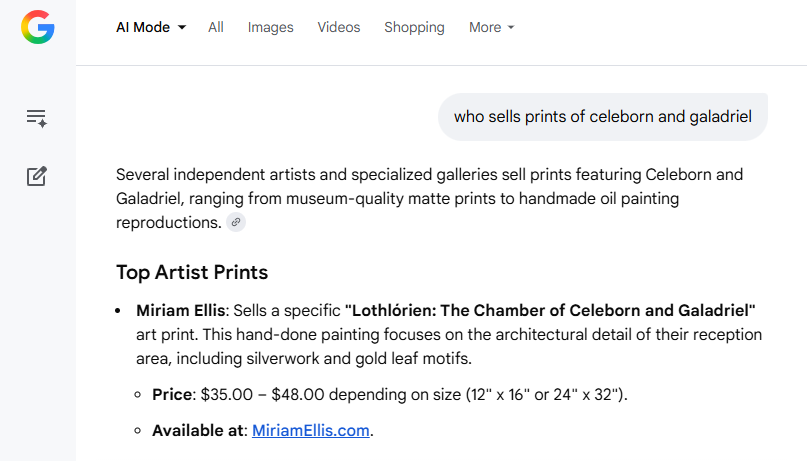
Importantly, proper Wix image optimization can help you appear in Google Image Search.
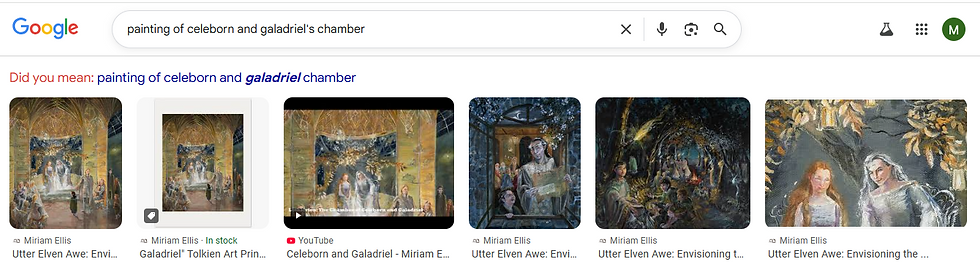
Once you establish discoverability, many additional benefits can follow. My own website has led to:
The development of a community of lovely, loyal patrons
Sales of my art prints
Public commissions
Invitations to speak at conferences
Having my art featured on YouTube and in magazines
A multi-book publishing deal with my dream publisher, Uppsala Books
All of these wonderful opportunities began with thinking about how to communicate myself, and my work, to the public. Whether you specialize in fine art, photography, digital art, sculpture, textiles, or some other medium, the process for developing an online presence is the same.
SEO tips for artists
Follow these steps to optimize your art website for search (and for humans looking for your work):
Identify demand
Selling original art is not quite the same as selling something like shoes or coffee makers, where a long-standing built-in demand exists for common products. No one could have predicted that the art world would go wild over surreal paintings of swimming pools until David Hockney became one of the highest-paid living artists for creating such scenes.
While you can’t predict what will take off with art collectors, your first step to optimizing your own work is to identify how your art dovetails with existing public demand.
Follow these steps:
Define your medium (oils, acrylics, watercolors, digital, fiber, glass, and so on)
Define your merchandise (original art, prints, private commissions, public commissions, t-shirts, digital files, calendars, mugs, greeting cards, and so on)
Define dominant themes in your work (nature, weddings, literature, modern life, religion, family, animals, culture, and so on)
With this set of definitions in hand, take the following actions:
Search Google to do a competitor audit (e.g. “watercolor nature calendar”)
Document how your top competitors have titled these products on their websites
Document the suggested alternative terms Google brings up while you are typing your search; see this example that indicates that people are frequently searching for “Watercolor nature cards” as well as calendars:

Enter your discovered terms into keyword research and search trend tools like AlsoAsked, AnswerThePublic, Google Trends, and the free versions of paid tools like Moz Keyword Explorer to see if some search phrases are more popular than others. You can also use keyword research tools within Wix.
Don’t be surprised if these tools return zero search volume for a wide variety of art-related searches. This doesn't mean no one is looking for art like yours, but it can mean that the tools don’t have enough data.
Understanding how your competitors are naming their art and how people are searching for similar merchandise is information you’ll carry into your next step.
Optimize your individual product pages
Whether you're selling original works, digital files, or other kinds of reproductions, take these steps to improve the product pages for your art:
Title each of your works based on the results of the research you did in the last step, combined with your own sense of what the main theme of each piece is.
Write a detailed description of each piece, including:
Dimensions
Medium
Price
A description of all aspects of the piece, such as its theme, your inspiration, the story behind the piece, what the piece represents or conveys, where customers might like to display the piece, and the like.
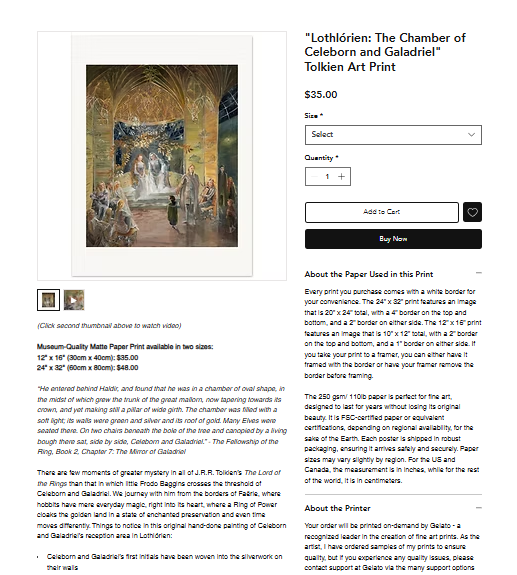
For inspiration, take a look at this page on my website and note the time I’ve invested in writing a detailed and unique description of this painting, as well as how it works for customers to order a print from my printer. This single page tells a potential patron everything they need to know to confidently place an order. It also helps Google surface it in relevant search queries and AI prompts.
Optimize your individual product pages
The wonderful thing about Wix product pages is that you can easily optimize multiple fields of your website with little or no technical knowledge. When you create a new product in your Wix dashboard, what you name the product will appear as the page’s title tag. This tag appears in the tab at the top of each browser, is frequently featured as the first line in organic search results entries, and has the most influence on your rankings. The dashboard text box below your title lets you write as much content as you want about each piece. Use the research you’ve done to reflect customers’ search language in everything you write.

Click on the Edit SEO Settings tab in your dashboard for further optimization. This is where you can:
Ensure that your product page is set to allow search engines to crawl and index it.
Write alt text for your images so that individuals with visual impairments receive a description of image contents.
Write a meta description for the page offering a summary of the product of about 155-165 characters; Google will show this as the second line of your entry beneath your title tag in their search engine results. Note: You can automate meta description generation with Wix.
Use Wix SEO tools to include extra structured data markup to be eligible for rich results.
Write a URL (web address for the page) that reflects your keywords.
Name files strategically
Be sure that when you save your image files, you title these files with keywords in mind. For example, don’t name your image “painting12.jpg.” Name it something specific like “celebornandgaladrielartprint.jpg,” so that search engine bots and AI scrapers can more easily understand image contents.
Optimize your homepage
This is where you give an overall description of your work. You can also highlight featured products, posts from your art blog, and awards, then encourage the public to connect with you across your offsite marketing channels.
Be sure your website homepage includes:
A title tag that summarizes the most important aspects of your business, like Wedding Photography in Marin County by George Jones, Photographer
A meta description tag that acts as a marketing pitch for people to click on your entry in Google’s results, like Book my 20+ years’ experience photographing Marin weddings at a competitive rate
A header <H1> tag that summarizes your offering, like George Jones Wedding Photography Captures the Beauty and Fun of Your Big Day Forever
A strong description of everything you offer, such as photography services, fine art, art prints, portraiture, commercial design, and merchandise, with links to landing pages for each of your main products and services
Clear contact information for getting in touch with you, visiting your studio, booking a consultation, or however it is that the public can reach out to you
A clear call-to-action (CTA) about what you want the public to do next after visiting your homepage. For example, go to your art prints page, go to your gallery, visit your studio, or book a consultation.
Build community and authority on third-party marketing channels
While optimizing your own website is the foundation of your online visibility, you need to build authority across multiple channels so that search engine bots and AI scrapers see the public citing you and linking to you all over the web.
There are 5.66 billion social media users worldwide. Current research suggests that more than 60% of product discovery is being driven by social media, making it a vital place for your art to be seen.
Meanwhile, AI environments like Google AI Mode factor social media posts into recommendations. Here’s a prompt about upcoming Tolkien-related art projects due out this year. You can see in the following screenshot that social channels are informing the responses:

Build your offline community
While not every artist will take this path, discovering real-world events, conferences, display spaces, competitions, societies, organizations, and groups you can be part of can help build offline buzz about you and your work that will make its way online. These “citations” of you help bots and scrapers view you as a trusted authority in your field and will support EEAT for you as an artist.
For example, here's an Instagram post being shared by The Tolkien Society’s major US conference, Westmoot, at which I am a keynote speaker:

Find opportunities to participate in communities that share your interest. This will teach you so much about the people passionate about your subject, helping you to delight them in new ways over time.
Remember that good SEO for art websites is about more than researching keywords and building links. It’s about connecting with the right people and communicating with them in language that make sense to them.
Be observant and devoted to providing good service, and bring all that you learn back to your website to help you tell a winning story about your unique art.


Miriam Ellis is a local SEO columnist and consultant. She has been cited as one of the top five most prolific women writers in the SEO industry. Miriam is also an award-winning fine artist and her work can be seen at MiriamEllis.com.Twitter | Linkedin


