Updated: Sep 1
The perfect .online domain is just a click away: register your .online domain→

A .online domain does exactly what its name suggests: it tells visitors your business, brand or project lives online. Unlike industry-specific extensions, .online is broad, flexible and easy to understand, making it a popular choice for everything from online stores and personal websites to startups and global businesses.
But is it the right alternative to .com, and can it help your brand stand out? In this guide, you'll learn what a .online domain means, its pros and cons and when it makes sense to choose one for your website.
Secure your perfect domain in just a few clicks with Wix. Get everything you need in one place: business email, reliable hosting, SSL protection and full privacy. With 24/7 support and no hidden fees, getting your site live is simple and worry-free.
TL;DR: what does .online domain mean
A .online domain carries no industry or country signal at all, which is rather the point: it states that you operate on the internet and nothing further. Anyone can register one, and search engines rank it no differently from any other ending. The trade-off is familiarity, since people still default to typing .com when they guess an address.
You'll learn:
What .online actually stands for and where it came from
The sites and businesses it fits best
The real pros and cons next to a .com
How .online affects your search rankings
How to pick a .online name that sticks
You can register a domain directly on the Wix website builder and add Whois privacy and domain security for extra protection.

What is a .online domain?
The .online ending is a generic top-level domain, the part of a web address that comes after the dot. It launched in 2015 through a registry called Radix, and it arrived once ICANN opened things up beyond .com, .net and .org.
The .online domain meaning is right there in the word. It signals that your brand, project or service is active on the internet: no industry label, no location tag, just a clear hint that you're open for business on the web. The word online is recognized in around 24 languages, so it reads the same to a customer in Berlin as it does to one in Boston.
Learn the basics: what is a domain?
Anyone can register it. There are no restrictions tied to a profession, country or company type, which is part of why it caught on so quickly as one of the most popular new domain extensions.
Learn more: .com vs .org vs .net

What is a .online domain used for?
Because the meaning is so broad, a .online domain fits almost any site that does its main work on the web. Unlike narrower domain extensions, it reads naturally next to most words, which helps when your name is taken everywhere else.
Some site types where it feels right at home:
eCommerce shops: A name like shopname.online tells buyers instantly they can purchase from you on the web.
Digital-first brands: Companies built for the internet use it to signal they were born online, not bolted onto a physical shop.
Course creators and educators: It adds clarity for learners searching for virtual classes and programs.
Creative portfolios: Designers, photographers and writers can grab their own name and share work with a global audience.
Communities and forums: A .online ending hints at a space people gather in, not a brick-and-mortar address.

Pros and cons of a .online domain
The .online extension was created to give businesses, creators and organizations a flexible alternative to .com. It doesn't tie you to a specific industry, location or type of website, which is part of its appeal. At the same time, that flexibility comes with trade-offs that are worth understanding before you register one.
Pros of a .online domain
More naming options
Finding a short, memorable .com domain can be difficult. Many of the best names were registered years ago, leaving businesses to add extra words, hyphens or abbreviations. With .online, you're more likely to secure the exact brand name you want, which can make your domain easier to remember and share.
Works for almost any website
Some extensions immediately place you into a category. For example, .store suggests ecommerce, while .tech suggests technology. .online is much broader. It can work equally well for a business website, online course, blog, portfolio, community, nonprofit or startup.
.online extension reinforces your business model
Unlike many newer domain extensions, .online is immediately understandable. When someone sees a domain ending in .online, they instantly know the business operates on the internet. For companies that sell products, offer services or build audiences digitally, the extension naturally supports their brand message.
Can create stronger domain combinations
Sometimes the extension becomes part of the brand itself. Domains like learn.online, shop.online or coaching.online can be more memorable than longer .com alternatives. In these cases, the extension helps create a complete phrase instead of simply sitting at the end of the domain name.

Cons of a .online domain
.com is still the default in people's minds
Many internet users automatically assume a website ends in .com. If your brand owns example.online but someone types example.com, they may end up on a different website or get an error. This is less of an issue for brands that attract visitors through search, social media and direct links, but it's still worth considering.
.online domain doesn't communicate a niche
While flexibility is a strength, it can also be a limitation. Extensions like .store, .app or .ai tell visitors something specific before they even visit the site. .online is more general, so it doesn't provide the same immediate context about what your business does.
May feel less familiar in traditional industries
Customers are becoming more comfortable with newer domain extensions, but some industries still lean heavily on .com. If you're building a law firm, accounting practice or financial services business, a .com domain may feel more familiar to some visitors.
Brand protection can be more complicated
If you build your business on a .online domain, you may eventually want to secure the matching .com version as well. This helps prevent confusion and protects your brand as it grows. While this isn't unique to .online, it's a common consideration for businesses investing in long-term brand building.
Found the perfect name for your business? Lock in your domain before someone else does.
How does a .online domain affect SEO?
Here's the reassuring part: the ending itself doesn't push your rankings up or down. Google has said it treats new endings like .online the same as .com, so the choice is neutral in the eyes of search engines.
What actually drives rankings is the usual mix: helpful content, fast load times, a name people want to click and links from other sites. A .online domain competes on equal footing with any other ending across all of those.
There's even a small upside. A keyword-friendly name like yoga.online reads clearly in search results and can nudge the right people to click, since the address itself hints at what they'll find.

Is a .online domain good for you?
A .online domain is a strong fit when your work happens mostly on the web, when your ideal .com is taken or when you want a name that's short, clear and easy to remember. Startups, creators and digital services tend to get the most out of it.
It's worth pausing if you run a mostly local, in-person business or work in a field where customers expect a .com by default, like banking or law. There, the familiarity of a traditional ending can matter more than the clarity .online gives you.
When you upgrade to a premium plan, you'll even get a voucher for a free domain name for your first year.

How to choose a strong .online domain name
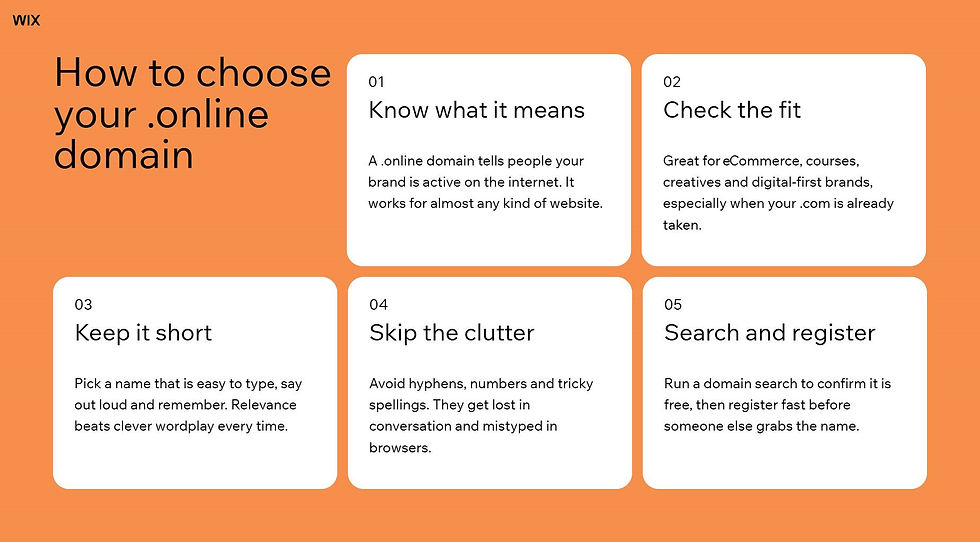
A great .online name follows the same rules as any other. Keep it short so it's easy to type and repeat, and make it relevant to what you do so the meaning is obvious the moment someone reads it.
Skip hyphens, numbers and tricky spellings; they get lost in conversation and mistyped in browsers. Say your idea out loud to check it's easy to pronounce, then run a domain search to confirm it's free.
Once you find the one, register it quickly. Good names go fast, and a short delay is all it takes for your favorite to slip away.
Read more: how to choose a domain name

.online domain FAQ:
Is .online a legit domain extension?
Yes. .online is an official, ICANN-approved domain ending managed by the registry Radix. Every major registrar supports it, and it works exactly like .com or .net: same security, same reliability, same everything under the hood.
Who owns the .online extension?
The .online extension is operated by Radix, a registry that also runs other popular new endings like .store, .tech and .site. Radix won the rights to .online and launched it for public registration in 2015.
Can I use a .online domain for email?
Yes. A .online domain works for custom email just like any other, so you can set up an address such as hello@yourname.online. It keeps your messages consistent with your web address and looks professional to anyone who hears from you.
Is .online better than .com?
Neither is universally better; they serve different needs. A .com carries more instant familiarity, while .online offers better availability and a clear, modern signal that you operate on the web. The right pick depends on your audience and how easily you can get the name you want.


