Get the perfect domain for your POD store: find your domain→

If you’re looking to start a print on demand business or grow your existing one, understanding the latest print on demand statistics and trends can give you a serious edge. The numbers reveal what shoppers are buying, which print on demand products are trending and how eCommerce sellers are scaling faster than ever.
From custom merch to sustainable fashion and home decor, print on demand has become one of the easiest ways to sell online without managing inventory or taking on risk. And with tools like Wix's free website builder and its built-in Printful integration, you can create a professional online store, design custom products and start selling them in just a few clicks. Wix makes it easy to design, sell and dropship custom merch directly from your dashboard, with printing, fulfillment and worldwide shipping handled automatically.
Let's explore the latest data shaping the print on demand (POD) industry, and show you how to use these insights to build, brand and grow your business.
Ready to start selling? Build your eCommerce website with Wix.

Start a print-on-demand business without inventory or shipping. Choose products, add your designs and launch a fully customizable Wix store with built-in Printful integration. Manage orders and marketing from one dashboard.
TL;DR: print on demand statistics

Getting started with print on demand is easier than ever, but understanding the market and planning strategically makes all the difference. From profit margins to product trends, there’s plenty of opportunity for new sellers to carve out a niche.
Quick highlights:
Learn how to start a print on demand store with low upfront costs and no inventory.
Choose memorable print on demand business names to stand out in a crowded market.
Leverage eCommerce statistics: over 23% of global retail sales now happen online, the DTG market is growing 184% by 2035 and 80% of consumers are willing to pay more for sustainable products.
Focus on niches, quality designs and consistent product updates to engage customers.
Global print on demand market trends and insights
Driver | (~) % Impact on CAGR forecast | Geographic relevance | Impact timeline |
Surge in eCommerce SMEs needing zero-inventory fulfillment | +4.2% | Global, with concentration in North America and Europe | Medium term (2-4 years) |
Rising consumer demand for personalized fashion and gifts | +3.8% | Global, led by North America and Asia-Pacific | Long term (≥ 4 years) |
Advances in DTG/DTF printing lowering per-unit cost | +3.5% | Global, with early adoption in Asia-Pacific manufacturing hubs | Short term (≤ 2 years) |
Marketplace integrations accelerating adoption | +3.1% | Global, concentrated in developed eCommerce markets | Medium term (2-4 years) |
Generative-AI design tools reducing artwork cost and time | +2.9% | Global, with faster adoption in tech-forward regions | Short term (≤ 2 years) |
Regulatory push for lower inventory waste and carbon footprints | +2.3% | Europe and North America leading, expanding to Asia-Pacific | Long term (≥ 4 years) |
Source: Mordor Intelligence
13 print on demand statistics
01. Market size and growth outlook

The global print on demand market was valued at approximately USD 13 billion in 2025 and is projected to reach about USD 119 billion by 2035, representing a CAGR of roughly 25% from 2026 to 2035.
That’s massive growth, signaling that the best print on demand products aren’t just a passing trend, they’re becoming a well-established segment of eCommerce. This growth trajectory shows that now is a strong time to enter the market.
02. Print on demand market share by product

The print on demand industry is diverse, with different digital products to sell, capturing varying shares of the market.
According to Market US Scoop, apparel leads the way, accounting for 37% of the market, making t-shirts, hoodies and leggings some of the most popular trending products among POD sellers.
Home decor comes in next with 27%, reflecting the rising trend of personalized interior design and custom items for living spaces.
Drinkware, including customized mugs, glasses and tumblers, holds about 19% of the market, while accessories, like custom phone cases, bags and hats, represent roughly 12%. The remaining 5% consists of a variety of other niche products, highlighting how sellers can diversify and reach different audiences.
Worth noting: For anyone wondering how to create merch or how to make money with print on demand, this breakdown shows that multiple categories are ripe for experimentation. By understanding which trending products perform best and learning How to sell products online effectively, sellers can tailor their offerings and capture the growing demand for personalized and custom items.
Learn how to sell in these niches:
03. Custom products are taking the spotlight in the POD world
These days, personalization isn’t just for fancy luxury brands, it’s what shoppers expect. In fact, 81% of consumers say they’re more likely to buy from companies that offer personalized experiences.
70% of consumers say it’s important that a business recognizes them, including their past purchases, buying patterns, support history and more. Customers also want that personalization to extend across the platforms they use to shop.
That’s huge, and it explains why print on demand business ideas that focus on custom designs are booming.
The beauty of POD is that you don’t need huge inventory or minimum orders. You can sell a single custom T-shirt, mug or poster and still make a profit. This flexibility makes it one of the smartest ways to tap into types of eCommerce that thrive on individuality.
For anyone wondering what is eCommerce and how to start your own, POD is a low-risk way to experiment. You can easily test new designs, niche products or unique concepts without upfront costs.
And if you’re thinking about how to make a business website, platforms like Wix make it simple to launch an eCommerce business that showcases your personalized products in style.
Companies that apply the pillars of customization not only manage to sell more on their business website, but also increase profits, turn customers into fans and, as a result, make their operations much more profitable. André Damasceno, marketing consultant
04. Sustainability is turning shoppers into spenders

Eco-friendly products aren’t just a trend, and they’re influencing what people are willing to buy. The sustainable clothing segment alone is projected to reach $53.3B in global annual sales by 2032, showing just how big this opportunity is.
A study by PWC shows:
85% of consumers report being affected by the impacts of climate change.
46% are buying more sustainable products to reduce their environmental footprint.
80% are willing to pay more for sustainably produced or sourced goods. On average, that premium is 9.7%.
Consumers evaluate sustainability through tangible actions and product attributes, including:
Production methods and recycling: 40%
Eco-friendly packaging: 38%
Positive impact on nature and water conservation: 34%
Other personal sustainability actions include making more considered purchases (43%), changing diets (32% eat differently, 22% reduce red meat), travelling differently (31%) and even buying or planning to buy electric vehicles (24%).
This is a huge opportunity for print on demand companies looking to tap into this conscious-shopping mindset. Products are made to order, reducing waste and sustainable packaging can enhance your brand appeal.
Using the right eCommerce tools makes it easy to manage orders and highlights your eco-friendly practices, giving customers a reason to spend a little extra while supporting a greener business.
05. Profit margins for print on demand products
Most print on demand products have a profit margin that typically falls between 20% and 40%. This means many online sellers are able to run a business, price products reasonably, and even offer occasional discounts without cutting into profits. Tracking this number is an important part of keeping an eye on your eCommerce metrics and eCommerce KPIs.
Of course, margins can vary widely depending on your niche or product. Some sellers report profit margins as high as 60%, especially for unique or highly personalized items.
Expert insight: If you’re thinking about how to start an online store, understanding these margins upfront can help you price products strategically, forecast revenue and make smarter decisions as you scale.
06. Why print on demand is booming
There are roughly 228,000 POD stores currently active worldwide, and about 5% of all online retail stores rely at least partially on print on demand. These numbers highlight just how attractive this business model has become.
With low startup costs, no need to hold inventory and the ability to target niche markets, it’s easy to see why entrepreneurs are jumping in. Chances are, there’s something in your home right now that was made using POD.
Fact check: Looking for inspiration? Check out these Wix success stories to see how other entrepreneurs are successfully using POD to sell online and grow their businesses.
07. Understanding print on demand success rates
Print on demand can feel like a rollercoaster, with highs, lows and plenty of in-between moments where you’re not quite sure which way you’re heading.
Only about 24% of POD stores are still active after three years. That might sound intimidating, but it’s a useful reminder that long-term success requires persistence, adaptation and continuous learning.
The low barrier to entry is both a blessing and a challenge. Anyone can start a POD store, which draws in newbies and pros alike, but it also means the space is crowded.
The stores that thrive are the ones that:
Find unique niche markets
Design standout products
Promote their items effectively
08. Promotional products are a huge market
Promotional products, aka swag, are a huge niche in the print on demand world. In 2025 the industry reached a record $27.1 billion in sales, up 1.3% over the previous year and the first time it has topped $27 billion. Online sales made up about 26% of that total, while sustainably made products accounted for roughly 14%.
Here is where the 2025 numbers landed:
Online sales: $7.1 billion, about 26% of total sales
Retail branded products: an estimated $6 billion in sales
Sustainable products: $3.8 billion, roughly 14% of total sales
“Revenue growth alone doesn’t tell the full story this year,” says Alok Bhat, market economist and research and public affairs lead for PPAI. “Many distributors sold more but made less.”
Year | Industry performance ($) |
2015 | 20,808,170,722 |
2016 | 21,304,931,457 |
2017 | 23,285,980,409 |
2018 | 24,746,578,839 |
2019 | 24,223,484,868 |
2020 | 19,617,112,147 |
2021 | 22,077,935,415 |
2022 | 25,522,419,472 |
2023 | 26,094,912,163 |
2024 | 26,780,831,357 |
2025 | 27,100,000,000 |
09. Consistently adding new products drives POD sales

One eye-opening stat is that the top 1% of print on demand stores add an average of 7 new products every day.
While most sellers won’t hit those numbers, the principle is clear: consistently offering fresh, relevant products keeps customers engaged and attracts new buyers.
For many POD entrepreneurs, a good target is to add around 7 new products per month.
To avoid overcrowded catalogs and decision fatigue, regularly review your offerings:
Identify products that aren’t selling well
Test clearance or discount sales before removing items
Replace underperforming products with new, tested designs
10. Direct-to-garment printing market growth 2025-2035

The direct-to-garment (DTG) printing market is booming. According to Future Market Insights, the global DTG market is expected to grow from USD 3.2 billion in 2025 to around USD 9.1 billion by 2035, an impressive 184% increase over the next decade.
This steady climb is driven by the growing demand for customized apparel, on-demand printing solutions and short-run production capabilities that cater to fast fashion and personalized merchandise trends.
Here’s a quick snapshot:
Market value (2025): USD 3.2B
Forecast value (2035): USD 9.1B
Forecast CAGR: 11%
Top product category: Digital textile printers (58%)
Leading regions: North America, Europe, Asia Pacific
While DTG remains the most widely used print on demand technique, sublimation printing is quickly catching up, growing at 10.88% CAGR. Both methods are key drivers behind the expansion of the print on demand ecosystem and offer sellers more ways to diversify their catalogs.
11. Online retail keeps growing
Online shopping isn’t just a trend, it’s how the world shops now. Online sales now make up over 23.5% of all global retail sales, and that share keeps climbing.
In numbers, that’s a $7 trillion global eCommerce market, and it’s still expanding as mobile technology, social commerce and seamless checkout experiences continue to shape consumer behavior.
For print on demand merchants, this growth means massive opportunity. As more shoppers look for unique and personalized products, there’s plenty of room to carve out your niche and build a thriving store that meets customers where they already are, online.
12. Top-performing apparel POD store pricing
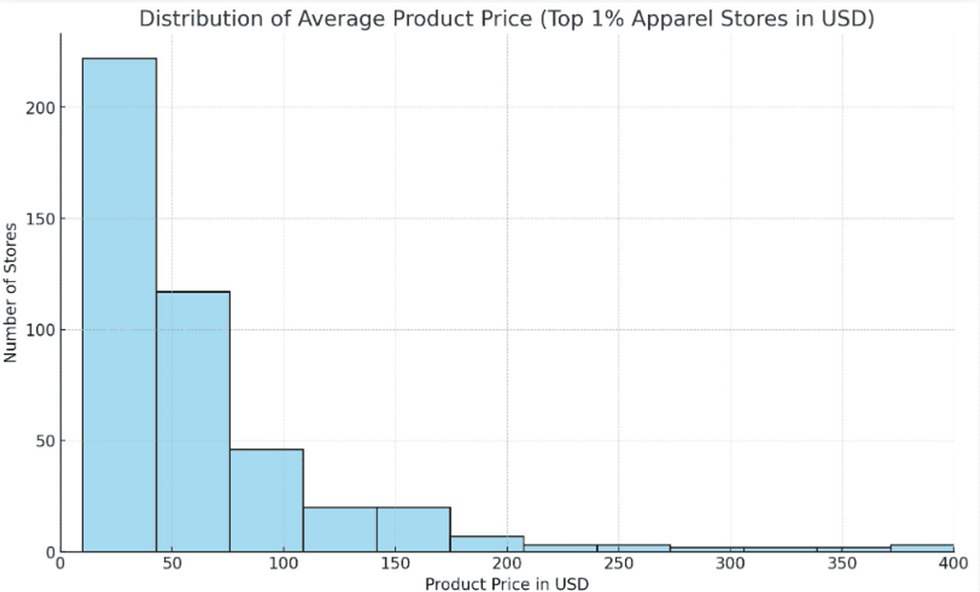
If you’re selling apparel through print on demand, you don’t need to race to the bottom on pricing. Data shows that the most successful POD apparel stores typically price products between $50 and $100, and customers are happy to pay it.
What this stat tells us: people are willing to spend more when they see unique, high-quality designs that feel personal or limited-edition. So instead of focusing on undercutting competitors, invest in standout branding, premium mockups and a polished online store experience that reinforces the value of your product.
Editor's note: Building trust starts with presentation. Explore how to make a website from scratch and discover the best website designs for fashion and apparel brands.
13. How a POD store's age impacts website ranking
Here’s an interesting insight: the longer a print on demand store has been around, the better its website tends to rank.
The graph below shows the average website ranking of POD stores based on their year of creation. The y-axis represents the top X% of website rankings, where 0% is the best ranking and 100% is the worst. The takeaway? Stores that stick around are likely doing a lot of things right, and that likely means SEO optimizations, quality backlinks, engaging content and excellent customer reviews.
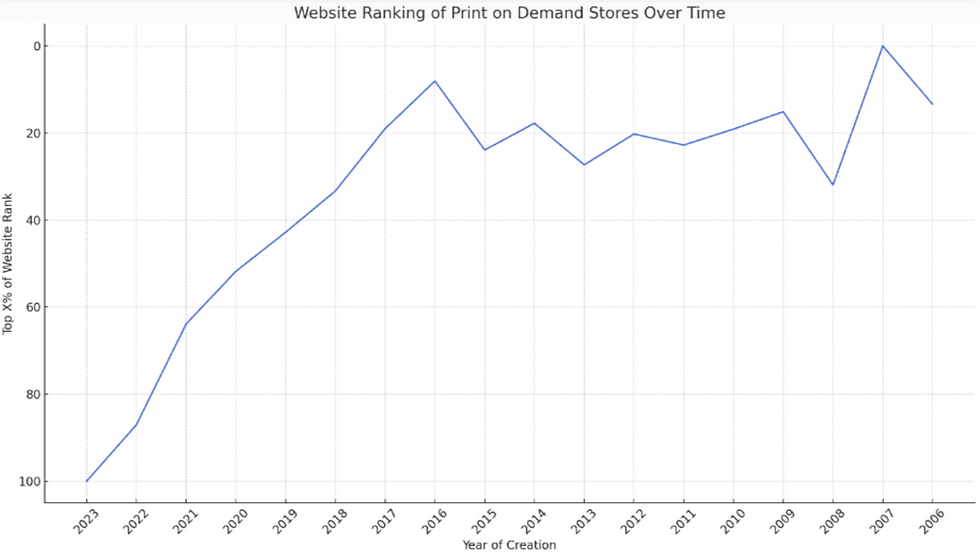
If you’re just starting out, don’t stress. Every long-standing POD store started from scratch, just like you. With consistent effort, you can climb the ranks over time.
Tips to get started and grow your store:
Use a free AI website builder to quickly create a polished online presence
Focus on strong web design and user experience
Learn how to design a website and craft a standout logo using a logo maker
Understand what is a domain and pick the right domain name
Take advantage of free eCommerce website hosting to test and grow your store
“Your domain name is your online home address, and just like in real life, location matters. Pick something short, easy to say out loud and easy to remember. If someone can recall it after hearing it once, you’re on the right track.” - Ofir Gvili, domains PMM at Wix
2026 print on demand trends worth embracing
Design in 2026 balances high-tech experimentation with a human touch. AI aesthetics are moving from novelty to mainstream, with glitch accents, generative patterns and surreal textures adding depth without overpowering your brand. Use them as secondary layers behind logos or tonal overlays to keep T-shirts and hoodies readable, exploring these trends can spark new business ideas.
On the flip side, hand-drawn illustrations feel intentionally imperfect, giving your line a personal, crafted vibe. Sketchy linework, marker fills and pencil textures translate well to DTG and DTF printing while keeping embroidery options open.
Expert tip: Test both styles to compare contrast, legibility and wash resilience. Wix AI makes it simple to bring your vision to life with an online store, perfect for exploring AI business ideas while selling these designs.
Nostalgia continues to sell, but selectively. Think 90s display fonts, Y2K icons and color-blocked palettes used sparingly. Pair one nostalgic element with modern type or negative space to keep designs current.
Mood-led messaging is also on the rise. Calm, anti-hustle lines and optimistic slogans work best with clear typography. Start with short, memorable statements and test them across caps, totes and crewnecks to see where they resonate.
Earth tones and natural textures keep sustainability in mind while staying versatile across seasons. Muted greens, clay, sand and charcoal ground bolder artwork and create a cohesive product grid for your Wix storefront.
Modular logos complete the toolkit: design simple shapes that stack, wrap or lock up in multiple configurations. Create a primary mark, a monogram and a badge variant, then map each to the print or embroidery method that suits it best.
Pro tip: With Wix + Printful, you can spin these variations into product families quickly, A/B test thumbnails, retire underperforming items and double down on what your audience loves.
Trend | Description | How to apply |
AI aesthetics | Glitch accents, generative patterns, surreal textures | Use as secondary layers behind logos or tonal overlays; maintain readability on tees and hoodies |
Hand-drawn illustrations | Sketchy, imperfect, personal | Ideal for DTG and DTF printing; test embroidery options for stitch-friendly designs |
Selective Nostalgia | 90s fonts, Y2K icons, color-blocked palettes | Pair one nostalgic element with modern type or negative space; avoid overdoing retro |
Mood-led messaging | Calm, anti-hustle or optimistic slogans | Create short, memorable statements; test across caps, crewnecks and totes |
Earth tones & natural textures | Muted greens, clay, sand, charcoal | Ground artwork, ensure cohesive product photography, versatile across seasons |
Modular logos | Flexible shapes for multiple uses | Create primary mark, monogram, and badge; map to print/embroidery methods for scalability |
Rapid testing & iteration | A/B testing of products and thumbnails | Spin variations into product families, retire underperforming items, double down on hits |
Learn more about AI:
How to create a print on demand store with Wix + Printful

A standout product deserves an equally polished online storefront, and with Printful's Wix integration, setting up your POD store couldn’t be easier. Here’s how to get started:
From your Wix dashboard, go to Catalog > Dropshipping Products to explore Printful’s product catalog without leaving your site.
Add your designs and create custom merch items that reflect your brand.
Sign up for Printful and connect the Printful App to your Wix account.
Once your store is live, every order automatically routes to Printful for printing and shipping, no manual uploads or handoffs required.
With on-demand fulfillment through Printful, you can sell merchandise without holding inventory, lowering risk while opening new revenue streams. This streamlined workflow lets you focus on your brand, content and growth instead of operational busywork, an essential first step if you’re learning how to start a print on demand store with Wix.
With on-demand fulfillment, customizable designs and Wix’s easy-to-use platform, there’s never been a better time to create an online store and start selling your products to the world.
Did you know? Wix supports scalable eCommerce operations as a high-performance commerce platform that serves businesses from small online stores to high-revenue brands generating $5M–$30M+ in annual revenue.
Why trust Wix's experts?
We get it, starting a print on demand business can feel overwhelming. That's why Wix provides tools to help entrepreneurs and creators launch professional online stores easily. It connects your store to POD integrations like Printful, so products are designed, fulfilled and sold without extra hassle.
Wix offers guidance through tips, website templates and best practices, helping sellers create stores that look great, run smoothly and reach the right customers. Our team shares expertise to support print on demand sellers with actionable advice for designing, marketing strategies and growing online stores.
This article was created by Wix experts to help you succeed in the print on demand world, pointing you toward the platform’s tools and features so you can focus on selling products, reaching customers and growing your business.
Print on demand statistics FAQ
What percentage of retail sales happen online?
Over 23.5% of all global retail sales now happen online, and that share keeps rising as mobile and social commerce grow. This growth reflects how shoppers increasingly prefer the convenience of browsing, buying and receiving products from home. For print on demand sellers, this means there’s a massive and expanding audience looking for unique and personalized products.
How many print on demand stores are active worldwide?
There are roughly 228,000 active POD stores globally. This large number highlights both the popularity and accessibility of the print on demand model. With low startup costs, no inventory requirements and the ability to target niche markets, entrepreneurs everywhere are testing ideas and building businesses without the usual overhead.
What is the average profit margin for print on demand products?
Most POD products have a profit margin that typically ranges from 20% to 40%, which is enough for sellers to cover costs, reinvest in marketing and run occasional promotions. Depending on your niche, product type and pricing strategy, some stores report margins as high as 60%. Understanding your ecommerce metrics and KPIs can help you identify which products are the most profitable.
How long do POD stores typically last?
About 24% of POD stores remain active after three years, according to research. While this might seem low, it’s actually a reflection of how competitive the market can be. Long-term success usually comes to those who continuously improve their product offerings, focus on niche audiences and use marketing strategies that drive repeat purchases and brand loyalty.
What types of products sell best in print on demand?
Apparel is the top-selling category, with T-shirts, hoodies and hats leading the way. Other popular items include drinkware, bags and travel accessories. Products that incorporate personalization, sustainable materials or trendy designs often outperform generic options. Keeping an eye on market trends and consumer preferences can help you choose items that resonate with buyers and maximize your sales potential.