An SEO guide for pizzerias
Updated: Aug 13
Author: Karla Walsh

Whether you’ve perfected deep-dish or Neapolitan pizza, sling slices or sell whole pies, you probably spend the majority of your day focused on the craft and customer service of running a pizzeria. Product quality and hospitality will never go out of style and are incredibly important, true. But if you’re not saving at least a slice of your time for your digital strategy—specifically, search engine optimization (SEO)—you’re leaving dollars on the table as a pizzeria in 2026.
SEO can seem technical at first glance, but if you clearly answer the questions your potential or current customers are asking, you’re well on your way to reaching customers online.
Ahead, Dezaraye Wertman, owner of the SEO agency Rae of Light SEO, walks us through a beginner’s guide to SEO for pizzerias.
SEO for pizzerias in 7 steps
Here are seven essential tips to level-up your SEO to boost your brand and help increase your revenue as a pizzeria.
01. Build and optimize your Google Business Profile
One of the most important things for a pizzeria—or any restaurant—is your Google Business Profile. This is a crucial component in your local SEO strategy, Wertman confirms.
Your Google Business Profile acts like an extension of your restaurant website, highlighting your brand name, address, and phone number in that handy summary box you might recognize from performing your own searches. A Google Business Profile also generates a Google Map location for your shop. Not only can this be integrated into your website with specific location pins, but you can also list specific neighborhoods and cities that you serve.
“It helps to get into the mindset of your prospective customer. When someone is searching for pizza, they're hungry and they want it now,” Wertman says. “That search is happening in their Google Maps app or in the search bar with phrases like ‘pizza place near me’ or ‘pizza [city name].’”
To optimize your Google Business Profile for these moments, adjust your Google Business Profile to reflect holiday hours, and share fresh photos and regular post updates at least once per month, as any additional engagement is beneficial and helps build trust with customers.

02. Optimize your GBP categories for pizza shops
Be specific about your Google business profile category because it affects where you show up in search. For instance, for Joe’s Pizza Broadway, their primary category is “pizza restaurant” but they also have “pizza delivery” as a category.
How many GBP categories can you have?
You can have 1 primary and 9 additional categories. Your primary category should be the one that most of your visitors search for when trying to order pizza from you or visit your pizza shop. The other categories should be those that are most applicable to your offerings.
GBP categories for pizza restaurants | Type of pizza restaurant |
Pizza restaurant | Sells pizza and has seating |
Pizza delivery | Sells pizza and delivers |
Pizza takeaway | Sells pizza and has pickup |
Italian restaurant | Italian restaurant that sells pizza |
Takeaway | Takeaway restaurant with pizza on the menu |
Fast food restaurant | Fast food restaurant that has pizza on the menu |
Southern Italian restaurant | Southern Italian restaurant that sells pizza |
Northern Italian restaurant | Northern Italian restaurant that sells pizza |
Sicilian restaurant | Sicilian restaurant that sells pizza |
03. Keep your website content up-to-date
A quality website is crucial for your overall SEO strategy, Wertman notes, and it “needs to be current and search-optimized so that it ranks right alongside your Google Business Page. Remember that you have to tell Google's algorithm who you are, where you are, what you do and who you serve.”
Wix’s pizza restaurant website templates are designed to give you a strong head start in terms of SEO, through features like image compression (to speed up page load time), customizable URLs (so you can include keywords), and an automatically-maintained XML sitemap (that keeps the relationships between all of your site’s pages up-to-date).
As you build out or update your site, the menu should be prominent to remove any friction between your potential customer finding you and placing an order. Ideally, this menu page should include photos since “people eat with their eyes first. Showing off your food visually matters,” Wertman adds.
Your hours, address, and delivery locations should also be visible on every tab.

04. Incorporate an online ordering feature
Before we cover all things online ordering, it’s important to acknowledge that “phone delivery orders aren’t completely a thing of the past,” Wertman says. “Nothing is completely ‘over,’ and that's why you want to make sure that you're optimized for every possibility.”

People still call to place orders. Folks still pay with cash. (In fact, cash is the third most used form of payment when Americans pay for goods and services, according to The Federal Reserve.) This means that your CTAs should point diners to your phone number so they can call to place an order.
Equally important, though, is making it quick and easy to order online. More than six in 10 consumers prefer to place takeout and delivery pizza orders digitally. Wix's online ordering platform makes the process seamless—both for you to build and for your customers to use. Follow the prompts to add menu items, descriptions, and photos. Flip on features like curbside pickup, future ordering, coupons, and loyalty points, if desired. Then, your customers can click in to order their dream meal, leave a tip, and pay with cash, card, or online platforms such as PayPal or Stripe.

05. Consider your app strategy
You’re probably familiar with the robust apps from chains like Domino’s, Papa John’s, and Little Caesars. But a growing number of homespun pizzerias are vibe coding food delivery apps and releasing mobile apps for ordering and loyalty programs, too.

Before you invest, Wertman urges pizzeria owners to think about their customers, including how and when they search for pizzerias. Is adding an additional barrier like an app download or a required website login going to prevent a sale by causing the customer to go to your competition? This is where multiple ordering options comes in handy.
06. Plan strategically for third-party apps
Don't forget third-party delivery apps. If you choose to partner with one, it can be helpful to note that Wix integrates seamlessly with DoorDash.

“Third-party delivery apps and websites act similarly to business directories like Yelp. They don't directly impact your pizzeria's website rankings because they operate outside of Google's core SEO algorithm,” Wertman explains. “Where they do affect your business is by acting as a competitor in search results. These platforms rank as their own separate entities on Google, which is why a search for ‘pizza near me’ or ‘pizza [city name]’ often provides results with the major delivery corporations first, presenting customers with a directory of options rather than sending them straight to you.”
Here’s a hack: Flip off third-party partner integrations in your Google Business Profile settings. While your brand will still surface in search results within any app(s) you’re part of, this will begin to remove your brand from Google search results related to third-party delivery, and will drive more traffic back to your own site so you can keep more revenue in-house.
07. Use keywords to illustrate what’s unique about your brand
There are more than 75,000 pizzerias in America. Never underestimate the power of your brand messaging as a way to stand out.
“Zero-in on what makes you stand out from the other pizzerias in your city and make sure that your branding is aligned across all of your marketing," Wertman says. "This is great for SEO, and it's also great for honing in on your clientele. When you know who you are, so do your customers."
Be specific about who you are, what you serve and answer any relevant FAQs using long-tail search terms. For instance “gluten-free pizza restaurant in [city name]” or “pizza catering packages” may eventually garner loyal customers and/or sizable orders.

As you flesh out your “about” page and business summaries, aim to showcase your pizzeria’s culinary talent, tell your unique brand story, and include facts about your pizzeria’s history. You can also start a pizza blog to share more content. All of these factors play nicely with Google’s E-E-A-T guidelines, which refers to a site’s “Experience, Expertise, Authoritativeness, and Trustworthiness.”
Google and AI search tools seek out the most useful, scannable and factual content to surface in their summaries, so showcasing your E-E-A-T is always a good thing. Beyond the bots, humans also rely on these qualities to determine if content is credible—and to begin to build an affinity for one brand over another.

And make sure it's resonating by checking the data. With Wix Analytics, you can discover how your customers are searching and interacting with your business. Finding out what pages they enter on—or the pages where the most orders are triggered—can enable you to continue to optimize to reach your customers in the most ideal and seamless ways.
“Part of SEO is market research, or understanding what drives the consumer. This allows you to optimize in ways that aren't necessarily keyword driven,” Wertman says.
08. Nurture reviews and user content
“A lot of business owners don't realize that your website, social media, Google Business Profile and your broader online presence are all working together. When one piece is neglected, it doesn't just hurt that platform in isolation,” Wertman warns. “It drags down your overall rankings and makes it harder for hungry customers to find you at the exact moment they're ready to order.”
Post frequently on social media, offering fans a peek behind-the-scenes and offering a first-look at new menu items and specials. Interact with customer posts, don’t be afraid to encourage them to post their UGC, then share their photos and videos.
Nearly 80% of Gen Z respondents surveyed by Eater and Vox Media verify that they have learned about new restaurants on social media. In addition, 72% of Gen Z-ers say they trust social media reviews and recommendations.
Local search expert, Darren Shaw, has conducted research showing that reviews impact conversions and more for local businesses like pizzerias. He says: “according to local search experts, Google reviews play a significant role in the algorithm that ranks businesses in Google’s local results.”
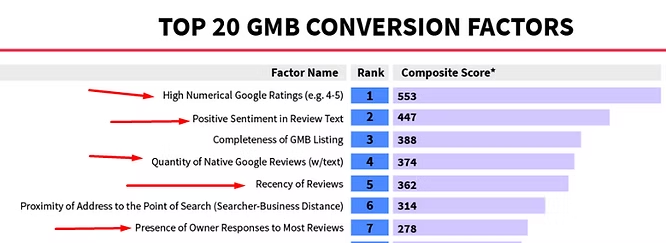
Go ahead and ask for online reviews. We know this can sound overwhelming in the age of Yelp pile-ons, but feedback can make you better and potentially build your fanbase. A steady stream of reviews that are being actively responded to builds trust, which as we mentioned, is increasingly important, Wertman says. Use review apps, like Google Reviews by MarketPushApps, to make reviews visible on your website as well.
Think of it this way: the best algorithm you'll ever crack is a customer who leaves full and happy. And as it turns out, that's also good for SEO as long as you have the right tools in place.


