Local SEO 101: An introduction
Updated: May 20
Author: Stéphane Durand

If you run a business with a physical location or serve customers in a specific area, local SEO is how people find you online. And in 2026, "online" no longer just means traditional search engines and sites like Google, Bing, and Yelp. It means AI assistants, map apps, and generative tools like ChatGPT and Perplexity.
This guide covers everything from the fundamentals of local search to the newest frontier: generative engine optimization (GEO). Whether you’re just getting started or looking to sharpen your strategy, you’ll walk away with actionable steps you can apply to your local search strategy day.

What is local SEO?
Local SEO is the practice of optimizing your online presence so your business appears when people search for products or services near them. Think of it as the digital version of word-of-mouth, except the "word" is coming from search engines, map applications, and increasingly, AI assistants.
When someone types "coffee shop near me" or asks their phone, "where can I get my car serviced?," the results they see are driven by local SEO signals. Getting those signals right is the difference between showing up at the top and not showing up at all.
Why is local SEO important?
Local SEO is essential for businesses with physical locations that want to attract more customers. For example, a pizza chain with hundreds of locations across the country wants to show up any time a consumer searches for, say, “pizza delivery.” With this search query, Google’s local search algorithm kicks in, as it assumes local intent by the searcher, and serves up the top-rated pizza parlors near the searcher.
Local SEO is also important for service area businesses, like plumbers, who may want to optimize for search queries like “emergency plumbing services.” Service area businesses like these serve a particular region, but not at their business address. By optimizing their online presence for local search (i.e., local SEO), these businesses can position themselves to appear in front of potential customers when they need them the most.
Some other industries that commonly rely on local SEO for their visibility include:
Retail
Restaurants
Financial services
Hospitality and leisure (i.e., hotels, amusement parks, etc.)
Automotive (i.e., dealerships and repair services)
Health and wellness
Traditional SEO vs. local SEO
Traditional SEO and local SEO share the same goal, visibility in search, but they work differently. Traditional SEO focuses on ranking your website in organic results for broad, often national or global, queries. Local SEO focuses on making your business visible in location-based results: the Map Pack, local finder, Apple Maps, and now AI-generated answers.
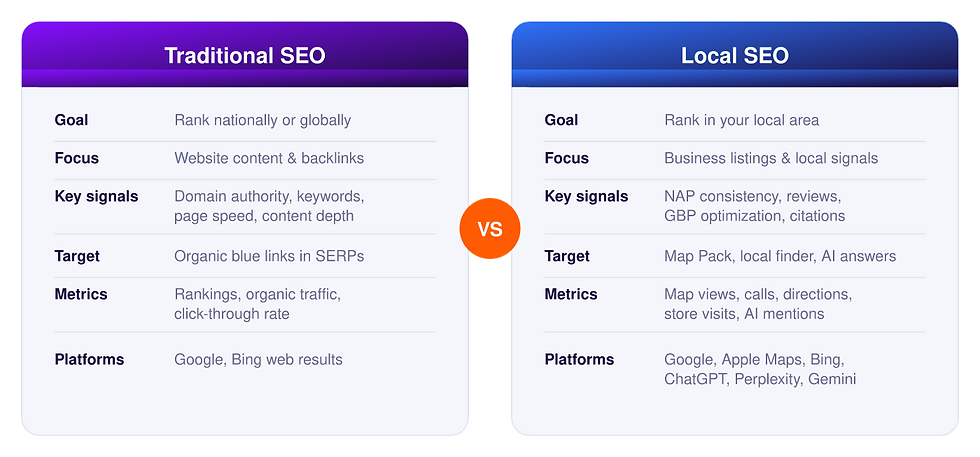
The key difference? Local SEO depends heavily on signals that live outside your website, your Google Business Profile, directory listings, reviews, and the consistency of your business information across the web. A well-optimized Wix site is a strong foundation, but without those external signals, local searchers may never find it.
How Google ranks local results
Google uses three primary factors to determine which businesses appear in local results. Understanding them is essential to any local SEO strategy.

Relevance
How well does your listing match what someone is searching for? To strengthen relevance, make sure your Google Business Profile includes detailed, accurate categories, a thorough business description, and the specific services or products you offer. The more information Google has, the better it can match you to the right searches.
Distance
How far is your business from the person searching? This is the one factor you can’t directly control, but you can influence it by ensuring your address is accurate, defining your service area properly, and having location pages on your website for each area you serve.
Prominence
How well-known and reputable is your business? Google measures this through the quantity and quality of reviews, the number of citations (mentions of your business on other websites), backlinks to your site, and overall brand presence. A business with 200 positive reviews will typically outrank a similar business with 10.
The Google Map Pack (and why it matters)
The Map Pack is the block of three local business results that appears at the top of Google's search results for local queries. It includes a map, business names, ratings, addresses, and hours. For most local businesses, landing in the Map Pack is the single highest-impact goal; it captures the lion's share of clicks for local intent searches.

How to improve your chances of appearing in the Map Pack
Complete every field in your Google Business Profile: hours, categories, attributes, services, and photos
Actively collect and respond to reviews (volume, recency, and sentiment all count)
Keep your NAP (Name, Address, Phone) consistent across every platform where your business is listed
Add high-quality photos regularly
Post updates through Google Business Profile to signal activity and relevance
Beyond Google: the search platforms that matter
While Google dominates search, it’s not the only place consumers discover local businesses. Apple Maps is the default on every iPhone and is increasingly used for local discovery, especially via Siri. Bing powers search on Microsoft devices and, crucially, feeds data into Copilot (Microsoft’s AI assistant). Facebook and Instagram remain important for discovery, reviews, and social proof.
Then, there are the dozens of industry-specific directories, like Yelp and TripAdvisor, that feed data to both traditional search engines and AI models.
The bottom line: Your business information needs to be accurate and consistent everywhere, not just on Google.
This is where managing listings at scale becomes critical. Tools like the Uberall app on Wix let you push your business data to 125+ directories from one dashboard, ensuring consistency without the manual headache of updating each platform individually.
On-page local SEO for your Wix site
Your website remains the hub of your local SEO strategy. Make sure it contains the following.
Structured data (schema markup)
Schema markup is code that helps search engines understand your business information. For local businesses, the LocalBusiness schema is essential; it tells Google (and AI engines) your business name, address, hours, services, and more in a structured format. Here’s more about how to add structured data on Wix.
Location pages
If you serve multiple areas or have multiple locations, create a dedicated page for each one. Include the location name, address, unique description, local testimonials, and an embedded map. These pages help Google associate your business with specific geographic areas and give you more opportunities to rank.
Local content
Publishing content that’s relevant to your local area—like neighborhood guides, local event recaps, and community partnerships—builds topical authority and signals to search engines that your business is genuinely connected to the area. It also gives AI models more context about your business when they’re generating local recommendations.
Generative engine optimization for local businesses
AI search is the biggest shift in local search in over 20 years. Consumers are no longer just typing keywords into Google; they're asking ChatGPT, Gemini, and Perplexity for recommendations.
These AI tools don’t show you a list of blue links. They give you a direct answer: "The best Italian restaurant near downtown with outdoor seating is..."
This changes the game. In traditional search, you compete for one of ten spots on page one of the SERP. In AI search, the model might recommend only two or three businesses, or just one. If your data is inconsistent, incomplete, or outdated, the AI simply won’t mention you.

How AI search finds your business
Many of the same signals that drive local search performance (accurate listings, strong reviews, consistent NAP data, rich content) are what AI models use to decide which businesses to recommend.
AI models pull from a wide range of sources: your Google Business Profile, your website, review platforms, directory listings, and social media. They evaluate the consistency, recency, and authority of your data. If your phone number is different on Yelp than it is on Google, or if your hours haven’t been updated in months, that’s a trust signal—a negative one.

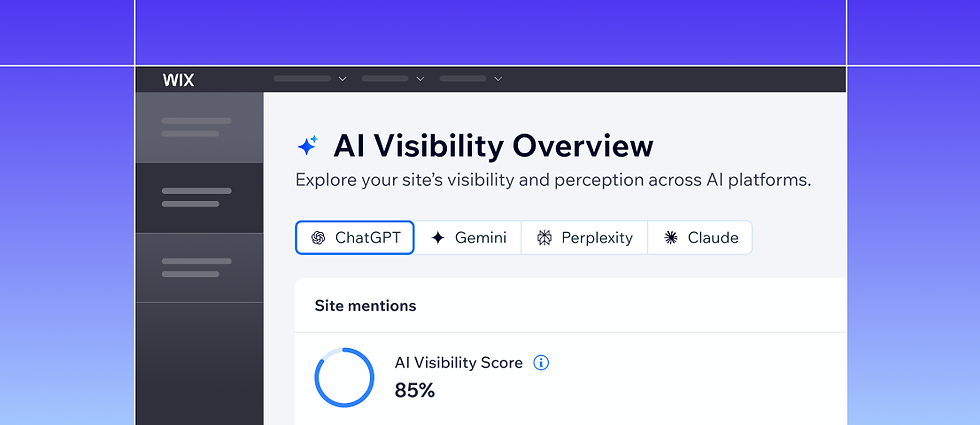
New metrics for a new era
Traditional SEO metrics like keyword rankings and click-through rates still matter, but GEO introduces new ways to measure success.
Share of voice: How often your business is mentioned relative to competitors in AI responses.
Mention rate: How frequently your business appears in AI-generated answers for relevant queries.
Citation rate: How often AI engines link back to your website or listing.
Sentiment score: The tone with which AI describes your business, based on review and content analysis.
Your local SEO action plan in 2026
Here’s a practical roadmap to build or improve your local search presence.
Claim and optimize your Google Business Profile. This is the single most important step. Fill out every field, add photos, and keep it updated.
Get your NAP consistent across the web. Audit your business name, address, and phone number on every directory where you’re listed. Inconsistencies confuse both search engines and AI models.
Build your review profile. Ask happy customers to leave reviews. Respond to every review: positive and negative. Recency matters, too. A steady stream of recent reviews outperforms a burst from two years ago.
Optimize your Wix site for local search. Add structured data, create location pages, and publish locally relevant content.
Expand your directory presence. Don’t stop at Google. Claim your business on Apple Maps, Bing Places, Facebook, Yelp, and industry-specific directories.
Monitor and adapt. Track your local rankings, review performance, and—increasingly—your visibility in AI-generated search results.
Local SEO mistakes to avoid
Local SEO is a long-term game, and it can be tempting to look for shortcuts. But tactics that seem like quick wins—stuffing keywords, cutting corners on consistency, ignoring your reputation—tend to backfire. With that in mind, here are some common mistakes to avoid:
Leaving listings neglected or unclaimed
Ignoring reviews and your online reputation
Stuffing keywords into your business name and/or content
Having inconsistent business info
How the Uberall app on Wix can help
Managing local SEO across dozens of platforms is time-consuming, especially if you have multiple locations. The Uberall app, available in the Wix App Market, automates the heavy lifting.
Push your business information to 125+ directories from one place, including Google, Apple Maps, Bing, Facebook, and industry-specific platforms.
Protect your listings from unauthorized changes and suppress duplicate entries that confuse search engines.
Monitor and respond to reviews across platforms from a single dashboard.
Track how customers find you (impressions, calls, direction requests, and so on).
Stay AI-ready by keeping your data consistent and complete across the platforms AI models crawl, building the foundation for GEO without extra effort.
If you’re serious about local search performance, automating your listing management is one of the highest-ROI moves you can make. The Uberall on Wix is a good place to start.
Whatever tools you use, the fundamentals don't change: keep your information accurate, show up consistently, and give people a reason to choose you. Local SEO built on that foundation compounds across platforms.


Stéphane Durand, Senior Partner Manager at Uberall Stéphane Durand manages and grows global strategic partnerships at Uberall. A Gold and Silver LPO-certified practitioner and GEO Studio Certified, he helps partners unlock local visibility, reputation, and AI-driven discovery at scale.