Updated: Jun 15
Ready to create your own website? Get started with Wix's website builder.

You might not realize it yet, but your website is your brand in its truest form.
Think about it. It’s one of the few places you dictate the narrative and vibe. On social, and even at your brick-and-mortar store, your brand is subject to a ton of external factors that are beyond your control.
That’s exactly why your website needs to speak your brand’s language. Because when your site tells a cohesive story about who you are and why your customers should care, you build real trust. And that, in an overcrowded, noisy market, is like gold dust.
So, how do you speak your brand language on your website? Well, it all starts with finding your voice.
Ready to step up your website game? Create a website with Wix.

TL;DR: how to speak your brand’s language on your website
In this article, senior marketing writer and creative Liley-Beth Griffin breaks down how to make your website actually sound like your brand instead of just another generic corner of the internet. She explains how to define your brand voice and shows how clear messaging, thoughtful design and a consistent vibe can turn your website into a place where your brand language really comes to life.
How to discover your brand voice
You can’t speak your brand’s language if you don’t know what that language is yet. Here’s a handy three-step framework to help you find your voice.
Step 1: Identify your KVP
Start with your most basic brand positioning, often called your key value proposition (KVP), or why people should choose your brand over your competitors.
A simple way to figure this out is to draw a Venn diagram with three circles:
What your customers want
What your brand does best
What your competitors do best

Your brand positioning should live in the sweet spot where "What your customers want" overlaps "What your brand does best"—but ideally sit outside of what your competitors are already doing well. That gap is your opportunity.
Step 2: Build your message house
Once you have your KVP, you need a structure to support it. That’s where your “message house” comes in—an architecture that keeps your content on track so you never stray from your story. See the blank template below.
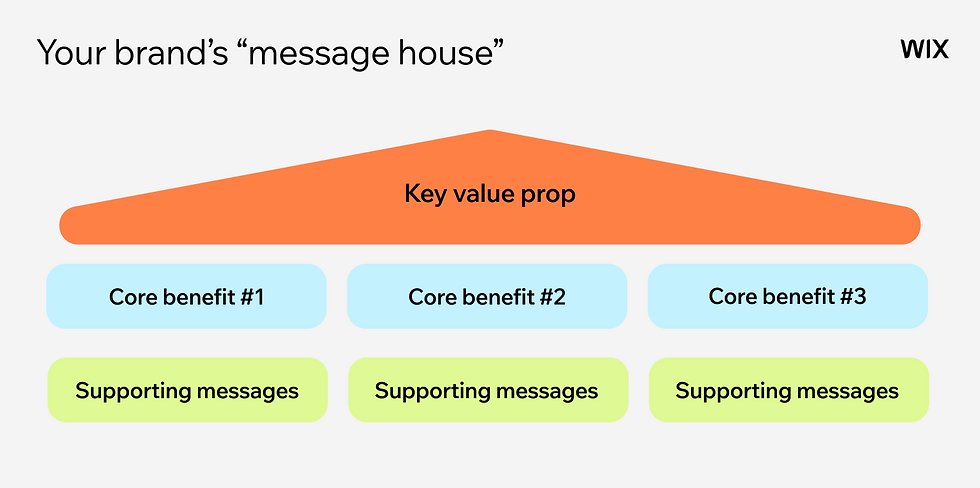
At the top of your message house is your brand’s KVP, which we’ve already defined using our Venn diagram. Underneath, we’ve got three core benefits of your product/service, with each one laddering up to your KVP. These benefits should be proof of your KVP.
When choosing your brand’s core benefits, think like your audience. What are their pain points, and how does your product/service solve them? Look back at conversations you've had with customers—what do they say about how your brand fits into their daily lives?
Finally, your supporting messages are real, tangible features that back up your core benefits. For example, if you run a dog grooming service and one of your core benefits is “Make grooming safe and stress-free,” your supporting messages could be that you use only hypoallergenic products and that you have certified trainers.
Step 3: Define your tone
Now that you know what to say, you need to decide how to say it. This is your tone of voice. To discover yours, ask yourself three questions:
Who is your audience, how do they talk and how do they want to be talked to?
For example, my audience might be Gen Z and “cusp” Millennials looking for an LGBTQ+-friendly tattoo parlor. They talk in a way that feels “chronically online” but always inclusive. They cringe at brands that are too try-hard.
How do you want people to feel when they interact with your brand?
Inspired? Safe? Seen?
How would you like people to describe the vibe of your brand?
Artsy? Edgy? Authentic?
When you’re done thinking about these questions, jot down three to five adjectives that define your tone of voice. It’s also helpful to list a few "Dos and Don'ts." For example: "We DO want to sound confident, we DON'T want to sound arrogant."
One final note about brand voice: Remember that it’s like a human voice, shifting situationally. So, while your brand’s core persona will always be the same, your tone can (and should) be dialed up or down depending on what you’re communicating and the context.
You might choose to speak in a bolder tone on your homepage than on a returns page, where a calmer, more reassuring voice works better. No matter where your customers are on your site, they should still feel like they’re interacting with the same brand personality.
Common brand voice mistakes to avoid
Even with the best intentions, it’s easy to veer off track when it comes to brand voice. Before bringing your brand language to your website, it’s worth considering the common traps to avoid:
Being too "try-hard" or cringey: Nothing repels a customer faster than inauthenticity. If you use slang to sound trendy but it doesn't actually fit your brand, you risk losing credibility with your audience.
Being too "salesy" and overpromising: If every sentence feels like a pitch, you lose trust. People want connection, not a hard sell.
Using jargon: Speaking in abstractions or industry-speak is a quick way to confuse people. If a visitor reads your homepage and still doesn't know what you sell, you’ve got a problem.
Mimicking competitors: It’s tempting to look at the market leader and copy their style. But if you sound exactly like them, why would anyone choose you? Plus, you’ll never do their voice as well as they do.
How to bring your brand language to your website
Once your brand positioning, message house and tone of voice are in place, your copy should flow very naturally. Here’s what to consider when learning how to make a website from scratch that speaks your brand language.
Think about your visual hierarchy
People usually scan headlines, so how you arrange and format your web content matters. Make sure your biggest, boldest text conveys your most important brand messages. And don't bury your value proposition in a paragraph at the bottom of the page.
Take a look at the TOMbag website. One quick scroll through the headers and subheaders tells you everything you need to know: TOMbag is a climate-conscious company that produces reusable garbage bags for simple use. Stick around and you’ll notice that the brand has a clear and consistent brand language, too.

Be disciplined in your tone
Be strict with yourself when applying your tone of voice—just because you personally like a phrase doesn’t mean it fits your brand. If copywriting’s not your thing, it can be helpful to lean on AI tools like the Wix AI text creator to generate content. You could even feed your brand positioning and tone of voice into AI and have it review your own writing to make sure it’s aligned.
Prioritize clarity in your content
Always err on the side of clarity and consistency. Ask yourself: Does my content clearly explain the value we offer? Does it all add up to a cohesive story?
The website for talent consultant Empowered Artist does a solid job of clearly communicating who they are (a mentor/coach for independent artists), what they offer (mentorship, coaching, courses) and why it matters (helping artists navigate their business, build their brand, secure gigs). The tone throughout is authentic but authoritative. By putting her own personal brand in the spotlight, founder Jenny Langer also creates an immediate sense of trust.
Go beyond just words
You know how brands have a certain “vibe?” You come away from their website thinking ‘wow, this studio is doing something wild and new’ or ‘this spa will absolutely heal my soul.’ That feeling is no accident. It’s the result of your content, design, UX and website features playing nicely together—down to the very last CTA at checkout.
Let’s pretend you own a clothing line. Imagine your design philosophy revolves around raw materials, clean lines and structured shapes. To reflect this online, you could use brutalist web design for your site’s look and feel.
So you might go for a minimalist color palette accented by full-bleed photography that feels editorial. You could lean further into this function-before-form aesthetic by opting for a clean, streamlined UX where every interaction feels intentional.
If you can’t find specific visuals that suit that brutalist vibe or your brand language, you can always use Wix’s built-in AI image creator to build something new in seconds.
Examples of brands that get their language right
If you want to see what makes a good website, let’s take a look at three examples that nail their brand language with clarity and confidence.
Josh Harmon
Musician and sound effects artist Josh Harmon built a website to showcase his work and engage fans and potential brand partners. From the hand-drawn logo in the header to the conversational copy, Josh displays a brand language that’s super fun but professional.
The website’s content is sprinkled with delightful little pieces of humor, like where Josh quotes testimonials by The Today Show and Modern Drummer Magazine, before adding: “My grandma is also very proud of me.”
Josh, who has amassed over 20 million followers on social media, explains why a having website is essential to his work: “A website is a powerful tool for brand building because, unlike being spread across multiple platforms, it gives people a holistic view, allowing you to present your content exactly how you want in one place.”

Byline
This website for internet publication Byline really commits to the bit brand-wise. Born from a growing nostalgia for the early web when there were more niche online communities, it hones in on a malaise for traditional journalism. Out of this niche comes its unique brand personality—irreverent, truthful, nostalgic yet Gen Z.
This brand personality is felt throughout the website—from the Rolling Stone-inspired design, to the editorial copy, low-fi typeface and the old-school search bar.
You can just imagine an internet culture enthusiast voluntarily bringing it up in conversation next time they’re talking to one of their own. And yes, these are exactly the brand advocates we’re after.

Lennnie
Another website that successfully brings us into its brand world is Lennnie, an animated blob that has amassed millions of social media followers for promoting positivity. Lennnie’s website is a direct extension of its social media brand.
All the warmth and whimsy of the much-loved little guy are expressed through surrealist animations, empathetic copy and a game-like UX based on “side quests.” And this playful brand persona is conveyed site-wide while still serving as an eCommerce hub for merch, books, a podcast and link-outs to social.
The lesson we can take from Lennnie is that going all-in on a unique brand persona is what turns social media followers into paying customers.
Want to start selling online? Build a free eCommerce website with Wix.

Why small brands are in a unique position
You don't need a massive marketing budget to have a winning brand language on your website. In fact, small businesses often do it better than the big guys for a few reasons:
You have the final say on your brand persona. The more people there are weighing in on copy and design, the more diluted a brand can get.
You can get really, really niche. You’re not a huge department store trying to be all things to all people. Once you’ve honed in on your USP and tone of voice, you can get as edgy or specific as you want.
You can evolve faster and respond to your audience in real time (because of the previous points), especially if you’re only defining who you are now. For this reason, it’s the newly emerging micro-brands that are on the mood boards of macro-brands.
No matter the size of your brand or team, there is only ever one source of truth for your persona. And it’s laid out when you define your positioning and tone of voice. Stick to it across all your touch points, and you can’t really go wrong.
As more and more AI-generated content floods the web, brands with a distinct, human point of view will go far. By investing the time now to define and speak your brand’s language, you’re building a connection that no algorithm can replicate.
Making sure your site speaks your brand language
Before you jump into creating content, it helps to see the big ideas all in one place. Here’s a quick guide to creating a website that speaks your brand language and how the tactics might play out in the real world.
Pro tip | What Liley says | Real-world example |
Find your sweet spot | “Your brand positioning should live in the sweet spot where ‘What your customers want’ overlaps ‘What your brand does best.’ That gap is your opportunity.” | Think of a boutique coffee roaster that realizes people want flavor without fuss. Their site leans into that message—super clear and super simple, like, “We roast great beans, so you don’t have to think about it.” |
Build a message house | “Once you have your KVP, you need a structure to support it… an architecture that keeps your content on track so you never stray from your story.” | A small skincare company uses a simple message house to keep their site tight. Every piece of content comes back to “gentle, effective basics,” so nothing on the site ever feels random or off-brand. |
Think like your audience | “When choosing your brand’s core benefits, think like your audience. What are their pain points, and how does your product/service solve them?” | A meal-prep startup focuses its site copy around “I’m busy, please just make this easier.” Every page talks like a helpful friend who gets your chaos and wants you fed. |
Keep things clear, not salesy | “If every sentence feels like a pitch, you lose trust. People want connection, not a hard sell.” | A wellness coach writes their service page like a conversation: here’s what I do, here’s how it helps, here’s how to get started. No pressure, no hype—just honest info. |
Use visual hierarchy wisely | “Make sure your biggest, boldest text conveys your most important brand messages. And don’t bury your value proposition.” | A home-cleaning service puts its core promise—“We make clean easy”—right at the top. Scroll once and instantly know exactly what they’re about. |
Use design + copy together | “Your content, design, UX and website features [should] play nicely together—down to the very last CTA at checkout.” | A minimalist clothing brand keeps everything clean and structured—photos, layout and even product descriptions. The whole site feels like stepping into their studio. |
Embrace your small-brand advantage | “Small businesses often do it better… you can get really, really niche.” | A tiny candle studio picks a super specific voice—cozy, witchy and a little dramatic. Their website feels like you walked into a magical place. People love it because it’s so unique. |
Speaking your brand language on your website FAQ
What exactly is "brand language" for a website?
Think of brand language as your company’s verbal outfit. It’s not just what you say (the information), but how you say it (the personality). Whether you’re witty, empathetic, rebellious or calm, your brand language is the distinct style of words and phrasing that makes your website sound like you, rather than a generic template.
Why can't I just try to sound "professional"?
You can, but "professional" can be code for "boring" or "safe," and safe doesn't stick in people's heads. If you sound exactly like every other competitor in your industry, you’re in danger of becoming invisible. A distinct brand voice is the quickest way to differentiate yourself. It shows you’re not just another faceless corporation, but a team of humans they can actually connect with.
Will being too conversational make me lose credibility?
Not if you do it right. There’s a huge difference between being "unprofessional" (sloppy, rude, unclear) and being "conversational" (accessible, clear, human). In fact, shedding the stiff corporate jargon usually increases trust because it shows you’re confident enough to speak plainly.
Does brand voice actually affect my sales numbers?
Absolutely. When a visitor lands on your site and feels like you "get" them because you're speaking their language, trust is built instantly. That emotional connection is what moves people from browsing to adding to cart. On the other hand, disconnected or robotic copy creates friction, causing potential leads to bounce because they don't feel a spark.
How do I figure out what my brand voice should be?
Start by looking at your ideal clients. How do they talk? What slang do they use? What are they frustrated by? Your brand voice should bridge the gap between who you are and who they are. A great trick is to read your website copy out loud. If you stumble or feel like you’re doing a bad impression of the person behind your brand, it’s not your real voice.
Should my voice sound the same on every single page?
Your voice (personality) should stay the same, but your tone (emotion) can change depending on the context. For example, your personality might be cheeky and fun, which works great for your headlines and About page. But if a user is on a Payment Failed page, you should dial down the jokes and dial up the helpfulness.


