Updated: 2 days ago
Build your website, your way with Wix Harmony →

A car park dressed up as a Mediterranean palazzo. Five hundred cushions filling a house. A pitch to one of the world's top luxury retailers. And all before the business even existed. Gergei Erdei's story of going solo is one of the most honest and practical you'll read. Here, he explains why aiming high from day one, backed by the right website, made all the difference.
In Gergei's words:
When it comes to starting a business, most advice tells you to start small. I did the opposite. I went straight after my dream client.
Before going out on my own, I was a designer at Gucci. It was an amazing brand and an incredible experience, but I knew pretty quickly it wasn't where I was meant to be.
At a big corporate house, unless you’re the creative director, you’re working on one small piece of a very large puzzle. I wanted to be behind the whole thing: to design the product, market the brand and build a website that would bring it all to life.
So I took the leap of faith and quit my job.
How I spotted my opening
It was 2017 when I noticed something shifting in the industry. Consumers were paying attention to their interiors in a way they never had before. Big luxury brands were collaborating with individual artists. Homeware was definitely having a moment.
That’s when I saw a window.
Rather than trying to compete in fashion design, I chose to focus on a smaller product category. One that was easier to produce, but still rich with craft and storytelling potential.
I focused on interior creations, specifically cushions and tableware.
But here’s the path I took that not many others choose: deciding who my first customer would be before I made a single product.

Building the brand from scratch
Before I could go after anyone though, I needed to build something worth pitching. That meant the product, the visual identity and the website. All working together, all saying the same thing.
I’d never built a website before and I’m not a naturally digital person. My first version, built by someone I hired, was pretty bad. In fact, I hated it. Within a few months, I scrapped it and started again, this time doing it myself on Wix. It took a few versions to get somewhere I was happy with, but the process was absolutely worth it.
I loved building it myself because I could be obsessive about the details. For a creative person like me, getting the composition and the feel of each page exactly right isn't a small thing. And Wix’s drag-and-drop builder made it possible to get that precision without writing a single line of code.
By the time I was ready to pitch, my website was a window into the world I was building, ready and waiting if anyone wanted to look closer.

Creating everything for one client
Matches Fashion was, at the time, one of the most respected luxury ecommerce platforms in the world and the kind of place that could make a brand overnight. They had customers who were exactly the kind of people I was designing for. And crucially, they didn't have anything quite like what I was planning to make.
Before producing a single piece, I’d done extensive research into pricing, suppliers, delivery and packaging. I decided to position the collection within a mid-level premium homeware market. That meant higher production costs, but it also meant I didn't have to compromise on quality.
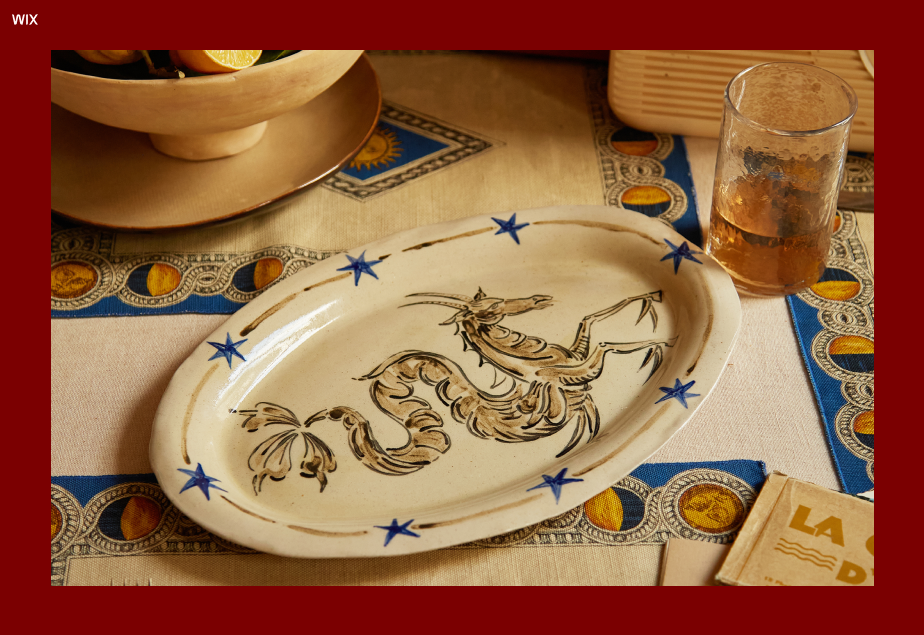
So, I built a homeware collection with Matches in mind: cushions and tableware inspired by the marble floors and antique frescos of Italian palazzos.
First, I produced a sample collection, photographed it (in a car park dressed up to look like a Mediterranean palazzo, as it happens) and sent over a lookbook with a simple introduction. The website was there to back it up if they wanted to dig deeper.

It wasn't a cold pitch. I’d studied Matches closely enough to know there was a genuine gap in what they were offering. Nothing on their site had the same aesthetic as my pieces. And they had a buying director who was known for championing emerging brands.
Not long after, I landed a call with them. I pitched my collection and they placed an order. Just like that. One big enough that I had to borrow money to produce it.
For the first order, which was particularly overwhelming, I hired friends to assist with packing. When the stock arrived, 500 cushion inserts literally filled the house where my friends and I were living. We had to climb over bags just to reach the kitchen. It was quite the scene.
It still took lots of hard work, but having Matches on board made other buyers take notice. Within three months, more clients followed. The Gergei Erdei brand had credibility.
It was a wild ride, but one that taught me an important lesson. Don't waste your early energy casting a wide net and hoping something sticks. Know exactly who your dream client is, understand what they’re missing and build your whole pitch around that gap.
Going deeper instead of bigger
For a while, everything was working. Then, suddenly the landscape shifted.
Retail budgets tightened. The big luxury platforms that had championed homeware started to struggle and consumer habits changed. The orders got smaller while production costs went up, and suddenly the math didn't make sense anymore.
By this point, I had also been working almost every weekend for four years and rarely took holidays longer than two weeks. Something had to give.
I had a choice: chase investment, scale up, move production somewhere cheaper and turn this into something much bigger. Or, go in the other direction entirely.
I chose to slow down and go deeper. And that’s when my website quietly became the most important thing I owned. It went from a supporting tool to the only front door my business had.
Today, I work almost exclusively on limited-edition pieces; objects that are much closer to art than commercial products, made to order. I work with galleries, interior designers and clients who find me directly. It's a completely different business model, and honestly, it's the one that feels most like me.
Your website is never really finished
Today, my website is the whole business. It’s not a store, it’s a window. Clients, galleries and interior designers can find me, understand my work and start a conversation. And that conversation is where everything happens.
My newsletter has become one of my most valuable tools, too. I have around 600–700 subscribers made up of past customers and people who follow my work. The open rates are strong. I don’t send it on a schedule. I send it when there's something worth saying. If it's surprising and genuine, people respond to it.
I’ve also redesigned my website on Wix more times than I can count (10 versions at least). But I think that's normal. As you evolve, your website should too. The key is knowing when it’s time for a refresh and not being precious about starting again.
Ready to get started? Build your business website on Wix Harmony.

What I'd tell someone starting out
You already know my belief in going after your dream client. But here are five other tips I’d tell someone going solo about creating their website.
01. Know your story first
Before you touch a website template or pick a font, get clear on what you actually want to say. Remember, your About page isn't a formality, it's your pitch. Who are you, what do you make and why does it matter? Write that down first. The design should follow the story, not the other way around. And when you’re ready to build, Wix offers a fast and intuitive website builder to bring your vision to life in minutes.
02. Your website should feel like you
Once the story is clear, the design should reflect it honestly. For me that means clean, minimal and timeless. Not loud. Not trendy. Nothing that'll look dated in a year. Study the visual world you’re trying to enter and match it. Then, make it unmistakably yours.
Need a hand figuring out what that looks like? Aria, Wix Harmony’s built-in AI agent, can brainstorm ideas and generate designs that have you written all over them. Try Aria on Wix Harmony.
03. Only sell on your site if the product fits
My site has no ecommerce function, but that's a conscious decision. My pieces are large, carefully crafted items (not exactly something you impulse buy). There has to be a conversation before anything changes hands. Removing the transactional layer makes the experience feel more premium, and many clients in my line of work appreciate that personal contact.
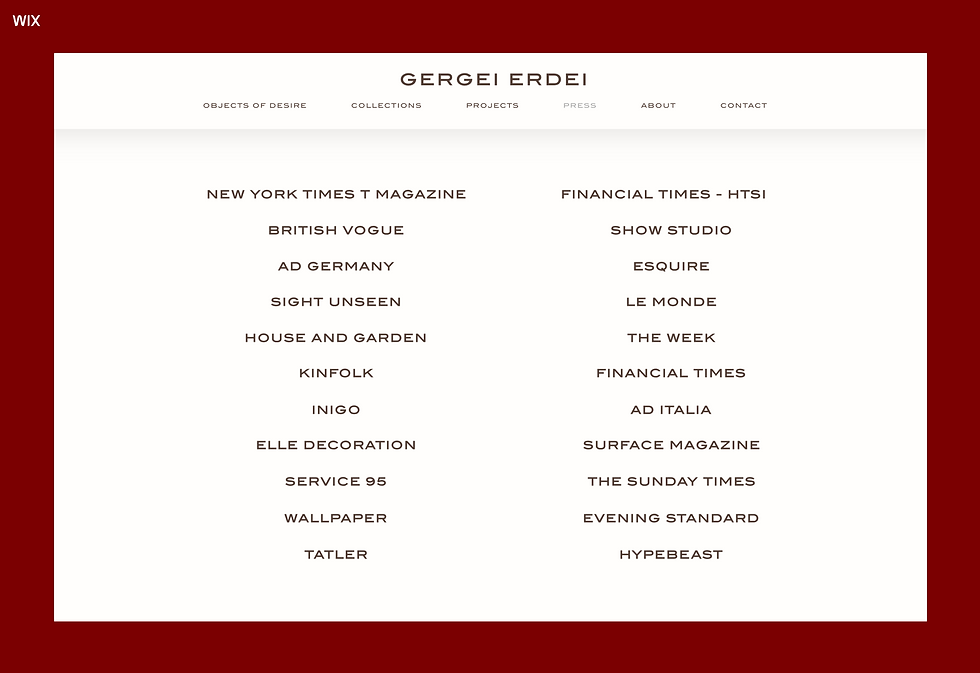
04. Use your website to build your press profile
Before you launch, get to know your industry. That includes the press, the PRs, the key figures and what they do. Learn the language of that world. Then, use your website to show you belong in it. A strong Press section on your website tells new clients that other people have already validated the work.
05. Start collecting emails from day one
A newsletter of people who actively want to hear from you is worth more than thousands of passive social followers. I have strong open rates not because I send constantly, but because I only send when there's something worth saying. Build that list through your site from the start. It's one of the most direct lines you'll ever have to the people who care about your work.

Do it on your own terms
There are all types of entrepreneurs out there: the ones who scale fast, chase investment and build big teams. That was never me. Becoming an entrepreneur on my own terms meant learning a different set of entrepreneurship skills: how to read a market, how to build a brand from scratch, how to pivot without losing yourself.
Sure, the early days were scrappy, involving a car park shoot, a house full of cushions, a website I had to rebuild from scratch. But every version of the business, every pivot, taught me something. Today I make the work I actually want to make for the people who want it.
It's not always easy. But it's entirely mine. And that's what I was after all along.


