Updated: 1 day ago
The perfect .com domain is just a click away: register your .com domain→

A .com domain is a generic top-level domain (gTLD), the ending that follows the name in a web address like example.com. The name is short for "commercial," but anyone can register one today, including individuals and organizations, with no commercial-use requirement.
Because .com has been around since 1985 and is the ending many people type by default, it's a common first choice for businesses, blogs and personal websites. Whether it suits yours depends on your audience, the names still available and your budget.
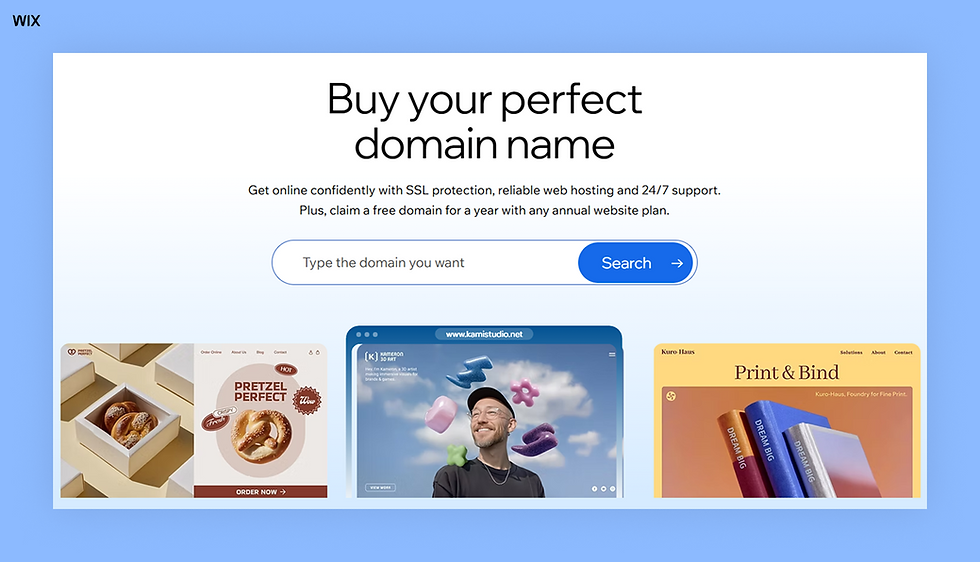
Secure your .com domain in just a few clicks with Wix. Get your domain, business email, hosting and an SSL certificate in one place. Wix is an ICANN-accredited registrar for .com and .net, and offers private registration as an option you can add.
TL;DR: what is a .com domain?
A .com domain is the largest extension by registration count and suits almost any kind of website. It works the same way as other extensions and gives no direct ranking advantage, so the right choice depends on availability, renewal price and who you want to reach.
You’ll learn:
What a .com domain is and where it came from
What a .com domain is used for and who it's for
Why .com became the most popular extension
Downsides, pricing and premium names
How to register and secure your .com domain
What .com does and doesn't do for SEO and business email
Alternatives worth considering
.com domain meaning
A .com domain is the ending part of a website address, like "example.com". The name is short for "commercial." It was originally intended for commercial entities, but the restriction was later lifted, so businesses, organizations and individuals can all register a .com. Today it's the most widely registered domain extension.
How the .com domain originated
The .com domain was introduced in 1985 as one of the original generic top-level domains (gTLDs). On March 15, 1985, Symbolics, Inc., a computer manufacturer, registered symbolics.com, the first .com domain name.

Why .com became the default
Back in the 90s, when the internet first took off, .com was one of the first domain extensions around. As more companies got online, .com naturally became the go-to for businesses and brands.
Fast forward a bit and everyone was so used to seeing .com that it became second nature. People just automatically assumed a website ended in .com and would type it in without a second thought. That habit is still going strong. Even with tons of new extensions out there, many of us still type .com first.
Today, .com remains the most widely registered extension worldwide. A few different players keep it running: Verisign operates the .com registry, which is the master database of every .com name, accredited registrars like Wix sell the registrations to you, and ICANN oversees the domain name system as a whole.
Learn more:

What makes .com so popular?
Many people choose .com because it's familiar and easy to remember in almost every industry. It's a generic top-level domain (gTLD), not a country-code domain, so it carries no geographic tie to any single country, which is part of why it works for audiences anywhere.
According to the DNIB Quarterly Report for Q3 2026, there were 169.8 million registered .com domains as of September 30, 2026, making .com the largest domain extension by registration count.
Read more:

Is .com required to have a website?
You don’t need a .com domain to create your website. Any extension like .net, .org, .co or even newer ones like .store or .tech will work just the same.
From a technical standpoint, all domain extensions do the same thing. They all connect people to your website through the same system so your site will work perfectly no matter which one you pick.
Registering a .com domain gives you a web address, but it doesn't create a website on its own. You still need a website and hosting to make that address lead to a working site. You can register the domain and arrange hosting separately, or choose a provider that offers both.
Does .com affect how a domain works technically?
Your domain extension doesn't change how your website works on the back end. All domain extensions use the same Domain Name System which points visitors to the right website.
There’s no difference in speed performance or setup between .com and any other extension. A website using .net or .co will load just as fast as a .com site if it's set up correctly.
How a .com domain affects perception, not performance
The only thing .com really affects is perception, not performance. It can make an address feel more familiar to visitors, but it won't affect your search rankings or how your website runs.
When you buy an eligible yearly or multi-year premium plan for the first time, you get a voucher for a free domain name for the first year. After that, the domain renews at the regular price.

Alternatives to .com domains
There are many great alternatives to a .com domain depending on what you need. Extensions like .net, .org and .co are widely used and trusted, each with its own vibe. .net is often chosen for tech and service sites, .org is common for nonprofits and community projects, and .co is popular with startups and modern brands looking for a short, simple option. These are especially helpful when your perfect .com name is already taken.
.com vs .biz .com vs .net
Industry-specific and country-code domain extensions
You'll also find specific, newer options that can better reflect your industry or audience. Extensions like .io are popular in tech, while .shop, .store and .design clearly say what your site is all about.
Country-code domains such as .co.uk or .de show visitors and search engines which country you serve, and newer options like .xyz or .online offer more availability for creative naming. The best choice is one that’s clear, easy to remember and aligned with your brand's personality.
Expert insight from Tim Hanson, CMO of Penfriend:
Penfriend.ai costs significantly more than a standard .com domain because it's a .ai TLD. In our case, it was a no-brainer because we're an AI company, and having that .ai extension instantly communicates what we do… If having a .ai domain helps close even one enterprise deal faster by adding legitimacy (which it has), it's paid for itself many times over. Sometimes the 'expensive' option is actually the cheapest when you look at the bigger picture of what you're trying to achieve.
Learn more:
What a .com domain is used for
A .com domain is one of the most flexible domain extensions. It works for almost any type of website from professional business sites to personal projects. Its versatility makes it perfect for different industries and purposes.
Who should use a .com domain
A .com domain works best for websites that want to reach a broad audience. It suits businesses, brands and creators who want an address people can remember and type easily, as well as personal websites that benefit from a familiar ending.
When a .com domain may be less successful
A .com domain can be less effective for very niche or local websites. If your audience is highly specific or your brand relies on regional identity, other extensions like .tech, .store or country-specific domains might be a better fit.
This comes up a lot for businesses that operate across borders. If you're targeting a global audience, .com is a widely recognized choice. If your business mainly serves one country, a country-code domain such as .de or .co.uk can signal your intended audience to visitors and search engines.
The extension alone doesn't guarantee better local rankings, since your content, audience relevance and other location signals still matter. Some businesses do both, using a .com as the main address with the local country-code domain pointed to it.
Learn more:

Why opt for a .com domain extension?
.com is business friendly: Many businesses, online stores and services use .com, so the ending fits commercial websites naturally.
.com works for any purpose: One of the main advantages of a .com domain extension is its versatility. It isn't limited to a specific industry, making it a suitable choice for businesses, organizations and individuals engaged in a variety of online activities.
.com is established: As one of the original domain extensions, .com has been in use since 1985 and is familiar to most internet users.
.com builds brand recognition: A familiar ending can make your address easier for people to remember and recognize, which helps when you share it in person, in print or on social media.
.com connects you globally: A .com isn't tied to any country, which suits businesses that want to reach audiences in several countries.
.com gives a competitive edge: Registering the .com version of your name stops anyone else from registering that exact address, which helps keep visitors who type .com from landing on someone else's site.
.com domain benefits
.com domain benefits | Why it matters |
|---|---|
Recognition | The .com domain is one of the oldest and most widely recognized extensions. |
Global reach | Not tied to specific countries or regions, .com makes it easy for businesses to connect with a worldwide audience. |
Easy to remember and share | Short, straightforward and familiar, .com domains are simple for people to recall, type and share with others. |
No direct SEO advantage | Google treats .com like other generic extensions for ranking, so it won't improve your position on its own. |
Familiarity | Many people type .com by default, which makes the address easier to guess and remember. |
Adaptability | A great fit for all kinds of industries and purposes, from personal projects to professional endeavors. |
Professional image | A custom .com address can make a website and its email look more established than a free subdomain. |
Widespread use | As the largest extension by registrations, .com works with registrars, email providers and website platforms everywhere. |
Resale value | One of the most sought-after extensions, .com domains tend to hold higher resale value. |
Email compatibility | Lets you set up email addresses that match your website, like hello@yourbrand.com. |
Many businesses also register several versions of their name as a protective move. They'll grab the .com alongside .net, relevant country domains and even common misspellings, then point them all to one website.
This guards the brand against copycats and typosquatters and makes sure visitors land in the right place no matter how they type it. It's a big reason companies prioritize the .com even when they mainly use a different extension.
What are the downsides of a .com domain?
The popularity of .com domains has created a few challenges. With millions already in use finding the name you want can feel impossible. The most direct and catchy names are usually taken.
Part of this comes down to timing. Because .com launched in 1985 and grew into the most popular extension on the internet, most short, dictionary and easily brandable names were claimed years ago.
With 169.8 million .com names registered as of September 2026, creativity matters more than ever, so landing a name you love often means combining words, adding a descriptor or coining something new.
Premium .com domains and resale prices
If the name you want comes with a much higher price, it's usually one of two kinds of domain:
Standard registration: The name is available to register at the registrar's listed price.
Premium or resale domain: The name costs more because the registry has designated it as premium, or because someone already owns it and is offering it for sale.
Domain names with popular words or catchy phrases can sell for thousands or even millions of dollars. For a small business owner or a personal website, that cost can be a hurdle.
When another domain extension is a better fit
While .com is widely known, it's not always the best choice for every brand. Niche businesses, regional companies or industry-specific websites might find better options. Extensions like .store or .tech, or a country-code domain like .co.uk, can offer more relevance and availability.
Expert tip from Keren Nir, Senior SEO Strategist at Wix:
"When choosing a domain, prioritize one that aligns with your brand and is easy for customers to remember. A domain should reflect your business and make it simple for people to find you online."
Who sets the price of a .com
Every .com registration passes through one registry, Verisign, which operates .com under a contract with ICANN. Registrars like Wix buy at Verisign's wholesale rate and set their own retail price on top, which is why the same .com costs different amounts at different registrars.
The 2026 .com wholesale price increase
Verisign is increasing its annual wholesale .com registration fee from $10.26 to $10.97 on November 1, 2026. The change affects what registrars pay for registrations and renewals, but the final retail price depends on each registrar's pricing.
The current registry agreement allows further increases of up to 7% a year. If Verisign takes the maximum increases permitted in the remaining years of the current pricing period, the wholesale fee could reach approximately $13.42 by 2029.
For most people this is a few dollars a year, not a reason to avoid .com. Registrars decide how much of a wholesale increase to pass on, so compare renewal prices as well as first-year prices before you register.

How to register and buy your .com domain
Select a reputable domain registrar, like Wix, that supports .com extensions.
Use the registrar's domain name search tool to verify the availability of your desired .com domain. You might need to explore variations or use a domain name generator to find an open and available option.
Once you confirm availability, choose the .com domain you want and complete the registration. Provide any necessary contact information, check the renewal price as well as the first-year price, and make the payment. Many registrars offer bundled services, including website hosting.
One thing worth knowing before you buy: registering a domain gives you the right to use it for a set period, usually one or more years, and you need to renew the registration to keep it. If you let it expire, you risk losing the domain, although it doesn't necessarily become available to someone else right away.
Auto-renew helps you avoid an accidental lapse, but it isn't a guarantee: an expired card or an account issue can still interrupt a renewal. Keep your payment details current and keep an eye on your renewal date.
If the exact .com you want is already taken, you've got good options before settling: Wix offers over 400 domain extensions and surfaces alternative domain suggestions when a user's preferred name is unavailable.
Add a location, like a city or region (for example, austinbakery.com)
Add an industry keyword that describes what you do (for example, riveraphotography.com)
Coin a short, brandable word that's easy to say and spell
Consider another TLD, like .co or an industry-specific extension, if it fits your audience better
Ask whether the current owner would sell it, usually at a resale price
How to secure your .com once you own it
Registering the name is the first step. These settings help you keep it:
Registrar lock: Helps prevent unauthorized transfers. How you unlock it for a transfer you want depends on your registrar.
Auto-renew: Renews the domain before it expires. Keep a valid payment method on file and watch for renewal reminders, since a failed payment can still interrupt a renewal.
Two-factor authentication: Protects the registrar account itself, so a stolen password alone isn't enough to take control of your domain.
DNSSEC: Helps protect against DNS spoofing. Turn it on if your registrar and DNS setup support it, and make sure it's configured correctly.
WHOIS privacy is worth deciding on too. It limits how much of your personal contact information appears in public registration records, subject to the rules for each extension.
That can reduce unwanted contact, but it doesn't protect the website itself. Check what privacy options your registrar offers, since some can only add it at the time of purchase.
Using your .com for business email
A .com is the address people expect on an email as much as on a website. hello@yourbrand.com reads as a business, while the same message from a free webmail address can read as a side project, even when the work behind it is identical.
Set it up at the same time as the domain. The address ends up on contact forms, invoices, proposals and email signatures from day one, and changing it later means updating all of them.
Once the address is live, add the email authentication records your email provider gives you (SPF, DKIM and DMARC). They help receiving mail servers confirm that your messages really come from your domain.
Learn more:

Examples of .com domains
These Wix sites show a few different ways a .com can work for a business:

Koketit is an illustration and branding studio with a short, invented one-word name. A .com keeps that made-up name simple to say and type, which suits a creative business built around a personal brand.

EatKinda is a plant-based ice cream brand sold in stores and online. Its .com gives the brand a short web address that shoppers can type without guessing the ending.

Izzy Wheels is an ecommerce brand selling fashion spoke guards for wheelchairs. Its .com gives the online store one address that isn't tied to a single country.
How a .com domain supported Upside Aerial's growth
For Upside Aerial founder Michelle Spurlock, the website became the center of the business, helping introduce aerial arts to people who had never heard of it. Through photos, class information and stories from real students, the site helped build an engaged community.
A professional .com domain gave the business a clear, recognizable web address that visitors could return to as the studio grew. During the pandemic, the website also became the hub for online classes and virtual events, helping the business stay connected with its community.
Find the domain owner and registration details for a website with a WHOIS domain lookup.

Learn more:
How does a .com domain affect SEO?
A .com domain doesn't give your website a direct ranking advantage in Google Search. Google treats generic top-level domains the same way for ranking, so choosing .com over .net or another generic extension won't, by itself, improve your position in search results.
A familiar domain may help people recognize and remember your website. That can have marketing benefits, but it's different from an SEO benefit. Focus on relevant content, a technically sound website and a domain name that accurately represents your brand.
“In general, domain names on TLDs are similar. But I’d avoid free, cheap or spam-heavy TLDs since domains there can come with a significant burden to overcome before they’ve been recognized to be reasonable...If spending $2 more will let you avoid a long struggle, I’d recommend spending the $2 more.”

Wix’s domain experts
This article was created by Wix’s in-house domain experts, with years of experience helping people choose, register and secure the perfect domains for their businesses and online projects.
The guidance, tips and best practices shared here come directly from real Wix projects, so you can be confident they’ll help you find a domain that represents your brand, stays secure and supports your long-term goals.
Domain management and security guidance from Wix
At Wix, we’ve guided millions of entrepreneurs, creators and small business owners in establishing a strong online presence. Our team keeps up with the latest in domain management, security and branding, making sure the advice you get is practical and backed by proven results.
Think of this article as your trusted resource for every stage of domain ownership, from finding your first custom domain to protecting and growing your online identity.
Learn more:
Expert tip: secure the .com version of your domain name
As Magee Clegg, the CEO of Cleartail Marketing shares:
"Make sure you can secure the .com version. If someone else owns the .com of your desired name, pick something different entirely. I've seen businesses spend thousands on paid ads just to overcome the confusion when customers land on their competitor's .com by mistake."

What is a .com domain FAQ
Can I use .com for non-commercial websites?
Yes. Commercial activity isn't a requirement, so individuals, nonprofits, clubs and personal projects can all use a .com. If you’re learning how to make a website, choosing the right domain extension is an important step.
Are there any restrictions on .com domain registration?
There are no eligibility requirements for .com, so anyone can register a name that's available. You still need to provide accurate contact details, follow your registrar's terms and avoid names that infringe someone else's trademark.
Is .com suitable for personal portfolios?
Yes. A .com works well for a personal portfolio, since it's easy for clients and employers to remember and type.
Can I use a .com domain for business emails?
Yes. If you’re learning how to create a business email, a .com lets your address match your website, like contact@yourbusiness.com or team@yourbusiness.com. You can also use email name ideas that reflect specific roles or departments.
Can I get a free .com domain?
Not a true .com, no. Wix's free plan gives you a Wix subdomain (yoursite.wixsite.com/name) rather than your own .com. To get a .com you need a paid plan: selected yearly or multi-year plans include a free domain voucher for the first year when you buy the plan for the first time, and the domain renews at the regular price after that.
What are the benefits of a .com domain over other extensions?
The .com extension is the largest by registrations and isn't tied to any country, which suits sites aiming for a broad audience. Many people also type .com by default, which can make the address easier to remember.
How does a .com domain affect SEO?
A .com domain gives no direct ranking advantage. Google treats generic top-level domains the same way for ranking, so a .com won't outrank a .net or .org because of its extension. Relevant content and a technically sound website matter far more.
Is .com or .org better?
It depends on your website's purpose. ".com" is the usual choice for businesses and sites aiming at a broad audience. ".org" is often associated with nonprofits and community projects, but anyone can register one, so it isn't limited to nonprofit organizations.
Is .com a safe domain?
A .com domain is a widely recognized extension, but the extension itself doesn't make a website safe. Security depends on factors such as the website's configuration, its HTTPS setup, account protection and how the domain is managed. Check that a website is legitimate before sharing personal or payment information.
Why are .com domains so expensive?
A standard .com registration is priced by each registrar on top of the registry's wholesale fee. The high prices you sometimes see apply to premium or resale names: short, memorable or brandable .com names that the registry has designated as premium, or that someone already owns and is offering for sale. These can sell for thousands or even millions of dollars.
Do I need a .com domain?
You don’t always need a .com. It's a familiar choice if you want to reach a broad or international audience. If your focus is niche, regional or industry-specific, another extension might work just as well.
How many .com domains are there?
As of September 30, 2026, there were 169.8 million registered .com domains worldwide, according to the DNIB Quarterly Report, making .com the largest domain extension by registration count.
What if the .com domain I want is already taken?
Check whether a close variation is available, for example by adding a location or an industry word. You can also ask whether the current owner would sell it, usually at a resale price, or choose a different extension that fits your audience.


