Updated: 14 hours ago

To create a hotel website, start with a hospitality template, connect booking and payment, then add room pages with clear photos and amenities. A good hotel website takes the reservation itself instead of sending the guest off to a third-party listing. Wix lets you build a booking website that includes tools for scheduling, payments, and client reminders. This guide covers the nine steps a hotel business needs to build and launch a business website.
Building a website for your business, passion project or side hustle should feel simple and exciting. Wix generates a personalized starting point with AI. You can customize every detail with intuitive drag-and-drop tools, while Wix handles the tricky parts to make building your site simple. That way, you can focus on what matters most: bringing your ideas to life. Ready to get started? Create your website today.
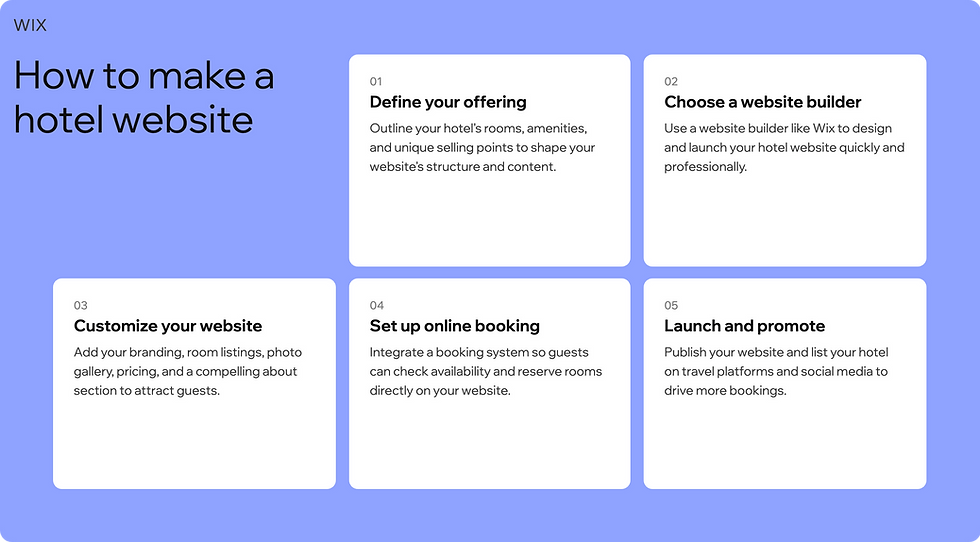
TL;DR: how to create a hotel website
A hotel website helps you take control of bookings, cut reliance on third-party sites and gather useful insights about your visitors. Costs can be low with free or affordable website builders or higher if you go for a custom design.
To make your site work, start with a hotel website template and add booking and payment options. Include key pages like Home, About, FAQ, Contact and detailed room pages with clear photos and amenities. Build trust with strong branding, a custom domain name, logo and consistent colors and fonts. Make sure the site works smoothly on mobile, is SEO-friendly and links to your social media. Get a second opinion before publishing and keep it updated with blogs or local travel tips.
Building a website for your business, passion project or side hustle should be easy and exciting. With Wix's hotel website builder, you can customize and launch a professional website in minutes, no coding needed. We’re all about simplifying the process so you can focus on what matters most–bringing your ideas to life.
You can also use Wix Harmony which takes you from a single prompt to a business-ready site for any industry or creative vision.

Hotel type | Key website features | Content / branding tips |
|---|---|---|
Boutique hotel | Online booking, image galleries, seasonal promotions | Highlight unique design, show local partnerships, share curated experiences that make your hotel stand out |
Luxury hotel | Reservation system, secure payment, virtual tours, concierge info | Emphasize upscale amenities, exclusive services and sophisticated visuals that match your brand |
Bed & breakfast | Booking calendar, testimonials, contact form | Show cozy spaces, personal touches, breakfast options and nearby attractions to create a welcoming feel |
Resort | Activity booking, multiple room types, event calendar | Showcase pools, spas, dining and family-friendly experiences, offer package deals for longer stays |
Hostel | Dorm booking, group reservations, FAQ section | Focus on affordability, social spaces, travel tips and community activities that appeal to younger travelers |
City hotel | Online booking, location map, transport info | Highlight convenience, business services and nearby restaurants and attractions |
Boutique resort | Packages and offers, photo galleries, booking | Blend luxury and unique experiences, show relaxation spots and exclusive services |
Vacation rental | Calendar availability, payment options, reviews | Display property layout, amenities, seasonal pricing and tips for local experiences |
Eco hotel | Sustainability info, booking system, blog | Highlight green initiatives, eco-friendly services and tips for responsible travel |
Apartment hotel | Multi-unit booking, long-stay options, neighborhood guide | Focus on flexible stays, extended-stay amenities and local highlights that help guests feel at home |
How to create a hotel website in 9 steps
01. Choose a hotel website template
As a busy owner (especially in this type of business) you have a ton of things to deal with, from the bills to your staff. However, web design shouldn’t be one of those tasks. Luckily, it doesn’t have to be thanks to the wide variety of templates available. Now you’re able to build the site you and your guests have always dreamed of, regardless if you’re a small B&B or a 100 room hotel.
When choosing a free hotel website template, you don’t need to worry about it missing anything, as each one comes with all the latest features already included. A couple of examples include a rich menu, a contact form, a gallery, a social network bar and an intuitive booking solution. All that’s left for you to do is fill your chosen templates with your hotel’s information, images and branding.
Of course, some people don’t want to spend too much time on creating their website and that’s just fine. If you fall into this crowd, then Wix’s AI website maker is the perfect tool for you. Just prompt AI to get a custom website in minutes. Wix's AI will suggest the right website layout, text and design. It will even suggest the right business solution, like online bookings, ecommerce tools and event management, to integrate into your site so that you can hit the ground running. You can always make additional tweaks to your website via the Wix Editor.
Move fluidly between prompt-driven creation with Wix Harmony and precise drag-and-drop editing. You’re never locked into one mode when vibe coding a website with Wix.
Or look to the future of website building and use Wix's native Chat GPT integration allows you to type"@Wix" in a conversation, to invoke its Wix Harmony vibe code website builder.
Learn more about how to design a website with AI.

02. Incorporate a booking and payment solution
Whether you’re renting out your hotel, B&B, city apartment or beachside bungalow, you’ll need the help of an all-in-one online booking system. As a Wix user you can incorporate Wix Hotels by HotelRunner on your site and get access to the following features:
Manage your reservations and accept payments: Easily keep track of your reservations online.
Create flexible pricing options: Set different rates according to the season so your prices match the demand.
Take bookings from any device: Create a seamless booking website experience directly on your site that can be accessed from both desktop and mobile.
Let guests book in their own language: Offer multilingual options for reservations so every guest can book easily.
Keep in touch with guests: Stay in contact at every stage of the stay, from the moment they book through to checkout.
Sync your rooms with major travel sites: Connect your availability and rates to platforms like Booking.com, Airbnb and Expedia from the same dashboard, so your inventory stays accurate everywhere you list. The channel manager is included when you upgrade your site and the number of connections depends on your plan.

03. Add the relevant website pages
While the primary goal of your lodging website is to get reservations, it takes a lot more than the ability to take reservations to sell to a potential customer. Your website needs to provide an ‘experience’ of what you have to offer at your location. You can achieve this by including the correct pages:
Home page: This needs no introduction, as the home page is the face of your website. It’s the page that your visitors will arrive at after inputting your domain into their web browsers. Considering this, it’s important that the essentials are found on this page. If your website was a restaurant, the home page would be the tasting menu showing you a little bit of everything your site has to offer, where your other pages would be the à la carte menu.
Photos: While your accommodations should speak for themselves, you should always provide clear photos of the space available. This is where your customers will potentially be staying and if you don’t have time to take clear pictures of the rooms you’re renting, well, it doesn’t send the most positive message. Also be sure to take several shots at different angles so your potential customers can better envision themselves there. Do you want to showcase photos of your property in the most stunning way possible? Display them in using Wix Pro Gallery to let your rooms come alive.

Descriptions: Take your future guests on a visual and descriptive journey of your rooms by describing the look and feel of your beautiful space. Using carefully crafted words, you’ll be able to give guests a glimpse of what to expect. In order to be as transparent as possible, state the facts about each one of your rooms as well. Make sure you leave no detail behind. For example: bed size, number of beds, amenities, maximum number of guests, extra charges (such as for breakfast or WIFI).
‘About us’ page: Everyone loves a beautiful story and it most certainly can affect decision making. An ‘About us’ page not only allows you to show off how your hotel came to be, but it also shows what makes you different than the others that offer similar accommodations. Even if your story isn’t meant to pull at the heartstrings, it lets your site visitors get to know you more, which in turn helps build trust.
FAQ: Answer before they ask. This is intuitive to your customer and efficient for you, which makes it a great addition to your website. By including an FAQ page you can provide answers to questions that may naturally come up while clients browse your site. To get it right, you can read through our guide on how to create a killer FAQ page.
Share your reviews: Save your site visitors a trip to Yelp and Google by putting guest reviews directly on your website. A reviews app from the Wix App Market can pull ratings in from the directories where your guests already leave them. Showing reviews directly on your website proves transparency, which helps build a trusting relationship between the vendor and customer. But that’s not the only reason to show reviews. It’s also a little bit about boasting about your successes. This is the place to show off your TripAdvisor reviews, positive press coverage, magazine features or awards your business has acquired. This is a good and accepted place to be a total show off and no one will judge you.
Contact page: This is arguably one of the most important pages on your site. Luckily, you can show that ‘you’re there’ in several ways. You can add a separate page (or a section) that is dedicated to all of your contact information. This includes phone numbers, email, social media accounts, a contact form and any other possible way clients can get in touch with you. Customers have come to expect to be able to find all your information in the footer of your site (you know, that area right at the bottom). So on top of the page that you create, make sure your footer is filled with up-to-date contact and any extra info like a map and your terms and conditions. Lastly, you should add an AI site chat so that your visitors can get answers then and there, even outside reception hours.
Privacy policy: make sure to get creating a privacy policy page for your website right. It's a great way to establish brand trust with your potential customers, and in many countries is also a legal requirement.

04. Brand your hotel website
Branding your hotel website is an important part of exploring how to start a business. It’s about showing visitors what makes your property unique and giving them a feel for your style. Along with a proper domain for your website, include all your key branding elements so guests instantly recognize you and get a sense of your hotel’s personality. Here are some key things to consider:
A customized domain: Your domain name should be the name of your hotel and possibly a strong keyword affiliated with it, like your location or type of hotel. For example, if your hotel is called ‘Sally’s Inn’ and is located in Maine, your domain could be: www.sallysinnmaine.com. If you're still stuck on a name for your hotel, explore these hotel name ideas or service business names.
A logo: This is the visual representation of your hotel that customers will associate with your brand. Don’t have a logo? No problem. You can create your own logo online and customize it using Wix Logo Maker. After that, your little gem can be displayed throughout all of your service marketing efforts and even your favicon (the small icon that appears on a tab in your browser). Lastly, don’t forget to always link your logo back to your homepage, since it’s a web norm these days. Make sure to read through this guide on what makes a good logo before you get started on your creation.
Define your visual language: The use of color is not only for making your site look pretty. Believe it or not, color has the ability to affect and evoke specific emotions within your visitors. The choice of your palette will also play an important role in the overall performance of your site (conversion rates, time spent on page, etc.). Want to play it safe? Go for a clean white or black background. Then, limit yourself to two colors for the other elements (buttons, texts, etc.) of your site. When it comes to your fonts we’ve got the ultimate guide to choosing the best fonts for your website.
Learn more: how to start a service business

05. Promote your hotel website on social media
It doesn’t end with just having a website. The Internet world basically runs on social networks, so it’s important that your business is also active on them as well. It’s a free and easy way to spread your name even wider. You can give your site visitors a glimpse of your social channels directly on your website by including a live Instagram feed or Facebook stream. Of course, it also doesn’t hurt to add a social bar with links to all of your social networks on the header or footer of your website as well.
06. Build your website for mobile
With more and more Internet traffic coming from mobile devices, it’s imperative that your entire website offers a mobile friendly experience. Luckily, Wix Hotels offers this out of the gate, so all you need to do is make sure it’s designed to your liking. Offering a seamless mobile experience not only ensures that you’re equipped to handle traffic from any source, but it can also positively affect your SEO ranking as well. You can check out these hotel website design examples for a drop of inspiration.
07. Pay attention to SEO
In simple terms, SEO is the practice of optimizing your site so that your pages can rank higher on search engines’ results. There are a couple of ways to boost your efforts, such as choosing the right domain name, adding alt text to your images and using the right keywords throughout your site. A good SEO setup is more than choosing the right keywords to ‘get on Google.’ It’s a process that will help your customers find you more easily and in turn bring you more business, so it’s a win-win. Luckily, you don’t have to be an SEO expert to yield great results. Wix SEO walks you through the entire process, is completely free to use and helps you get your site indexed on Google.
Since you’re a hotel with a fixed location, one important factor you need to focus on is your local SEO. Think of search engines as the online version of the Yellow Pages. There are a couple of actions you can take to ensure your hotel is associated with a geographical location in the minds of Google, Bing and Co. The first step? Sign up your business to Google Business Profile to put yourself on the map. For example, let’s say you are the owner of a hotel called ‘Sleep Tight Boston’. If a potential client looking for accommodation searches for ‘hotel in Boston’ your site will have a better chance of showing up since your business ‘matches’ the search criteria.
08. Get a second opinion before publishing
After spending too much time on any project it is important to be able to walk away from it so you can see it with fresh eyes later, allowing you to see details that you may not have noticed previously. Even though you’ve poured your digital blood, sweat and probably literal tears into the creation of your website, it’s best to get the opinion of someone else before you hit the publish button. Showing your website to a friend who isn’t close with the project will allow you to get feedback that you probably wouldn’t have thought of, which is feedback more in line to that of an anonymous website visitor. Listening to their feedback and making adjustments can make a great experience for the end user.
09. Update your hotel site regularly
A website isn’t a ‘set it and forget it’ project, especially if you’re relying on it for your business. Updating your website with fresh content consistently can bring your SEO ranking up with Google. Of course, there’s a good chance that your hotel isn’t going to grow thirty rooms overnight or dramatically change in ways that you can continuously update the website but this is why you should look into starting a blog. You could cover topics like the latest travel destinations, showcase the location of your hotel or create a list of top things to do and see when visiting your hotel. Not sure how to get going? Read through this insightful guide on blogging for business.
Why make a hotel website?
Starting a hotel website is a pivotal step in enhancing the visibility of your property. A dedicated website allows you to showcase your hotel's unique features, amenities and services, creating a positive first impression on potential guests. It allows for direct bookings, reducing dependence on third-party sites and associated commission fees.
Kindling Home, a vacation rental company in western North Carolina, now takes 60% of its bookings through its own Wix site.
Mackenzie Precht, Co-founder, Kindling Home
Having our own website allowed our properties to be a part of a brand as opposed to these independent entities, and it also gave us control over bookings. By having guests book directly through us, we're able to give them a pretty significant discount because we're avoiding a lot of fees.
Learning how to create a service website allows you to differentiate yourself from your competitors and offers an opportunity to build a unique brand identity.
Amanda Buhse, Owner + Chief Creative Officer of Coal and Canary
You could be the smallest fish in the sea, but if you have a professional website and branding, people will take you seriously.
A hotel website serves also as a potential data hub, offering valuable insights into visitor behavior. Analyzing this data aids in understanding your audience, tracking marketing efforts and making informed business decisions for your hotel. With your own site you not only potentially increase direct bookings but also create an online platform to promote and brand your hotel.

How much does it cost to make a hotel website?
The cost of building a hotel website can vary depending on how you choose to build it. One option is to go with a website builder, like Wix. You can create a site for free or opt for a paid plan for more functionality and to be able to accept payments online.
If you decide to have your hotel website built by a web developer and web designer, its cost could reach thousands of dollars.
Learn more: How much does a website cost, best hotel website builders
Wix Headless
Developers building hotel websites who want full frontend control while keeping a managed backend can build on a headless CMS like Wix Headless. Wix Headless gives agencies a backend they can trust on every client project, with payments, bookings and business operations running on enterprise-grade infrastructure with no maintenance required from the agency.
Read more about Wix Headless:
How to create a hotel website FAQ
What does a hotel website need?
A hotel website should have clear room descriptions, sharp photos and a simple booking system that makes reservations easy. Include pages like About, FAQ and Contact to answer questions and build trust.
What is the best website software for hotel booking?
Hotel booking software lets guests book rooms online, pay securely and get instant confirmations. Options like Wix Hotels integrations handle availability, pricing and reservations for you. They make managing your bookings smoother and save time so you can focus on guests.
How long does it take to launch a hotel website?
With a website builder and templates, you can launch in a few hours or days. Custom sites take longer, often a few weeks, depending on design complexity and content preparation.
How can I accept payments online safely?
Use secure payment gateways built into your booking software. Look for options with SSL encryption and PCI compliance to protect both you and your guests.
Can I manage bookings directly from my website?
Yes. Platforms like Wix Hotels let you track availability, set pricing and manage reservations all in one place. This reduces the need for third-party platforms and keeps everything running smoothly.
Should I show reviews on my website?
Yes. Displaying guest reviews builds trust and gives visitors confidence to book. Include testimonials, TripAdvisor ratings or press mentions to make your site more credible.
How often should I update my hotel website?
You should review and update your website at least once a month. Add new photos, seasonal offers, blog posts or local travel guides to keep content fresh. Regular updates not only improve SEO but also give guests reasons to return and increase the chances of repeat bookings.
What is a headless CMS?
A headless CMS separates where your content lives from how it gets displayed, so developers can build any frontend they want on top of it. Wix Headless gives agencies a backend they can trust on every client project, with payments, bookings and business operations running on enterprise-grade infrastructure and no maintenance required from the agency.


