- Rachel Bistricer

- Sep 24, 2025
- 9 min read
Updated: Nov 17, 2025

Creating content that truly connects with your audience requires more than just words on a page. Interactive content marketing transforms passive readers into active participants, building deeper connections and driving meaningful engagement across every platform you use.
Modern audiences expect experiences that respond to their input and provide immediate value. Interactive content delivers exactly that—turning one-way communication into dynamic conversations that capture attention, generate leads and create memorable brand experiences.
TL;DR: Interactive content ideas
81% of marketers agree that interactive content grabs attention more effectively than static content. Here's a quick overview of the interactive content types we'll explore, along with specific examples for each category:
Content type | Best for |
Quizzes | Lead generation, engagement |
Polls and surveys | Audience insights, social media |
Interactive infographics | Data visualization, storytelling |
Calculators | Lead magnets, practical value |
Interactive eBooks | Thought leadership, education |
Interactive videos | Product demos, tutorials |
Contests and giveaways | Brand awareness, community building |
47 Interactive content ideas
Transform your content strategy with these proven interactive content ideas that drive engagement and deliver measurable results.

Quizzes
Quizzes tap into people's natural curiosity about themselves, while providing valuable insights about your audience. They're shareable, entertaining and perfect for capturing leads.
Personality quizzes help users discover something about themselves, while subtly showcasing your expertise. A fitness brand might create "What's your workout personality?" while a productivity app could offer "What's your time management style?"
Knowledge assessments position your brand as an authority while educating your audience. Software companies can test users' understanding of industry concepts, while consultants might quiz visitors on best practices.
Product recommendation quizzes guide users to the perfect solution for their needs. Beauty brands excel at "Find your perfect shade" quizzes, while tech companies can match users with the right software package.
Industry trend quizzes keep your audience current while demonstrating thought leadership. "How well do you know 2024's marketing trends?" engages professionals while showcasing your industry knowledge.
Skill level assessments help users understand their current abilities and identify growth opportunities. Design agencies might offer "Rate your design skills" while language learning platforms could provide proficiency tests.
"Would you rather" quizzes create lighthearted engagement that reveals user preferences. These work particularly well on social media and help humanize your brand.
Myth-busting quizzes challenge common misconceptions in your industry while educating your audience. Healthcare brands can tackle wellness myths, while financial advisors might address investment misconceptions.
Historical or nostalgic quizzes tap into shared memories and cultural moments. "How well do you remember the 90s?" can work for brands targeting specific demographics.
Polls and surveys
Polls and surveys create two-way conversations with your audience, while gathering valuable data for future content and product development.
Quick opinion polls on social media generate instant engagement and provide real-time feedback. Ask about industry preferences, current events or product features to spark meaningful discussions.
Market research surveys help you understand customer needs while making participants feel heard. Offer insights reports to survey participants, creating additional value from their contribution.
User experience feedback forms improve your products while demonstrating that you value customer input. Interactive rating systems and comment sections make the feedback process engaging rather than tedious.
Prediction polls around industry events or trends create anticipation and position your brand as forward-thinking. "What will be the biggest marketing trend next year?" generates discussion and showcases expertise.
Behind-the-scenes preference polls give your audience a voice in your content creation process. Let them vote on topics for your next blog post or webinar theme.
Comparison surveys help users evaluate options while positioning your solutions favorably. "What's most important when choosing a project management tool?" guides prospects toward key benefits.
Community-building polls strengthen relationships by showing you care about your audience's interests beyond your products. Ask about their challenges, goals or preferences in relatable areas.
New to online forms? Check out our step-by-step guide on how to create an online form.

Interactive infographics
Interactive infographics combine visual appeal with user engagement, making complex information digestible and memorable.
Clickable data visualizations allow users to explore different data points and discover insights that matter most to them. Revenue charts that show breakdowns by category or timeline filters create personalized experiences.
Interactive timelines guide users through historical developments or process stages. Software companies can showcase product evolution, while consultants might illustrate industry transformation.
Hoverable statistics reveal additional context when users explore different data points. This keeps the main visual clean while providing depth for interested viewers.
Interactive maps work brilliantly for location-based data, customer testimonials by region or service area showcases. Users can click through different areas to discover relevant information.
Process flow diagrams with clickable steps help users understand complex procedures. Each stage can expand to show detailed information, tools needed or common challenges.
Comparison charts that users can filter and customize help them evaluate options effectively. Side-by-side feature comparisons become more engaging when users can highlight their priorities.
Calculators
Calculators provide immediate, practical value while capturing leads and demonstrating expertise in your field.
ROI calculators help prospects understand the financial impact of your solutions. Marketing agencies can show potential campaign returns, while software companies demonstrate efficiency savings.
Cost comparison tools position your pricing favorably, while helping users make informed decisions. Include factors beyond price to showcase your complete value proposition.
Assessment calculators evaluate user situations and provide personalized recommendations. Fitness brands might calculate caloric needs, while financial advisors could assess retirement readiness.
Sizing or specification tools help users determine their exact requirements. This works well for technical products, custom services or physical goods.
Timeline calculators show users how long specific goals or projects might take based on their inputs. This builds realistic expectations while demonstrating your understanding of typical challenges.
Savings calculators illustrate potential benefits from efficiency improvements, cost reductions or better resource allocation. These work well for productivity tools, energy solutions or consulting services.
Interactive eBooks
Interactive ebooks transform traditional long-form content into engaging digital experiences that readers actively participate in rather than passively consume.
Branching narratives let readers choose their path through the content based on their interests or situations. Business strategy ebooks can offer different routes for startups versus enterprises.
Embedded interactive elements like mini-quizzes, calculators or assessment tools break up text while providing immediate value. These elements also offer additional data collection opportunities.
Clickable case studies allow readers to dive deeper into examples that resonate with their specific challenges. Each case study can expand to show detailed results, methodologies or lessons learned.
Interactive worksheets turn theoretical concepts into practical tools readers can use immediately. Templates, checklists and planning documents make your ebook a working resource.
Video integration creates multimedia experiences that cater to different learning styles. Short explanatory videos or expert interviews can enhance key concepts without overwhelming the reader.
Interactive videos
Interactive video content increases completion rates by a remarkable 44% compared to standard videos. Interactive videos transform passive viewing into active engagement, creating memorable experiences that drive action and improve retention.
Shoppable videos allow viewers to click on products they see and purchase directly. Fashion brands and home decor companies use this to seamlessly connect inspiration with conversion.
Choose-your-adventure videos let viewers select different paths through the content. Training videos can offer role-specific tracks, while product demos can focus on different use cases.
Clickable hotspots provide additional information when viewers hover or click on specific areas. Product demonstrations become more detailed, while maintaining smooth viewing experiences.
Interactive tutorials pause at key moments to let viewers practice or make choices. Software training videos can include hands-on exercises, while cooking tutorials might offer ingredient substitutions.
Quiz-integrated videos test comprehension at strategic points, improving retention and engagement. Educational content becomes more effective when viewers actively participate in the learning process.
Personalized video experiences adapt content based on viewer inputs or preferences. Welcome videos can branch based on user roles, while product tours can highlight relevant features.
360-degree videos let viewers explore environments from multiple angles. Real estate, travel and event companies create immersive experiences that traditional videos can't match.
Live interactive streams incorporate real-time polls, Q&A sessions and viewer-driven content decisions. These create community experiences while generating immediate feedback.
Contests and giveaways
Contests and giveaways build excitement around your brand while encouraging user-generated content and expanding your reach through social sharing.
Photo contests encourage user-generated content while showcasing your products in real-world situations. Customers become brand ambassadors while you gather authentic marketing materials.
Caption contests generate engagement and creativity around your visual content. These work well on social media and can reveal how your audience perceives your brand.
Video submission contests create rich content libraries while building community. Customers sharing success stories or creative uses of your products provide powerful testimonials.
Design competitions tap into your audience's creativity while generating fresh ideas for your branding. Logo contests, packaging design or marketing campaign ideas can come from community contributions.
Trivia challenges educate your audience about your industry while rewarding knowledge. These position your brand as an authority, while making learning fun and competitive.
Social media challenges encourage users to create content around specific themes or hashtags. These can go viral and significantly expand your brand awareness when designed thoughtfully.
Referral contests reward existing customers for bringing new people to your brand. Gamifying word-of-mouth marketing strategy accelerates growth while acknowledging loyal customers.
What is interactive content
Interactive content requires active participation from your audience, rather than passive consumption. Unlike traditional content where readers simply absorb information, interactive formats demand clicks, responses, choices or other forms of engagement.
This participation creates a two-way dialogue between your brand and audience. Users invest time and attention in exchange for personalized results, immediate value or entertaining experiences. The interaction itself becomes part of the value proposition.
Interactive content spans multiple formats and complexity levels. Simple polls on social media qualify as interactive content, as do sophisticated calculators or branching video experiences. The key element is user participation, which influences the content experience or outcome.
Benefits of interactive content
Interactive content delivers measurable advantages that traditional content formats struggle to achieve. These benefits compound over time as you build more engaging experiences for your audience.
Higher engagement rates result from active participation requirements. Users spend more time with interactive content because they're invested in the outcome. This increased dwell time signals quality to search engines, while building stronger brand connections.
Superior lead generation happens because interactive content provides immediate value in exchange for contact information. Users willingly share details when they receive personalized results, recommendations, or insights they can't get elsewhere. Interactive content drives 2x more conversions than static content, proving its power to turn interest into action.
Valuable audience insights emerge from user interactions and choices. Every click, selection and response provides data about preferences, pain points and decision-making patterns. This information improves future content and product development.
Enhanced personalization becomes possible when you understand individual user preferences and needs. Interactive content naturally reveals these details, allowing you to tailor follow-up communications and recommendations.
Improved content sharing occurs because interactive content creates memorable experiences worth discussing. Users share results, challenge friends or recommend tools they've found valuable.
Better conversion rates follow the combination of higher engagement, personalization and trust-building that interactive content provides. Users who actively engage with your content are more likely to take the next step in your sales process.

Challenges of interactive content
Creating effective interactive content requires overcoming several obstacles that don't exist with traditional content formats.
Technical complexity increases with interactivity levels. Simple polls need basic tools, but sophisticated calculators or interactive videos require specialized platforms and potentially custom development work.
Higher production costs result from the additional resources needed for design, development and testing. Interactive content often requires collaboration between content creators, designers and developers.
Longer development timelines accommodate the extra steps involved in creating, testing and refining interactive experiences. User experience testing becomes crucial when people actively engage with your content.
Platform limitations can restrict where you can deploy certain types of interactive content. Some social media platforms limit functionality, while email clients may not support advanced interactive elements.
Analytics complexity grows when you need to track multiple interaction points and user paths through your content. Standard content metrics don't capture the full value of interactive experiences.
Maintenance requirements continue after launch, as interactive content often needs updates, bug fixes or platform compatibility adjustments over time.
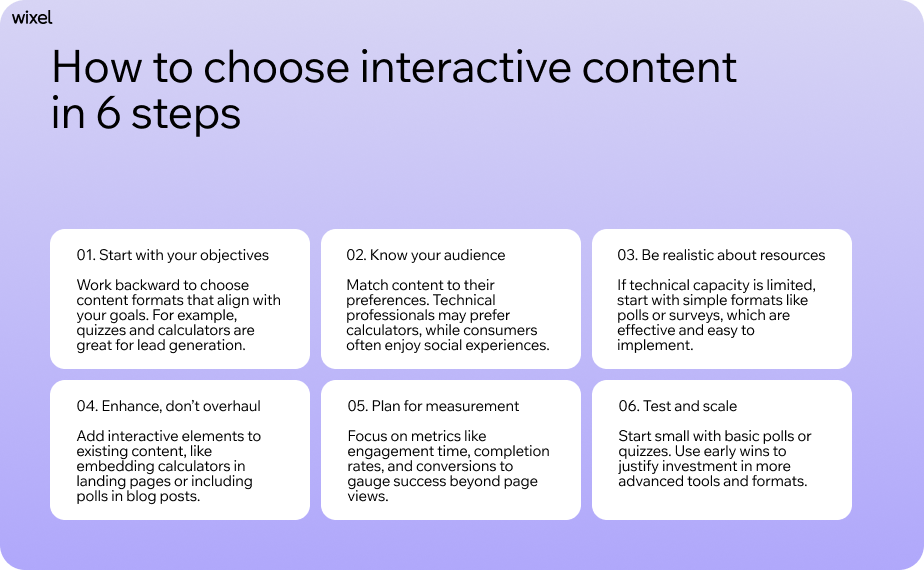
How to choose interactive content in 6 steps
Selecting the right interactive content format requires aligning your goals, audience preferences and available resources for maximum impact.
Start with your objectives and work backward to content formats that naturally support those goals. Lead generation favors quizzes and calculators, while brand awareness benefits from contests and shareable experiences.
Consider your audience's digital comfort level and preferred platforms. Technical professionals might appreciate sophisticated calculators, while consumer audiences often prefer visual and social interactive content.
Evaluate your technical resources honestly before committing to complex interactive projects. Simple polls and surveys can be highly effective, while requiring minimal technical investment.
Assess your content creation workflow and determine where interactive elements can enhance existing processes, rather than completely replace them. Adding polls to blog posts or embedding calculators in landing pages can boost engagement without overhauling your strategy.
Plan for measurement by identifying specific metrics that will indicate success for your interactive content. Engagement time, completion rates and conversion metrics often matter more than traditional page views.
Test with simple formats before investing in complex interactive experiences. Success with basic polls and quizzes can justify investment in more sophisticated tools and formats.
Interactive content ideas FAQ
How do I measure the success of interactive content?
Focus on engagement-specific metrics rather than traditional content measurements. Track completion rates, time spent interacting, click-through rates on different elements and conversion rates from interactive content to desired actions. Lead quality from interactive content often exceeds traditional forms, so evaluate the entire funnel performance rather than just initial metrics.
Can interactive content work for B2B companies?
Interactive content performs exceptionally well in B2B contexts because it provides immediate value and demonstrates expertise. ROI calculators, assessment tools and industry-specific quizzes help prospects evaluate solutions while gathering qualification information. B2B buyers appreciate content that saves time and provides personalized insights for their specific situations.